How “Agentic AI” Teams Just Took Over Enterprise Workflows
Agentic AI teams are replacing chatbots across enterprise workflows. Discover how multi-agent systems with orchestrator-delegate architecture are automating complex business processes with minimal human input.
Introduction: The Chatbot Era Is Over
Two years ago, the enterprise AI conversation was dominated by a single question: “Which chatbot should we deploy?” Companies rushed to implement ChatGPT-powered assistants, copilots, and conversational interfaces. These tools were useful. They answered questions, drafted emails, and summarized documents.
But they were also fundamentally limited.
Chatbots wait. They cannot act without a prompt. They cannot coordinate across departments. They cannot handle a customer who has a billing dispute and a delivery delay and an expiring contract—because that requires three different specialists working from shared context.
In 2026, that limitation has been erased.
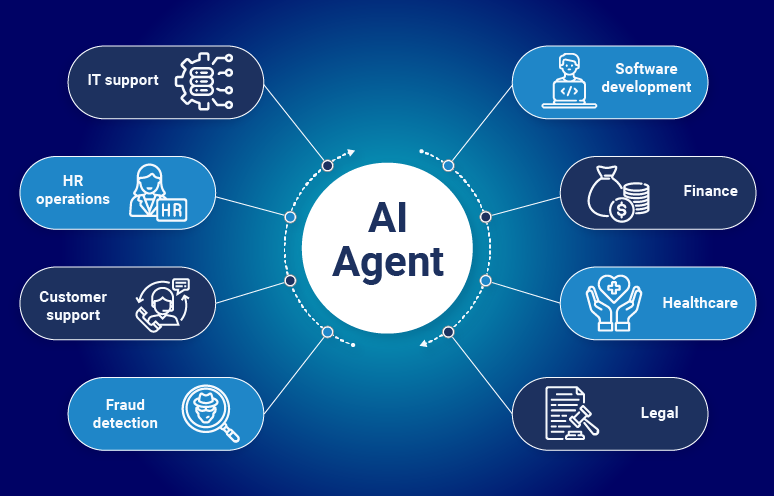
Welcome to the era of agentic AI—where autonomous, specialized agents form teams, delegate tasks, and execute complex business workflows with minimal human intervention . This is not a future roadmap item. According to The Futurum Group’s survey of 830 global IT decision-makers, agentic AI has surged 31.5% to become the fastest-growing enterprise technology priority, with 42% of organizations already in production .
The pilot phase is over. The agentic enterprise has arrived.
Part 1: What Is Agentic AI? (And Why It’s Not a Chatbot)
1.1 Defining the New Paradigm
The distinction between traditional AI assistants and agentic AI is not incremental—it is foundational.
| Capability | Chatbot/Copilot | Agentic AI |
|---|---|---|
| Responds to questions | ✅ Yes | ✅ Yes |
| Takes autonomous action | ❌ No (requires prompt) | ✅ Yes |
| Breaks down complex goals | ❌ No | ✅ Yes (planner role) |
| Delegates to specialists | ❌ No | ✅ Yes (orchestrator role) |
| Learns from past outcomes | ❌ Limited | ✅ Yes (memorizer role) |
| Handles novel situations | ❌ Breaks | ✅ Adapts |
As Doug Vargo, Vice President of Emerging Technologies at CGI, explains: “Agentic AI systems are intelligent digital workers capable of managing independent business processes. They are semi-autonomous—humans remain in the loop or on the loop—but they don’t require explicit inputs. They receive a general prompt, create a plan, and complete tasks leveraging AI tools” .
1.2 The Orchestrator–Delegate Model
At the heart of agentic AI systems is a simple but powerful architectural pattern: orchestrator–delegate.
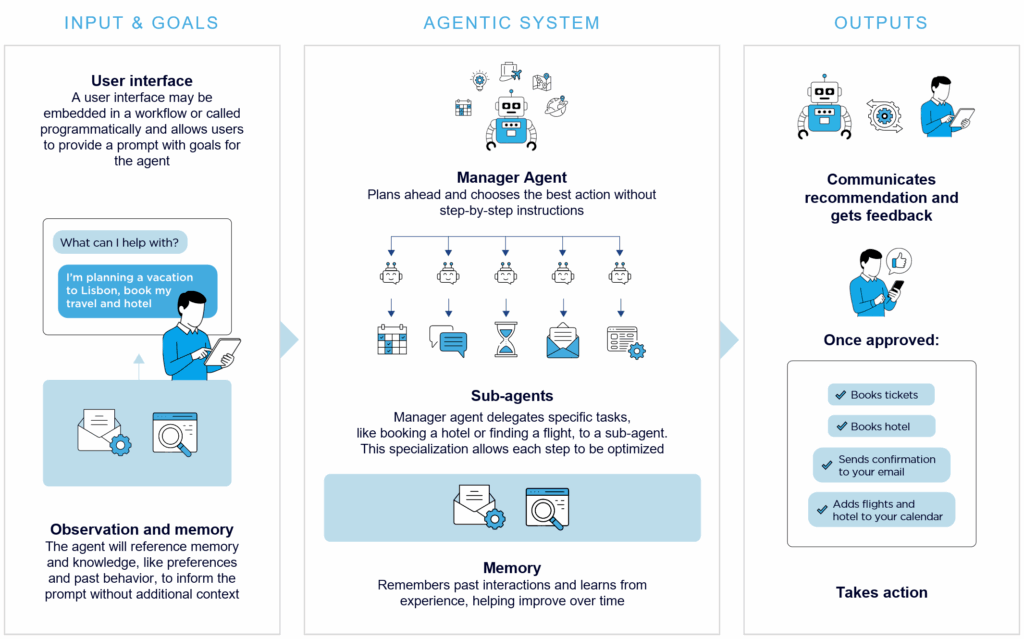
The user provides a high-level goal—for example, “Investigate why Q2 revenue missed target and propose corrective actions.” The orchestrator agent analyzes this goal, breaks it into subtasks, and delegates each to a specialized agent: a finance agent pulls sales data, a market agent analyzes competitive trends, an operations agent reviews supply chain disruptions. The orchestrator maintains the full context, ensuring all specialists work toward a unified outcome .
The T20 multi-agent framework illustrates this pattern in practice. When given a goal, the Orchestrator generates a step-by-step plan (Plan.json), assigns each task to the most suitable specialist agent, and logs every step for full traceability .
Part 2: Anatomy of an AI Agent Team
2.1 The Five Essential Roles
The most mature agentic AI implementations follow a five-role分工 that mirrors a high-functioning human team :
| Role | Function | Real-World Analogy |
|---|---|---|
| Coordinator | Manages the team, monitors progress, handles interruptions | Project Manager |
| Planner | Analyzes goals, breaks into subtasks, maintains plan | Architect / Lead Engineer |
| Coder | Executes tasks (writes code, processes data, takes actions) | Developer |
| Reviewer | Validates outputs, catches errors, ensures quality | QA / Peer Review |
| Memorizer | Extracts lessons, builds reusable knowledge | Documentation Lead |
The critical innovation is the Coder + Reviewer pairing. Unlike traditional workflows where review happens at the end, these agents work in parallel—each small module is written, immediately validated, and iterated until passing . This “paired programming” model dramatically reduces error rates and rework.
2.2 Structured Memory, Not Chat Logs
Another key differentiator is how agentic systems handle memory. Chatbots rely on conversational history—a linear, unstructured log that grows unwieldy and offers no retrieval guarantees.
Agentic AI systems use structured, wiki-style memory. After each task, the Memorizer automatically extracts a digest: title plus 3-5 key points. When 5+ digests accumulate on a related topic, they merge into a knowledge page. The next time a similar problem arises, agents query this structured knowledge base first .
This architecture has a critical advantage: it resists hallucination. If information isn’t in the knowledge base, the agent doesn’t invent it. It simply reports that no relevant memory exists.
2.3 Agent-to-Agent Communication Standards
As organizations scale from single agents to networks of agents operating across business units—and even across companies—interoperability becomes critical. The Linux Foundation’s AGNTCY project provides open standards for identity, trust, and secure agent-to-agent communication .
Key components include:
- Identity & Directory – Every agent has a verifiable identity, declared capabilities, and least-privilege access
- Secure Low-Latency Interactive Messaging (SLIM) – Encrypted, authenticated agent-to-agent messaging
- Policy-driven governance – Ensuring autonomy is controlled, auditable, and reversible
Cisco-backed Turiya AI has already deployed these standards in manufacturing environments, reporting 10x faster decision cycles and 25% reductions in downtime through coordinated cross-enterprise agent workflows .
Part 3: From Pilots to Production – The 2026 Tipping Point
3.1 The Numbers Don’t Lie
The shift from experimental chatbots to production agentic AI is backed by compelling data from Mayfield’s CXO Network survey of 266 Fortune 500–Global 2000 technology leaders :
| Metric | Value |
|---|---|
| Organizations with agentic AI in production | 42% |
| Organizations in production + pilots combined | 72% |
| Agentic AI as top-ranked priority (YoY increase) | +31.5% |
| CXOs planning to increase AI budgets in 2026 | 91% |
| Organizations mixing build + buy (hybrid) | 65% |
As Neetan Chopra, Chief Digital and Information Officer of IndiGo Airlines, reported: “We already have AI agents generating $15M in revenue, issuing 1.5M boarding passes, resolving 93% of customer inquiries, and autonomously selling bundles and upgrades” .
3.2 Top Use Cases Driving Adoption
The Futurum Group survey identified the leading deployment targets for agentic AI in 2026 :
| Use Case | Planned Deployment |
|---|---|
| Cybersecurity | 58.7% |
| Sales, Marketing & Service | 51.3% |
| Supply Chain Management | 47.8% |
| Developer Productivity | 70% (top 3 priority) |
These are not experimental, low-stakes applications. They are production-grade deployments targeting core business operations—cybersecurity threat response, customer service orchestration, and supply chain exception handling.
3.3 Measurable ROI in Weeks, Not Quarters
Early adopters are seeing tangible returns. As Tsvi Gal, CTO of Memorial Sloan Kettering Cancer Center, noted: “We don’t approve any AI initiative unless it delivers measurable ROI: cutting wait times from 42 minutes to under 1, reducing abandonment from 27% to nearly zero, or accelerating drug discovery by almost a decade” .
Scott Lesley, CTO of EdgeTI, added: “By embedding AI across our development workflow, we’ve reduced time-to-value dramatically—a six-month developer can now deliver at the level of someone with three years of tenure. AI isn’t optional for us anymore; it’s table stakes” .
Part 4: How Multi-Agent Systems Execute Real Work
4.1 The Orchestration Architecture in Practice
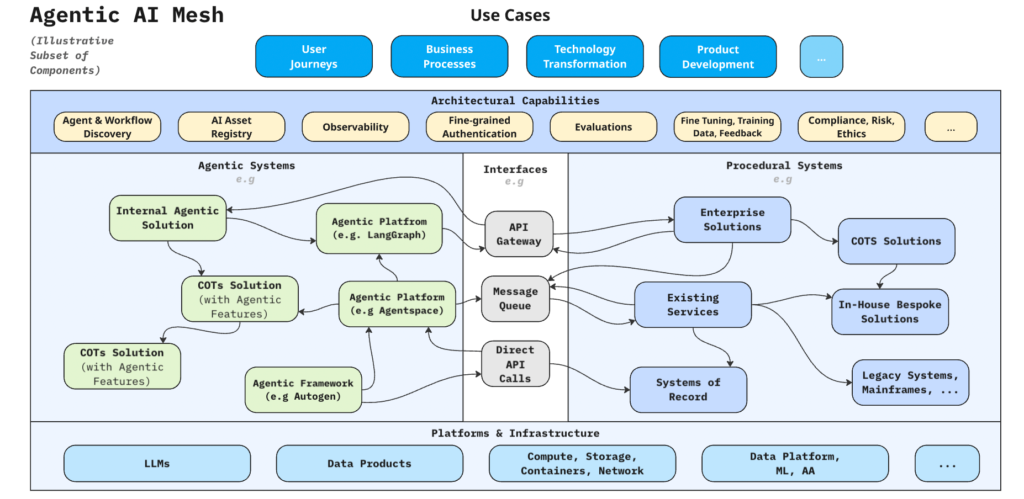
Salesforce’s Agentforce platform provides a concrete example of multi-agent coordination in enterprise workflows. The architecture includes :
- Specialist agents – Each highly capable within their domain (service, sales, finance, operations)
- Orchestrator agent – Reads the incoming situation, determines which specialists to engage, routes tasks, and aggregates results
- Shared context – All agents work from the same understanding, not parallel disconnected threads
The practical outcome: A customer escalation that previously required three internal meetings and multiple follow-ups now moves through a coordinated agent workflow—with each specialist contributing their piece and the orchestrator maintaining the thread from start to resolution .
4.2 From RPA to Adaptive Intelligence
The transition from traditional Robotic Process Automation (RPA) to agentic AI represents a shift from deterministic to probabilistic automation .
| Traditional RPA | Agentic AI |
|---|---|
| Hard-coded, rule-based instructions | General prompts + reasoning |
| Breaks on unexpected scenarios | Adapts dynamically |
| Requires explicit paths for every branch | Figures out paths through LLM reasoning |
| Fragile exception handling | Built-in adaptive exception handling |
Imran Aziz, Senior Director of Product Management at UiPath, explains: “With classic RPA, a developer had to code building blocks and stitch them into an end-to-end flow. With agents and LLM reasoning, we can layer on more semantic capabilities. You don’t have to pre-define all the paths through the system. The agent can reason and figure those things out dynamically” .
4.3 The Governance Imperative
As agents gain the ability to trigger real business actions—approvals, refunds, contract terms, scheduling—governance cannot be optional. The Agentforce trust architecture addresses three non-negotiable requirements :
- Agent Identity and Authorization – Defined identity, declared scope of authority, clear constraints on autonomous vs. human-approval actions
- Audit and Explainability – Every agent-to-agent communication and action logged with sufficient detail to reconstruct reasoning
- Human Override Mechanisms – Clear escalation paths where human judgment supersedes agent decisions
Yet a significant governance gap exists. The Mayfield survey found that while 84% of enterprises require security/compliance as non-negotiable, 60% report early-stage or no formal AI governance framework . The tension between speed and control defines the current landscape.
Part 5: Legacy Integration – The Bridge Problem
5.1 The $22 Billion Opportunity
Enterprises have invested heavily in traditional automation—RPA platforms, macros, and deterministic bots—that are deeply embedded in operational workflows. The US RPA market alone is predicted to reach $22.32 billion by 2032 .
These legacy bots are good at high-volume, repetitive tasks. But they lack contextual understanding, exception handling, and scalability in dynamic environments.
The solution is not to rip and replace. It is to retrofit .
5.2 The Pluggable Agentic AI Approach
A pluggable agentic AI system acts as a cognitive layer that upgrades existing legacy bots—without code changes. Think of it like a Chromecast upgrading a traditional TV into a smart one .
The architecture includes:
- Exception Handler – Listens for legacy bot failures and intervenes intelligently
- Anomaly detection – Identifies missing data, system errors, unexpected UI changes
- Learned resolution patterns – Applies past solutions; escalates only when human judgment required
Once plugged in, upgraded bots can sense anomalies, decide using embedded AI, and act autonomously even in unexpected scenarios—preserving existing investments while adding adaptive intelligence .
Part 6: The Road Ahead – What to Expect by 2028
6.1 Platformization Over Point Solutions
The 2026 trend is clear: enterprises are moving from isolated agent pilots to platformized agentic infrastructure. Shared compute, shared data, shared guardrails .
As Neeraj Gupta, CTO of Pindrop, notes: “AI succeeds when it strengthens existing workflows—not when it replaces them” .
6.2 Cross-Organizational Agent Networks
The AGNTCY open standards enable a future where a supplier’s fulfillment agent coordinates directly with your operations agent for routine scheduling—without human facilitation at every step .
This is not theoretical. Turiya AI’s manufacturing deployments already demonstrate cross-enterprise agent collaboration at scale.
6.3 The High-Value Human Shift
The most important long-term impact is the elevation of human work. By automating high-volume, routine tasks, agentic AI liberates human agents to focus on complex problem-solving, relationship management, and strategic decisions .
As Onix’s 2026 AI Trends Report concludes: “Enterprises that combine technological foresight with robust governance and talent development will not only enhance efficiency but also redefine their competitive advantage” .
Conclusion: Welcome to the Agentic Enterprise
The shift from chatbots to agentic AI teams is not a marginal improvement. It is a fundamental re-architecture of how work gets done.
Chatbots answer questions. Agentic AI teams execute outcomes.
The data is unequivocal: 72% of enterprises are now in production or pilots. ROI is being measured in weeks, not quarters. And the organizations that treat this as a strategic imperative—investing in governance, data readiness, and workforce transformation—are pulling ahead.
The question is no longer whether agentic AI will take over enterprise workflows.
It is whether your organization will lead the transition or be left explaining why your chatbot never saw it coming.
Frequently Asked Questions (FAQ)
What is the difference between agentic AI and a chatbot?
A chatbot is a passive assistant that responds to prompts. Agentic AI refers to autonomous systems that can plan, delegate tasks to specialized agents, and execute complex workflows with minimal human input .
How does multi-agent coordination work?
An orchestrator agent receives a high-level goal, breaks it into subtasks, delegates to specialist agents (e.g., finance, sales, operations), maintains shared context across the team, and aggregates results into a unified outcome .
What are the essential roles in an agentic AI team?
The five core roles are Coordinator (manager), Planner (task decomposition), Coder (execution), Reviewer (quality validation), and Memorizer (knowledge extraction) .
Is agentic AI replacing human workers?
No. Agentic AI systems are designed as semi-autonomous digital workers with humans “in the loop or on the loop” to guide and validate decisions. They automate routine tasks, freeing humans for higher-value work .
What governance is required for agentic AI?
Essential governance includes agent identity and authorization, full audit logging of agent actions and communications, clear escalation paths for human override, and policy-based access controls .
What are the leading use cases for agentic AI in 2026?
Top deployments include cybersecurity (58.7%), sales/marketing/service (51.3%), supply chain management (47.8%), and developer productivity (70% as top priority) .
Call to Action (CTA)
Is your organization moving beyond chatbots to agentic AI teams? Share your experience in the comments below. And if you found this article valuable, share it with a colleague navigating the shift from copilots to coordinated intelligence.