AI in the Classroom: How Schools in Cambodia are Adapting to Generative Tech
AI in the Classroom: Discover how Cambodian schools are integrating AI into education through the High Touch High Tech (HTHT) model, national AI literacy programs, and locally developed Khmer-language tools. Explore real impacts on teaching and learning.
The Classroom of Tomorrow, Today
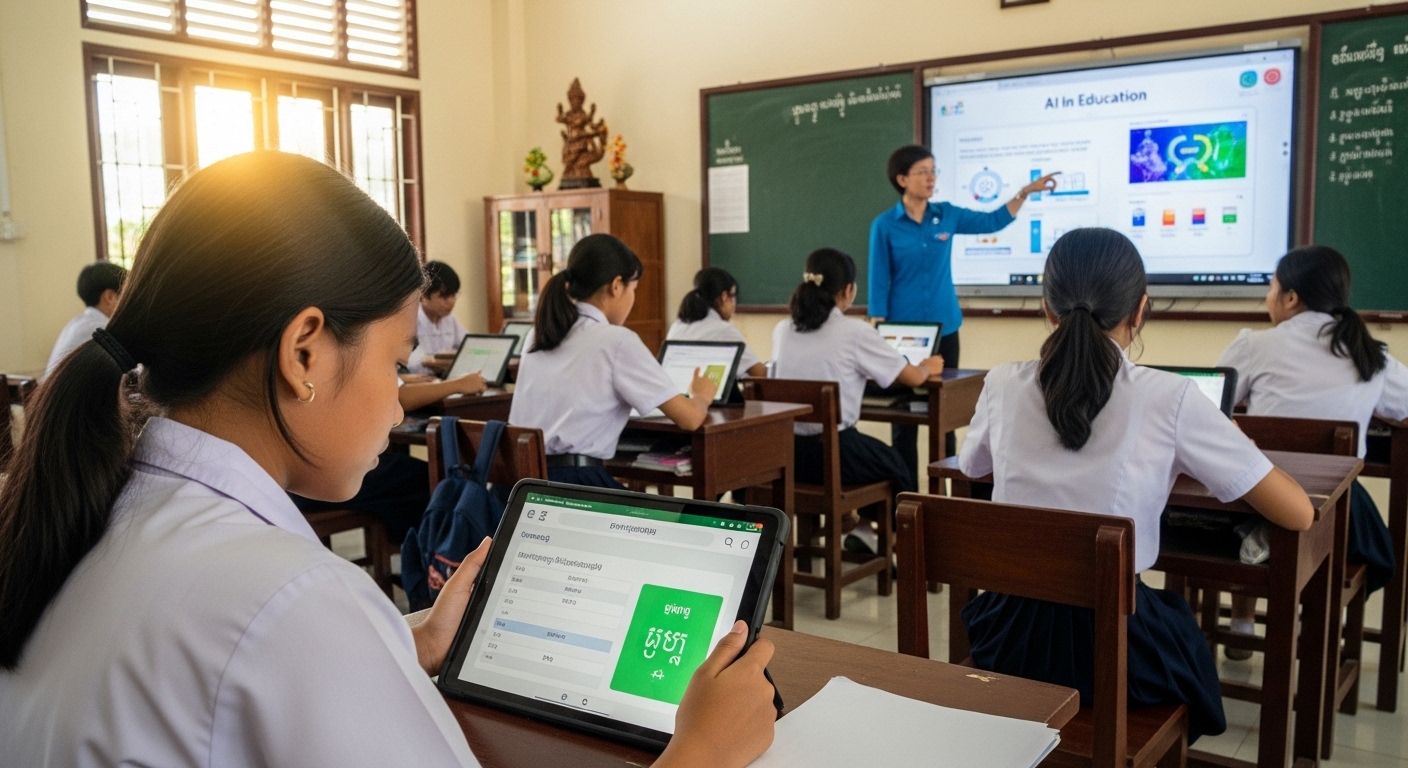
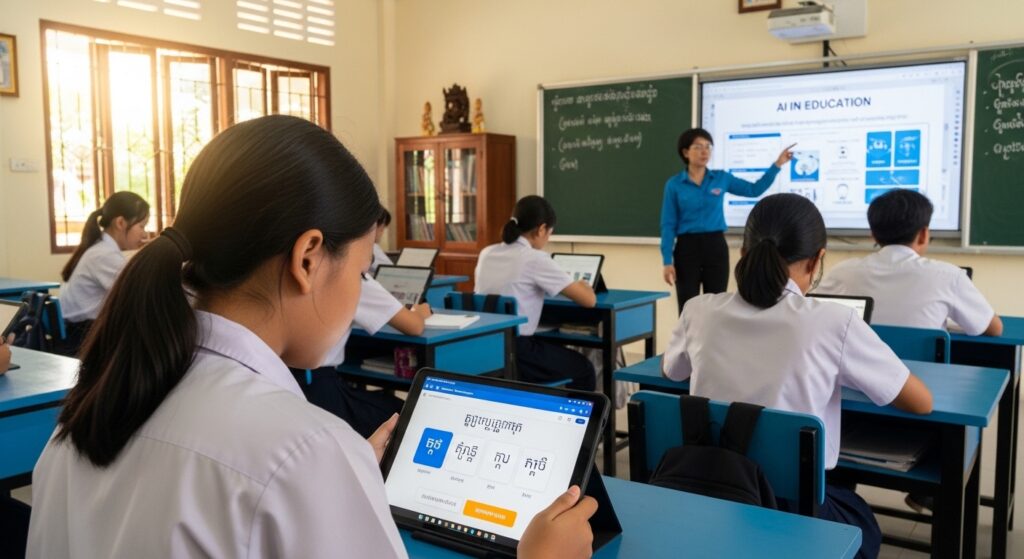
In a high school classroom in Kandal Province, something remarkable is happening. A math teacher named Sokhao no longer stands at the front of the room lecturing to 50 students at once. Instead, she glances at a dashboard that shows, in real time, exactly which students are struggling with fractions and which are ready to move on to algebra. She pulls a small group of six students together for a targeted mini-lesson while others work independently at their own pace on a personalized learning platform .
Six hundred kilometers away, in a rural district of Battambang Province, Physics teacher Mel Sereyvath uses AI as his personal teaching assistant. He feeds complex physics concepts into an AI tool, which helps him transform dry textbook material into engaging, easy-to-understand lessons. His students, many of whom had never touched a computer before, are now collaborating, solving problems, and dreaming of careers in the digital economy .
This is not Silicon Valley. This is not Singapore.
This is Cambodia in 2026.
While much of the world debates whether AI belongs in classrooms, Cambodia is quietly building one of Southeast Asia’s most ambitious education technology transformations—from the ground up, on its own terms, and with limited resources.
The Policy Foundation: A National AI Strategy Takes Shape
Cambodia’s AI journey in education did not happen by accident. It is the result of deliberate policy planning at the highest levels of government.
The Four Strategic Pillars
In February 2026, His Excellency Seng Sopheap, President of the Cambodia Academy of Digital Technology (CADT), presented Cambodia’s Draft National AI Strategy at the World Governments Summit in Dubai. The strategy rests on four pillars :
| Pillar | Focus |
|---|---|
| Human Capital Development | Training programs on AI and data science; integration of AI into educational curricula |
| Infrastructure and Data Development | National data governance; open data platforms; computing infrastructure for research |
| AI Adoption in Government | Implementing AI in public services with ethical standards |
| AI Adoption in Priority Sectors | Education, healthcare, agriculture, industry, and MSMEs |
The fourth pillar explicitly identifies education as a priority sector for AI integration .
The Teacher Policy Action Plan (2024-2030)
In March 2026, at a policy dialogue hosted by SEAMEO in Hong Kong, Cambodian Secretary of State for Education H.E. Dr. San Vathana detailed the Kingdom’s 2024-2030 Teacher Policy Action Plan. The strategy represents a significant shift for Cambodia as it seeks to integrate emerging technologies into general and higher education .
The plan rests on four pillars:
- Streamlining teacher oversight and deployment
- Redefining educational roles for the digital age
- Aligning teacher education with high-tech requirements
- Enhancing the status and career development of educators
Cambodian officials are specifically looking at AI to drive higher education reforms, aiming to create a template for “scaling up” quality instruction in regions where resources have historically been limited .
Ministerial Endorsement
In November 2025, Deputy Prime Minister and Minister of Education Hang Chuon Naron presided over the National Teachers’ Conference under the theme “Teachers at the Heart of Education Reform: Research, Policy and Practice for the Ethical Use of Modern Technology and Artificial Intelligence” .
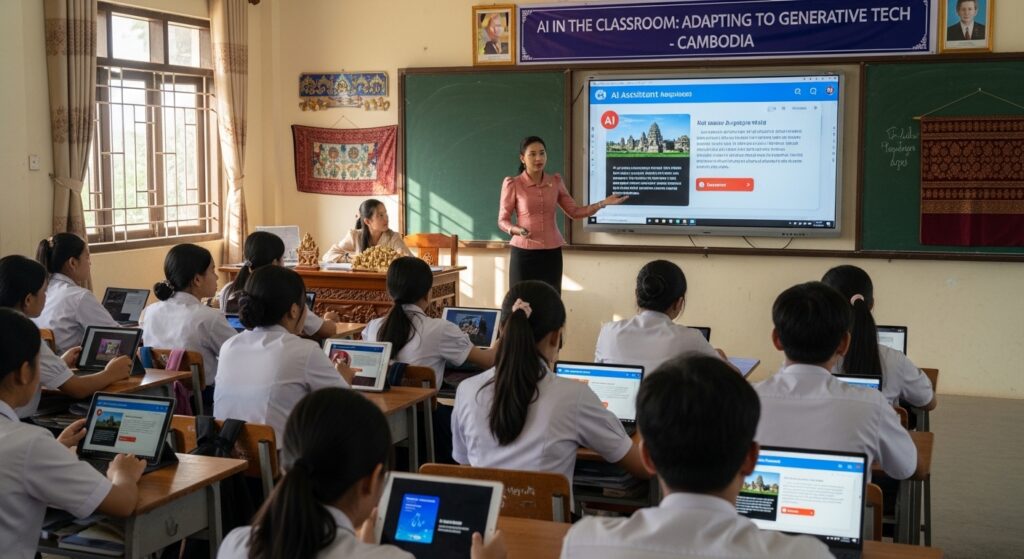
His message was clear: the Pedagogical Institute and New Generation Schools have already begun integrating educational technology and AI into teaching. The focus is on building teacher capacity to respond to the rapid evolution of digital technology .
The High Touch High Tech (HTHT) Model: Personalized Learning at Scale
The most significant implementation of AI in Cambodian classrooms is the High Touch High Tech (HTHT) approach—a blended learning model that combines AI-powered personalized learning platforms with targeted, teacher-led instruction.
How It Works
The HTHT model, piloted by Teach For Cambodia in partnership with the Learning Generation Initiative at the Education Development Center, uses the Maths Pathway platform—an AI-driven system that personalizes math instruction for each student .
The results from the pilot are striking:
| Metric | Outcome |
|---|---|
| Schools involved | 13 government secondary schools |
| Students reached | Approximately 2,200 |
| Locations | Phnom Penh and Kandal provinces |
The Shift: From Lecturer to Facilitator
The most profound change the HTHT model creates is not in technology—it is in the role of the teacher.
Sokhao, a second-year math teacher at Puk Russey High School in Kandal Province, describes the transformation :
“Real-time data from the system has really changed the way I support my students. In my previous teaching experience, I honestly didn’t know how many of them were falling behind or exactly where they were struggling. Now, I can see clearly who needs help and in which areas. That allows me to respond right away—whether it’s a quick one-on-one check-in or pulling a small group together for a mini-lesson. It’s also made me rethink my role. Instead of always directing the class, I’ve started to act more as a facilitator—someone who guides students based on their own progress.”
The model enables three types of targeted interventions:
- Targeted mini-lessons: The teacher uses data to form small groups (6-8 students) who are ready to learn something similar, then provides 20-25 minutes of explicit teaching to that group
- One-on-one support: Teachers identify students struggling with specific concepts and provide personalized guidance
- Personalized assessments: Replacing standardized testing with individual progress tracking and timely feedback
From Digital Illiteracy to Self-Directed Learning
Perhaps the most surprising finding from the pilot is how quickly students adapted—starting from almost zero digital exposure.
Kimchhou, a first-year math teacher at Sampeou Poun High School in Kandal Province, shares :
“At the start of the year, most of my students didn’t even know how to turn a computer on or off, let alone use Google tools or navigate the Maths Pathway platform. It was overwhelming for many of them… Now they’ve become confident and self-directed learners. They take charge of their own learning—working at their own pace, completing tasks independently, and checking their progress after each lesson.”
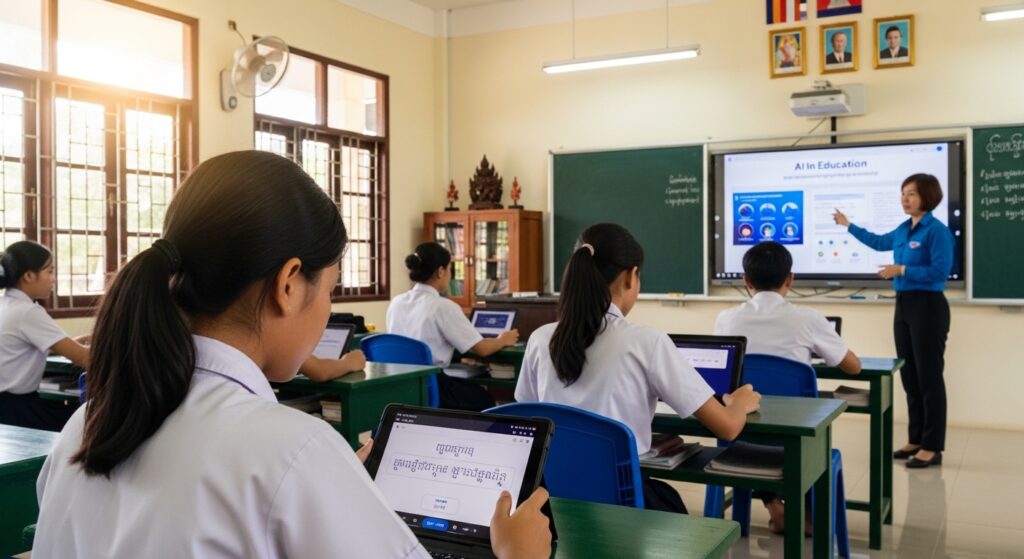
The cultural shift is equally important. Students are no longer afraid to make mistakes. They collaborate, help each other navigate the platform, and share how they solved problems. They have developed what their teacher calls “grit” .
High Tech Enables High Touch
A crucial insight from the pilot is that technology does not replace teachers—it empowers them.
Sreynith, a second-year math teacher at Hun Sen Ksach Kandal High School, experienced this directly. In her first year without the HTHT model, she struggled constantly. Her students were at vastly different levels, and many were far below grade level. She spent her energy trying to fill foundational gaps rather than moving forward with the curriculum .
With the HTHT model, she describes a different reality :
“Students are building a stronger foundation through the high-tech component, which allows me to teach the content much more effectively and efficiently in the high-touch sessions. What excites me most is that some students are now getting to a point where they can apply their understanding by creating their own exercises and explaining their thinking to others.”
The conclusion is clear: The high-tech component strengthens, not replaces, teacher-led instruction .
The AI Ready ASEAN Project: Scaling AI Literacy Nationwide
While the HTHT pilot focuses on math instruction through an AI-powered platform, a separate initiative is building AI literacy from the ground up.
The AI Ready ASEAN (AIR) Project, supported by the ASEAN Foundation and Google.org, is equipping Cambodian educators and youth with AI skills. In March 2026, a National Consultative Workshop was held at Prek Leap High School (a New Generation School) in Phnom Penh, presided over by Her Excellency Dr. Kim Sethany, Permanent Secretary of State of the Ministry of Education .
The scale of the initiative is ambitious:
| Target | Number |
|---|---|
| Master trainers to be trained | 118 |
| Schools, universities, and teacher training centers involved | 400 |
| Students, children, and youth to be reached | 166,750 |
| Project duration | 2 years |
These master trainers are not just technical instructors. As the workshop emphasized, they are “ambassadors of a digital education revolution” who will help bridge the gap between urban and rural areas by teaching youth to utilize AI for research, problem-solving, and future career readiness .
Changing Mindsets: From Fear to Empowerment
One of the most significant outcomes of the AIR project has been shifting teachers’ perspectives on AI.
Ms. Sary Lyda from Stung Treng and Mr. Nov Sokkea from Battambang shared at the workshop that the training transformed their view of AI—from something to be feared to a “smart classroom assistant” that allows them to prepare lessons more efficiently and engage students more deeply in their learning process .
Dr. Kim Sethany captured the vision :
“The contribution of all stakeholders is a powerful driving force in promoting digital education. This collaboration prepares us for the future by strengthening the quality of education, developing human capital, and reforming the education system to meet the demands of the labour market and the evolving social landscape.”
The Basic Digital Literacy Curriculum: Starting in Primary School
Cambodia is not waiting until high school or university to introduce digital skills. The government is starting in primary school.
The Ministry of Post and Telecommunications, in collaboration with the Ministry of Education, Youth and Sport and Tech for Kids Academy (TKA), has developed a Basic Digital Literacy Curriculum for Grades 4, 5, and 6 .
The curriculum covers:
- English for technology
- Computer fundamentals
- Digital citizenship
- Online safety
- Mathematics and logical thinking
- Coding
- Artificial Intelligence (AI)
- Problem-solving skills
Phase II Expansion
In March 2026, the program expanded to 18 additional target primary schools in Banteay Meanchey Province as part of Phase II. This brings the total to 60 target schools across 19 city-provinces nationwide, with 17,988 students enrolled (including 8,796 girls) .
Early results are encouraging. During the 2024-2025 academic year, students from 22 target schools participated in the Technovation competition and the VIRTUAL GLOBAL GAME JAM 2025 organized by UNICEF, where they won the National Young Entrepreneur Award for the primary school level .
H.E. So Visothy, Secretary of State of the Ministry of Post and Telecommunications, encouraged students at the launch event: “Students should remain committed to developing these digital skills so they can grow into a capable digital human resource in the future” .
Innovation from Within: The “Assistant” Robot
Cambodia is not just adopting foreign AI tools. Cambodian students are building their own.
A team of four students at the National Polytechnic Institute of Cambodia (NPIC)—Ny Virbora, Cheat Chea, Sokheang Ching, and Ny Piseth—developed “Assistant,” a box-like robot that can recognize and respond to spoken Khmer .
Technical Specifications
| Feature | Detail |
|---|---|
| Height | 22 cm |
| Screen size | 3.2 inches |
| Speech recognition system | CMU Sphinx (Carnegie Mellon University) |
| Training data | 85 speakers, 157 Khmer words |
| Word recognition accuracy | 89.91% |
| Sentence recognition accuracy | 90.02% |
| Internet requirement | None (works offline) |
| Hardware cost | Approximately $200 |
The robot operates entirely offline, which is critical in a country where internet connectivity remains inconsistent, especially in rural areas. It uses noise reduction technology to understand spoken Khmer and can display pictures and videos to students .
From University Lab to Classroom
The team’s professor, Srun Channareth, noted that achieving 90% accuracy is considered the threshold for real-world deployment based on Microsoft’s research standards .
The team is now recruiting volunteers to expand the robot’s vocabulary. As lead student Ny Virbora explained: “As for the number of words, it depends on the location or sector where the robot will be used. If we use it for the education sector, we’ll see what words need to be used by looking at textbook lessons” .
The project demonstrates that Cambodia is not just a consumer of AI technology—it is becoming a creator, building solutions tailored to Khmer language and local educational needs.
Rural Innovation: AI Literacy in Battambang
The most inspiring stories of AI adoption in Cambodia are happening far from Phnom Penh.
In Phnom Proek District, Battambang Province—a remote area where resources are scarce—Physics teacher Mel Sereyvath is proving that geography is not destiny.
Starting from Zero
Mr. Sereyvath participated in the “AI Literacy” and Hour of Code training organized by the AI Ready ASEAN project in May 2025. The training covered not just technical skills but also the ethics of AI usage, including concepts like “AI Bias” and responsible technology use .
He returned to his school facing significant challenges. The school had a severe shortage of computers. Many students did not own smartphones. But instead of giving up, he adapted .
The Teaching Transformation
Mr. Sereyvath developed a new teaching strategy:
- Divide students into small groups to share available devices
- Use AI as a personal assistant to organize lesson plans and research complex Physics content
- Transform dry material into engaging, easy-to-understand lessons with practical examples
The impact was immediate. Students who had seemed intimidated by technology became active learners. They started thinking critically, asking questions, and collaborating to solve problems .
The Ripple Effect
Mr. Sereyvath did not keep his knowledge to himself. He has now shared AI literacy with a total of 800 teachers and students—a remarkable achievement for a single teacher in a resource-constrained rural area .
His message to educators is powerful :
“Understanding AI Literacy is not just about learning to use a new tool; it is about opening a door to a new world that allows me, as a rural teacher, to bridge the gap in educational quality. When I use AI to help prepare Physics lessons, it gives me more time to focus on individual students and brings dry lessons to life. I see my students transform from shy children into brave individuals who express their opinions and use technology to solve problems together. However, I always remind them that AI is a brilliant ‘assistant,’ not the ‘master’ of our thinking.”
He concludes with an analogy that captures the Cambodian approach to AI in education :
“AI technology acts as the wings that allow us to fly towards the shores of knowledge, but our own ethics and intellect are the rudder that determines the direction of true success.”
Higher Education: Incorporating AI Skills into University Curricula
The integration of AI extends beyond primary and secondary schools into Cambodia’s universities.
In November 2025, Deputy Prime Minister Hang Chuon Naron presided over the National Research Forum and Higher Education STEM Exhibition 2025, held under the theme “Research for Development in the Age of Artificial Intelligence” .
He encouraged both public and private higher education institutions to embrace AI by focusing on :
- Incorporating AI skills into curricula, teaching methods, and digital learning assessments
- Promoting teacher training in digital skills
- Organizing libraries and digital infrastructure
- Cultivating human capital with digital, research, and specialized skills to meet job market needs
He emphasized the ethical use of AI, noting the need for responsibility and a deep understanding of the impact of digital technology .
Regional Collaboration: The Chinese Connection
Cambodia is also benefiting from regional partnerships. Yunnan Minzu University in China has developed an “International Industry-Education Integration Curriculum Agent” that includes a multilingual AI问答工具 supporting seven languages, including Khmer .
The platform includes:
- AI course learning companion systems based on knowledge graphs
- Cross-cultural AI问答 tools supporting Chinese, English, Thai, Lao, Burmese, Vietnamese, and Khmer
- Infrastructure project analysis and engineering scenario simulation
This collaboration provides Cambodian students and teachers access to AI teaching resources that might otherwise be unavailable .
The Khmer Language Challenge
Throughout all these initiatives, one challenge consistently appears: AI does not natively speak Khmer.
Most global AI models are trained primarily on English and a handful of other high-resource languages. Khmer—with its unique script, lack of spaces between words, and limited digital datasets—is not well-represented.
The NPIC “Assistant” robot team experienced this firsthand. Converting Khmer speech to text required using Latin alphabet representations of Khmer in Unicode format because computers do not natively recognize Khmer script .
The team spent almost half a year just creating their initial database, collecting voice data and creating word lists. However, they developed software that sped up the process—collecting 10-20 new words in just over an hour compared to two days previously .
This is not just a technical problem. It is a sovereignty issue. If Cambodian students are to benefit from AI, the technology must work in their language, reflect their culture, and be developed with their needs in mind.
The “Assistant” robot, with its 89.91% accuracy on a limited vocabulary of 157 words, is a first step. But much more work remains.
Ethical Considerations: AI as Assistant, Not Master
A consistent theme across all Cambodian AI education initiatives is the emphasis on ethics.
The National Teachers’ Conference in November 2025 explicitly focused on “ethical use of modern technology and artificial intelligence” . The AIR project curriculum includes education about “AI Bias” and responsible technology use . Minister Hang Chuon Naron has repeatedly stressed the need for responsibility and deep understanding of AI’s impact .
Mr. Mel Sereyvath’s warning to his students captures the Cambodian philosophy :
“We must use AI to augment our intelligence, not to replace our thought processes, because critical thinking and creativity are the invaluable assets of humanity.”
This is not anti-technology Luddism. It is a pragmatic recognition that AI is a tool—powerful but imperfect—and that the ultimate goal of education is not to produce efficient AI users but to develop critical thinkers who can use AI responsibly.
Challenges and the Road Ahead
Despite remarkable progress, significant challenges remain.
Infrastructure Gaps
Internet connectivity outside major cities remains inconsistent. Many rural schools still lack sufficient computers. The HTHT pilot found that 95% of students at the start of the year had little to no prior experience using computers .
Khmer Language AI
The “Assistant” robot’s 89.91% accuracy on 157 words is a proof of concept, not a production system. Expanding Khmer-language AI capabilities requires massive datasets that do not yet exist.
Teacher Training
While the AIR project aims to train 118 master trainers and reach 166,750 students, Cambodia has over 4,000 teachers and directors in the KAPE network alone . Scaling training to reach all educators remains a challenge.
Sustainability
Many of these initiatives are pilot programs or donor-funded projects. Ensuring they continue and expand without external support is an open question.
Equity
There is a real risk that AI-enhanced education will concentrate in Phnom Penh and other cities, leaving rural students further behind. The Battambang story is inspiring precisely because it is exceptional. Making it normal requires intentional policy focus.
Key Takeaways for Educators and Policymakers
For other developing countries looking to learn from Cambodia’s experience, several lessons emerge:
Start with teacher training, not technology. The most successful initiatives—HTHT, AIR, and the Battambang AI literacy program—all prioritized teacher development first. Technology came second.
Adapt, don’t just adopt. Global platforms like Maths Pathway work, but they require localization for Cambodian classrooms. The NPIC team’s decision to build a Khmer-language robot rather than import a foreign solution is instructive.
High tech enables high touch. The goal is not to replace teachers with algorithms. It is to use AI to free teachers to do what only humans can do: mentor, inspire, and provide targeted support.
Ethics must be embedded from the start. Every AI education initiative in Cambodia emphasizes responsible use, critical thinking, and awareness of AI bias. This is not an afterthought—it is foundational.
Start early, start simple. The Basic Digital Literacy Curriculum begins in Grade 4. Students are learning AI concepts before they reach high school. This builds a foundation for more advanced work later.
Celebrate local innovation. The “Assistant” robot was built by Cambodian students for Cambodian students. Supporting local AI talent creates solutions that are culturally appropriate and linguistically accurate.
The Future: Cambodia’s AI Education Vision
What does success look like for Cambodia?
By 2030, the government aims for Cambodia to become an upper-middle-income country. By 2050, a high-income country . Achieving these goals requires a workforce equipped with digital skills and AI literacy.
The building blocks are already in place:
- A National AI Strategy with education as a priority sector
- A Teacher Policy Action Plan focused on digital transformation
- Pilot programs reaching thousands of students with proven results
- AI literacy training scaling to over 166,000 students
- Digital literacy curriculum in 60 primary schools across 19 provinces
- Local AI innovation like the Khmer-language “Assistant” robot
- Regional collaborations providing multilingual AI resources
The pieces are coming together. The challenge now is scale, sustainability, and equity.
Frequently Asked Questions
Q: Do Cambodian schools have enough computers for AI education?
A: Not yet in many rural areas. However, programs like HTHT use group sharing strategies, and the Basic Digital Literacy Curriculum includes computer installation in target schools. The Battambang example shows that creative adaptation can overcome hardware shortages .
Q: Is AI replacing Cambodian teachers?
A: No. All initiatives emphasize that AI empowers teachers rather than replacing them. The HTHT model explicitly combines “high tech” with “high touch” teacher facilitation .
Q: What AI tools are currently used in Cambodian classrooms?
A: The Maths Pathway platform for personalized math instruction, AI literacy curricula from the AIR project, and locally developed tools like the NPIC “Assistant” robot for Khmer language support .
Q: How is AI taught to students who don’t speak English?
A: This remains a challenge. The NPIC robot team is building Khmer-language AI from the ground up. Regional collaborations are developing multilingual tools that include Khmer. However, most global AI platforms remain English-centric .
Q: Can other developing countries replicate Cambodia’s approach?
A: Many elements are replicable: starting with teacher training, prioritizing ethics, adapting global platforms to local contexts, and supporting local AI innovation. The specific implementation would need to adapt to each country’s language, infrastructure, and cultural context.
Target Keywords (for SEO):
- AI in Cambodian education
- High Touch High Tech Cambodia
- AI literacy Cambodia
- Khmer language AI
- Cambodia digital education
- Teacher training AI
- Personalized learning Cambodia
- AI Ready ASEAN Cambodia
Internal Linking Suggestions:
- Link to a post on “EdTech in Southeast Asia”
- Link to a post on “AI for Low-Resource Languages”
- Link to a post on “Teacher Professional Development in the Digital Age”
Conclusion: A Model for the Global South
Cambodia is not waiting for perfect conditions to bring AI into classrooms. The internet is not always reliable. Computers are not always available. Khmer-language AI is still in its infancy. And yet, the work is happening.
In Kandal, teachers are using real-time data to reach students who were falling through the cracks. In Battambang, a physics teacher is using AI to bring lessons to life for rural students who had never touched a computer. In Phnom Penh, university students are building Khmer-language robots from scratch.
The Cambodian approach offers lessons for the entire Global South: start with teachers, adapt to local conditions, embed ethics from the beginning, and build your own solutions rather than waiting for them to arrive from elsewhere.