AI for Civil Engineers: Using Computer Vision for Structural Integrity Audits
AI for Civil Engineers: Discover how computer vision and AI are transforming structural integrity audits for civil engineers. Learn about real-time defect detection, BIM integration, and the future of infrastructure inspection.
The $177 Billion Problem Hiding in Plain Sight
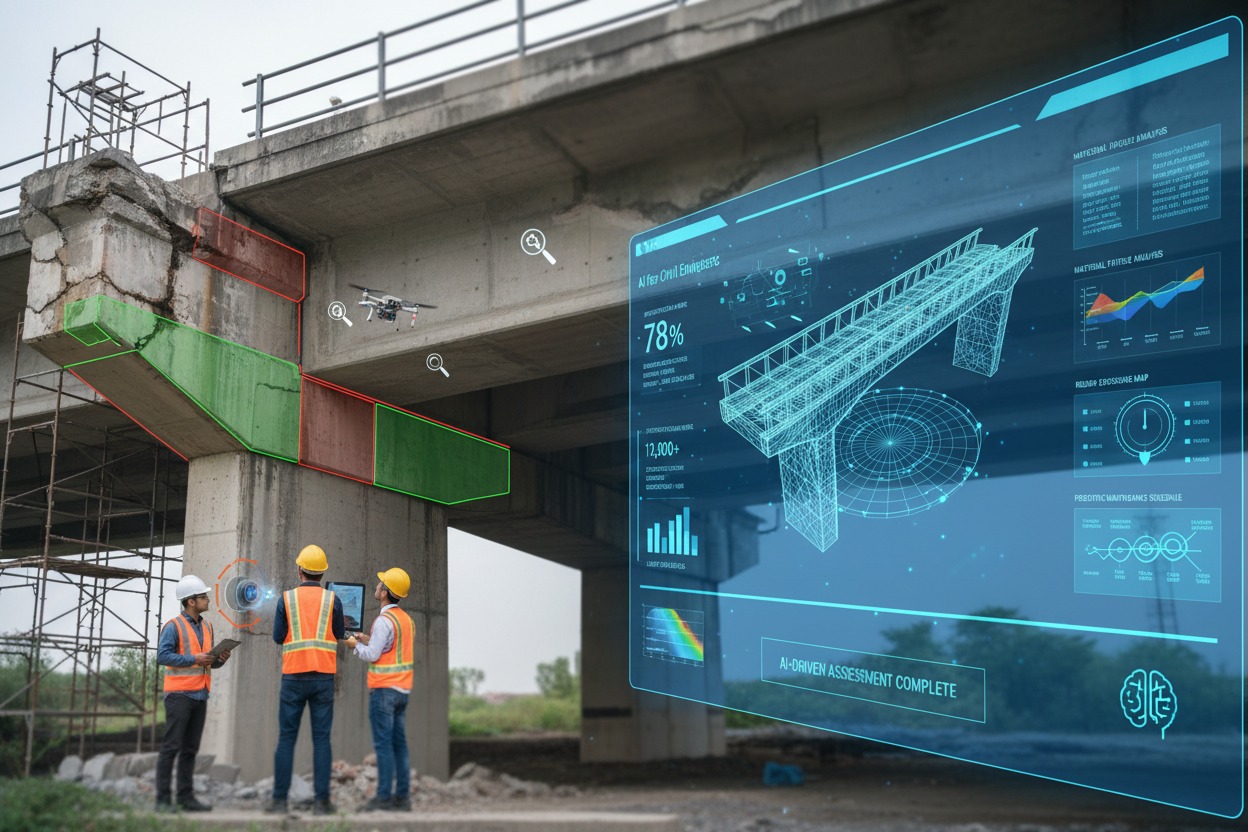
Every day, civil engineers walk across bridge decks, climb scaffolding, and crane their necks at concrete facades. Their mission: spot cracks, corrosion, spalling, and other defects before they become catastrophic failures.
The tools? Clipboards, cameras, and calibrated eyeballs.
The construction industry’s reliance on manual “spot-checking” for design errors costs an estimated $177 billion annually to fix mistakes discovered too late . Senior engineers spend up to 50% of their time cross-referencing drawings against building regulations by hand—a process that is slow, tedious, and inherently unreliable .
Traditional visual inspection methods are subjective, labor-intensive, and limited in interpretive value . Different inspectors reach different conclusions. The same inspector reaches different conclusions on different days. And subsurface defects—rebar corrosion, delamination, internal cracking—remain entirely invisible to the naked eye .
Enter computer vision—the field of artificial intelligence that trains computers to interpret and understand visual information. For civil engineers, this technology is not a futuristic promise. It is a practical tool, already deployed on bridges, buildings, and infrastructure projects worldwide, cutting inspection times in half and detecting defects humans miss.
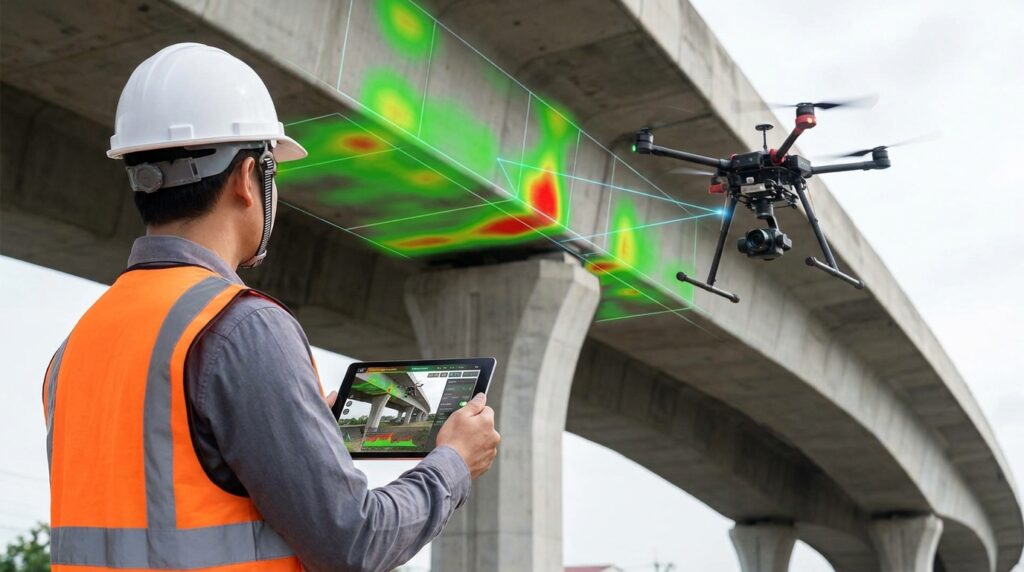
This guide explains how computer vision works for structural integrity audits, what technology you need, and how to implement it in your practice.
How Computer Vision Detects Structural Defects
At its core, computer vision for structural health monitoring (SHM) uses deep learning algorithms—specifically Convolutional Neural Networks (CNNs) —to analyze images of infrastructure and identify anomalies .
The most common architecture in production today is the YOLO (You Only Look Once) family of object detection models. Unlike older systems that scanned images piece by piece, YOLO processes an entire image in a single pass, making it fast enough for real-time applications .
What These Models Can Detect
| Defect Type | Visual Characteristics | Detection Method |
|---|---|---|
| Surface Cracks | Linear fractures, varying widths | Bounding box + segmentation |
| Spalling | Flaked or chipped concrete | Pixel-level mask |
| Corrosion | Rust staining, material discoloration | Color analysis + pattern recognition |
| Delamination | Subsurface voids (invisible to naked eye) | Infrared thermography + AI |
| Rebar Exposure | Visible reinforcement bars | Object detection |
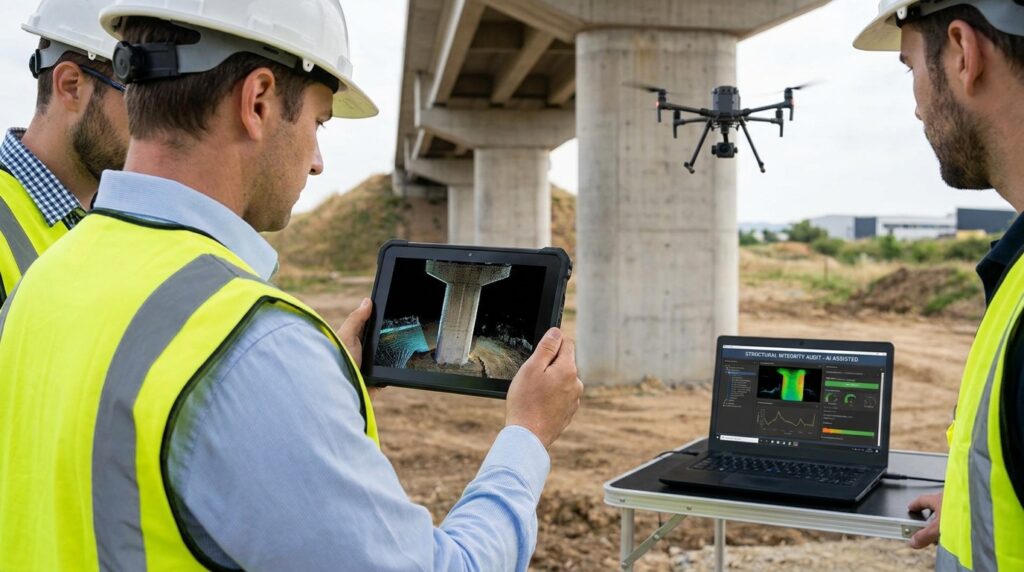
The Three-Stage Pipeline
State-of-the-art systems like the framework proposed in recent Springer research operate in three stages :
Stage 1 — Detection: YOLOv10 identifies defects and draws bounding boxes around them. This model achieves 96.5% average precision on structural defect images .
Stage 2 — Segmentation: DeepLabV3+ performs pixel-by-pixel analysis, creating precise masks that outline the exact shape and extent of each defect. This achieves 95.1% intersection-over-union (IoU) —meaning the AI’s mask aligns nearly perfectly with the actual defect boundaries .
Stage 3 — Contextual Description: A fine-tuned CLIP model generates engineering-specific natural language descriptions. Instead of just saying “crack detected,” it outputs: “Hairline longitudinal crack, 0.3mm width, extending 45cm along beam bottom flange” .
Total processing time per image: 0.3 seconds on standard GPU hardware .
Beyond Surface Cracks: Multi-Technology Integration
Surface cracks are often just the visible symptom of deeper problems. Modern AI-powered inspection systems integrate multiple sensing technologies for comprehensive assessment .
The PolyU Multi-Tier System
Researchers at Hong Kong Polytechnic University have developed an intelligent bridge inspection system deployed across 11 local bridges that combines three technologies :
1. Drone-Enabled Visual Inspection
High-resolution cameras capture surface images from angles impossible for human inspectors. A proprietary deep CNN model called SBDE (Smart Bridge Deck Efficiency) detects cracks even in low-light conditions, outperforming other leading object detection models and reducing false positives from surface scratches .
2. Ground-Penetrating Radar (GPR)
GPR reveals what lies beneath the surface. The team’s fully automated GPR data interpretation model locates rebars with over 98% precision and maps potential corrosion zones using advanced amplitude analysis and clustering .
3. Infrared Thermography (IRT)
Delamination—separation between concrete layers—is invisible to optical cameras but reveals itself in thermal signatures. The team developed an Optimum Thermal Gradient Threshold (OTGT) system that adjusts detection parameters based on environmental conditions, automatically generating delamination maps .
The Results: Inspection time reduced by 50% , overall accuracy improved to 80% , and subsurface defects that previously required road closures can now be detected remotely .
AI + Infrared Thermography: A Systematic Review
A comprehensive systematic review published in Measurement: Journal of the International Measurement Confederation examined AI-IRT integration research from 2016 to 2025 . Key findings include:
- Sensor fusion strategies combining thermal signatures with complementary imaging data across multiple processing stages yield the most reliable results
- Neural network architectures specifically tailored to thermal analysis outperform generic models
- Environmental variability remains the primary challenge—weather conditions significantly affect thermal signatures
- The gap between controlled validation and field performance underscores the need for adaptive systems
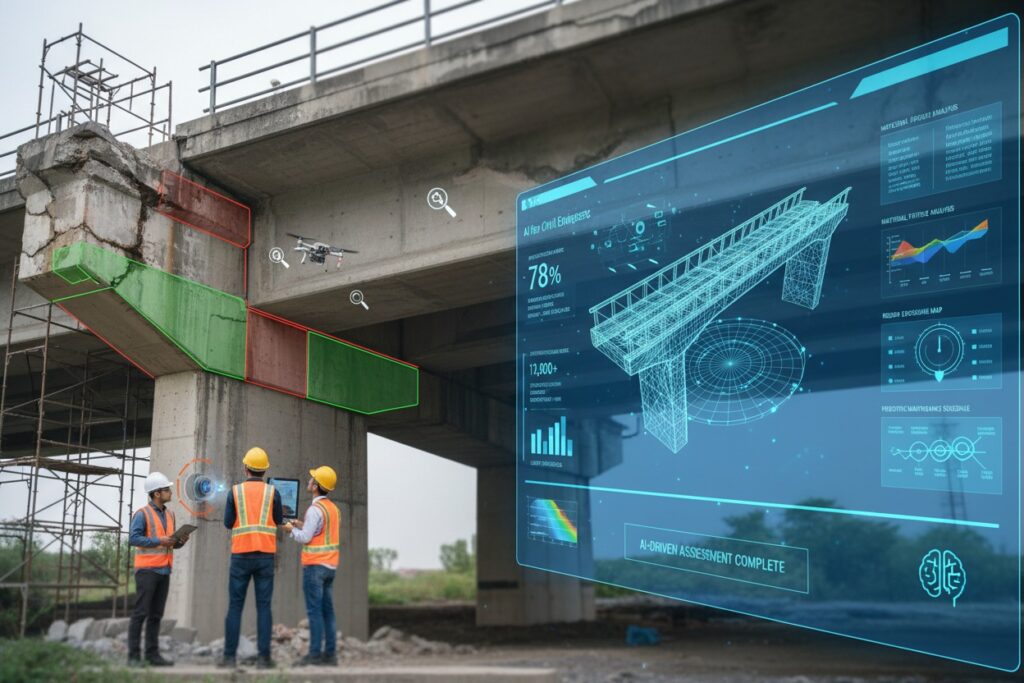
BIM Integration: Connecting Defects to Digital Twins
Detecting a defect is valuable. Knowing exactly where it is located within a structure’s information model is transformative.
Researchers have developed integrated systems that connect crack detection directly with Building Information Modeling (BIM) platforms . The workflow:
- Capture: Inspectors photograph cracks and deterioration using smartphones or tablets
- Upload: Images are processed through an automated cloud detection system
- Detect: YOLOv7-based models identify and classify defects (achieving 87.64% mAP )
- Locate: Defect information is automatically linked to the corresponding component in the 3D BIM model
- Visualize: Engineers receive location charts and intuitive visual data for decision-making
This integration means that when an inspector identifies a crack on a bridge girder, that crack is instantly mapped to the exact digital representation of that girder—complete with coordinates, dimensions, and severity classification.
Beyond Inspection: AI for Design Quality Control
Computer vision is not limited to inspecting existing structures. The same technology is being applied to catch errors before construction begins.
Articulate, a Y Combinator-backed startup founded by former SpaceX engineers, uses AI to automatically detect clashes, callouts, and discrepancies across MEP, structural, architectural, and solar layouts . The platform:
- Identifies misaligned mechanical, structural, and architectural plans before they reach the field
- Generates RFIs (Requests for Information) automatically
- Integrates with Procore, Revit, Autodesk, and Bluebeam
Structured AI takes a similar approach, deploying AI agents that perform quality control on technical documents and drawings. Their foundational vision model was trained on thousands of engineering symbols to read plans like an expert, checking 100-page blueprints against 2,000 pages of building codes in minutes—100x faster than manual review and identifying 150% more errors .
The cost of fixing a design error increases exponentially the later it is discovered. Catching a clash in Revit costs virtually nothing. Catching the same clash after steel is fabricated costs millions. AI-powered QA/QC shifts error detection as far left in the timeline as possible.
Real-World Deployments and Performance Data
Bridge Inspection — Taiwan
A study using deterioration images from long-term bridge inspections across Taiwan compared YOLOv4 and YOLOv7 algorithms. The YOLOv7-based model achieved 87.64% mean Average Precision (mAP) when implemented in an automated crack image cloud detection system integrated with a Bridge BIM Cloud Management System .
Structural Defect Detection — Research Framework
A comprehensive study on 300,000 annotated structural defect images achieved :
| Metric | Performance |
|---|---|
| Detection Average Precision | 96.5% |
| Segmentation IoU | 95.1% |
| Captioning BLEU-4 Score | 0.86 |
| Latency per Image | 0.3 seconds |
The framework, named BuildCaption, is planned for deployment as a responsive web application allowing field inspectors to upload images via smartphones, tablets, or PCs and receive automated reports containing defect localization, segmentation masks, and contextual descriptions .
Dynamic Identification — Water Tower
Computer vision techniques have also been applied to dynamic structural identification. Researchers combined motion magnification with statistical algorithms to calculate natural frequencies of a reinforced concrete elevated water tank under environmental noise excitation—validating computer vision outcomes against accelerometric measurements .
How to Implement Computer Vision in Your Practice
You do not need to build models from scratch. Here is a practical adoption roadmap.
Level 1: Off-the-Shelf Solutions (Entry)
Best for: Small firms, occasional inspections, proof-of-concept
Several commercial platforms offer AI-powered visual inspection without requiring in-house data science expertise. Look for solutions that integrate with your existing tools (Procore, Autodesk, Bluebeam) .
Expected investment: $500–$2,000/month per user
Level 2: Custom Model Training (Intermediate)
Best for: Medium-to-large firms with recurring inspection needs
If you have a substantial archive of past inspection images, you can fine-tune existing models on your specific infrastructure types. Open-source frameworks like YOLOv10 are freely available. Training requires:
- 1,000–5,000 annotated images per defect type (minimum)
- GPU computing resources (cloud options available)
- Domain expertise to validate model outputs
Level 3: Integrated Multi-Sensor Systems (Advanced)
Best for: Large asset owners, government agencies, major infrastructure projects
Deploy drone fleets with integrated visual, thermal, and GPR sensors. Process data through automated pipelines connected to BIM platforms. PolyU’s multi-tier system represents this tier .
Expected investment: $50,000–$500,000+ depending on scale
Challenges and Limitations
No technology is perfect. Be aware of these constraints:
Environmental variability remains the primary challenge for thermal imaging. Weather conditions, time of day, and seasonal changes all affect infrared signatures. Systems must be adaptive, not static .
The gap between controlled validation and field performance is real. Models that achieve 98% accuracy in a lab setting may drop to 70% on a cloudy Tuesday afternoon. Test extensively in your actual operating conditions .
Explainability is crucial for engineering trust. Bounding boxes and segmentation masks tell you where a defect is but not what it means. The latest research focuses on generating natural language descriptions that provide actionable engineering insights—closing the “explainability gap” .
Computational requirements for state-of-the-art models (YOLOv12, transformer-based detectors) may exceed what is practical for edge deployment on mobile devices. YOLOv10 offers the best balance of accuracy and efficiency for field use .
The Future: What to Expect by 2030
Physics-guided learning will combine neural networks with physical models of structural behavior, reducing the amount of training data required and improving generalization to unseen conditions .
Autonomous knowledge discovery will enable systems to identify novel defect types without human labeling—flagging anomalies that engineers have not yet defined .
Transparent decision systems will provide not just detections but confidence intervals, uncertainty estimates, and audit trails—essential for regulated infrastructure sectors .
Fully autonomous inspection using drone swarms that navigate, capture, detect, and report without human intervention is already in research pipelines. The first commercial deployments are likely within 3-5 years.
Getting Started Today
Step 1: Audit your current inspection workflow. Where are the bottlenecks? Which defects are most commonly missed? What would you do with 50% more inspection capacity?
Step 2: Test a commercial solution. Upload 50–100 past inspection images to a platform like Articulate or Structured AI. Compare AI detections against your original field reports .
Step 3: Build a labeled dataset. If you plan to train custom models, start annotating your image archive now. Open-source tools like LabelImg or CVAT can help.
Step 4: Pilot on one asset type. Do not try to inspect everything at once. Pick one bridge, one building facade, or one tunnel. Run AI-assisted inspections alongside traditional methods for 3–6 months. Compare results.
Step 5: Scale what works. Once you have validated the technology on one asset type, expand to others. Integrate with your BIM platform. Train your team.
Frequently Asked Questions
Q: Do I need to be a programmer to use computer vision for inspections?
A: No. Commercial platforms handle the AI complexity. You need domain expertise to validate outputs, not coding skills.
Q: How accurate is AI compared to human inspectors?
A: For surface crack detection, state-of-the-art models achieve 96.5% average precision under good conditions—comparable to or exceeding human performance. For subsurface defects, AI combined with GPR or IRT detects what humans cannot see at all .
Q: Can AI replace structural engineers?
A: No. AI is a tool that augments, not replaces, engineering judgment. Engineers interpret AI outputs, make maintenance decisions, and take legal responsibility for safety.
Q: What hardware do I need?
A: For basic image upload and analysis, a smartphone or tablet suffices. For real-time video processing or drone integration, a laptop with a mid-range GPU (NVIDIA RTX 3060 or better) is recommended.
Q: How much does this cost?
A: Entry-level software subscriptions start around $500/month. Custom model training and integrated multi-sensor systems cost significantly more. However, the cost of a single missed defect that leads to structural failure or extended road closure far exceeds the software investment