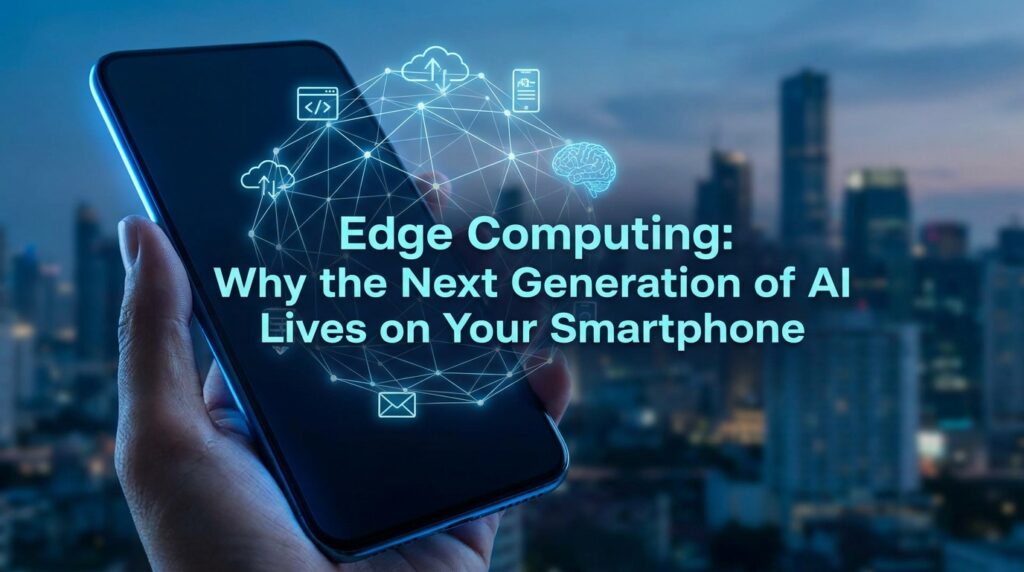
Edge Computing: Why the Next Generation of AI Lives on Your Smartphone
Edge Computing: Discover why edge AI is shifting from cloud servers to your smartphone. Learn about the privacy, speed, and efficiency benefits of on-device artificial intelligence in 2026.
The AI Migration You Haven’t Noticed
Every time you unlock your phone, you are carrying an AI supercomputer in your pocket.
Not metaphorically. Literally.
The latest smartphones contain specialized neural processing units (NPUs) capable of trillions of operations per second. Your camera uses AI to recognize scenes and adjust settings instantly. Your keyboard predicts your next word without sending a single keystroke to the cloud. Your voice assistant processes commands locally, responding even when you have no signal.
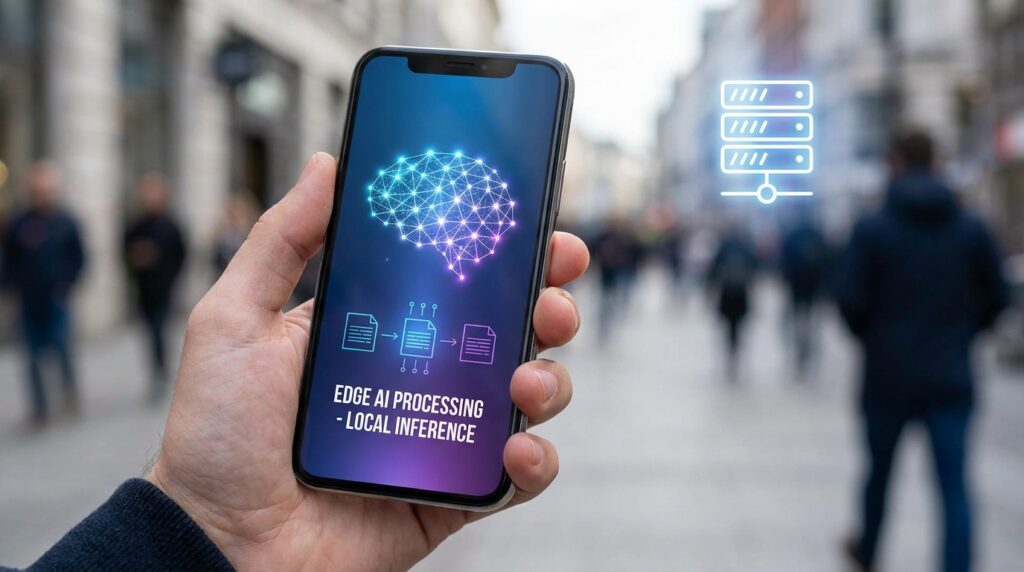
This is edge AI—artificial intelligence that runs on your device, not in a distant data center.
And it is fundamentally reshaping how we interact with technology.
For years, the narrative was simple: AI lived in the cloud. Your phone was just a window. You typed a prompt, it traveled to a server farm somewhere, a massive model generated a response, and the answer traveled back. This worked, but it was slow, power-hungry, and raised serious privacy questions.
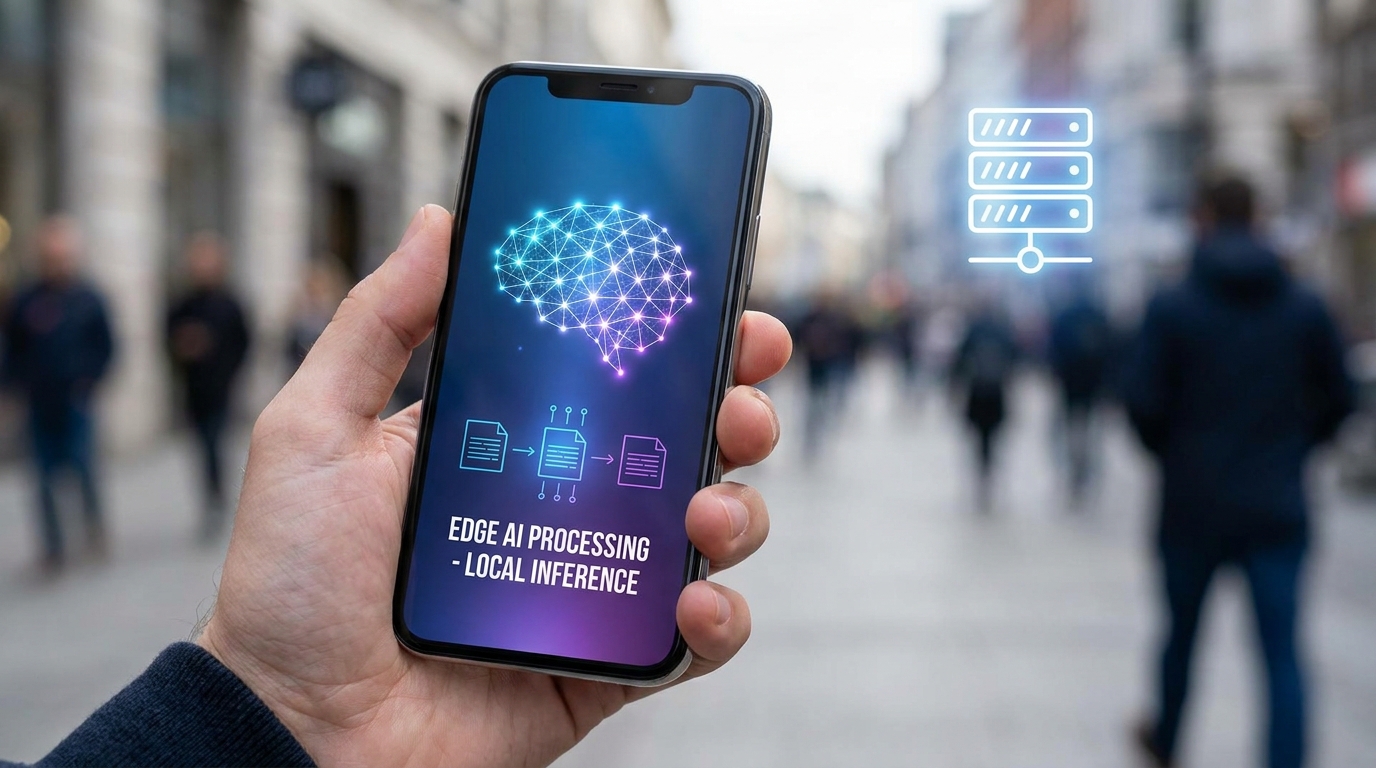
Now, that architecture is being inverted. The AI is moving to the edge. And your smartphone is ground zero for this transformation.
What Is Edge AI?
Edge AI refers to running artificial intelligence models directly on devices—smartphones, wearables, laptops, IoT sensors—rather than sending data to centralized cloud servers for processing .
Think of it as the difference between calling a librarian across a library to fetch a book versus having the book already on your desk. The cloud model sends your request on a round trip that can take hundreds of milliseconds. Edge AI answers instantly because the intelligence lives where you do.
The core benefits are straightforward:
| Benefit | What It Means for You |
|---|---|
| Speed | Responses in milliseconds, not seconds |
| Privacy | Your data never leaves your device |
| Offline capability | AI works anywhere, even without signal |
| Efficiency | Lower power consumption than constant cloud communication |
A recent analysis of AI architectures found that edge AI achieves a staggering 10,000x efficiency advantage over cloud processing. Modern ARM processors and specialized AI accelerators consume merely 100 microwatts for inference, versus 1 watt for equivalent cloud processing .
That is not a small improvement. It is a fundamental shift in what is physically possible.
The Privacy Revolution Hiding in Plain Sight
Here is a question worth sitting with: Would you rather an AI model process your personal data on your phone or on a server owned by a company you have never met?
The answer seems obvious. Yet for years, we accepted cloud-only AI because there was no alternative.
Edge AI changes this equation fundamentally.
When processing happens on your device, sensitive information—your photos, messages, health data, location history—never needs to travel across the internet. It never sits on a company’s server waiting to be breached. It never becomes part of a training dataset without your explicit consent.
Consider the security implications:
In 2023, the HCA Healthcare breach compromised data of an estimated 11 million patients . Centralized cloud architectures create single points of failure. Attack one server, and you access millions of records.
Edge AI distributes the risk. Each device is its own isolated environment. A breach of one phone reveals only that phone’s data—not the entire user base.
This is why 91% of companies now see local processing as a competitive advantage . And why 53% of organizations adopt edge AI specifically for privacy and security .
For consumers, the shift means something simpler: AI you can trust with the intimate details of your life because those details never leave your hands.
The Speed Gap: Milliseconds vs. Seconds
Latency is not just a technical metric. It is the difference between a tool that feels magical and one that feels broken.
Cloud AI requires a round trip. Your request travels to a data center, gets processed, and the response travels back. Best-case scenario: 100-500 milliseconds. Worst case: multiple seconds .
Edge AI processes locally. 5-10 milliseconds .
That gap matters.
For real-time applications, it is non-negotiable:
- Autonomous vehicles processing visual data must react to obstacles in milliseconds. A self-driving car cannot afford to lose signal in a tunnel .
- Live translation during conversations cannot pause for cloud latency between sentences.
- Augmented reality applications require immediate response to head and eye movements.
- Gaming with AI-driven opponents or physics cannot tolerate lag.
Even for everyday tasks, the difference is palpable. A keyboard that predicts your next word instantly feels natural. One that hesitates for half a second feels broken. Edge AI delivers the former.
The Hardware Revolution Inside Your Phone
None of this would be possible without dramatic advances in mobile hardware. The smartphone in your pocket today contains AI-specific silicon that did not exist five years ago.
Heterogeneous Computing: The Secret Sauce
Modern flagship phones do not rely on a single processor. They use heterogeneous computing—distributing workloads across CPUs, GPUs, and dedicated NPUs based on what each does best .
As Chris Bergey, Executive Vice President of Arm’s Edge AI Business Unit, explains: “When you have those three working together, you can optimize your battery life in a different way. You can really optimize every feature in action that happens on that phone rather than just draining from the same thing all at once” .
What each component handles:
| Component | Best For |
|---|---|
| CPU | Sequential tasks, control logic, general computing |
| GPU | Parallel graphics, image processing, some AI workloads |
| NPU | Neural network inference, matrix operations, AI acceleration |
The NPU is the key innovation. These specialized accelerators are designed specifically for the matrix multiplications that power neural networks. Samsung’s Exynos SoCs, for example, integrate NPUs that support 4-bit and 8-bit low-precision computation, dramatically improving efficiency for on-device generative AI .
The Efficiency Numbers That Matter
Google’s Gemma 4 models, optimized for on-device deployment, demonstrate what is now possible. Running on Arm CPUs with SME2 (Scalable Matrix Extension 2) capabilities, early tests show:
- 5.5x speedup in processing user input (prefill)
- 1.6x faster response generation (decode)
For IoT and edge devices, the performance is even more striking. On a Raspberry Pi 5, Gemma 4 achieves 133 prefill tokens per second and 7.6 decode tokens per second on CPU alone. With NPU acceleration on Qualcomm hardware, those numbers jump to 3,700 prefill and 31 decode tokens per second .
That is not compromise performance. That is genuinely impressive AI running on devices that cost less than $100.
What Edge AI Can Do Today
The capabilities available on your phone right now would have seemed like science fiction five years ago.
Computational Photography
Your camera is perhaps the most visible edge AI application. Premium phones detect scenes automatically—recognizing sunsets, food, portraits, or text—and adjust settings instantly for the best results. Portrait modes apply computational depth-of-field effects. One-click photo fixes remove unwanted objects instantly .
All of this happens on-device. Your photos never leave your phone unless you choose to share them.
Intelligent Assistants
The AI assistant on your phone is becoming genuinely useful—not because cloud models got better, but because edge AI enables new capabilities.
Samsung’s Galaxy AI, available on devices like the Galaxy S25 Edge, features:
- Now Brief and Now Bar: Live, personalized content feeds that update throughout the day based on your context
- Circle to Search 2.0: Recognizes phone numbers, emails, and links on-screen and suggests instant actions
- Seamless Actions: Ask Gemini to take multiple steps across apps like Maps, YouTube, and Spotify
These features work because the AI understands your context—and that context stays on your device.
Productivity Agents
Honor’s Magic V6 demonstrates how edge AI is moving from novelty to productivity tool. Their AI Meeting Advisor can:
- Remind you before meetings
- Provide AI hosting during calls
- Generate structured meeting minutes and to-do lists with one click
Their AI Document Agent converts paper documents to editable files instantly. As Li Xiangdong, Honor’s AI product expert, puts it: “The underlying concept is to transform AI from a toy into a productivity tool” .
Accessibility
Perhaps the most meaningful applications are those that help people with disabilities.
Envision, an accessibility-focused app for blind and low-vision users, has evaluated running Gemma 4 entirely on-device using Arm CPUs. Users can capture a photo and receive a detailed scene description without any network connection—no need to send potentially sensitive images to the cloud .
As Envision’s CEO notes: “For our community, the ability to access these capabilities offline is incredibly meaningful because it ensures the technology works wherever they are, while also improving privacy” .
The Hybrid Future: Edge + Cloud
Edge AI is powerful, but it is not a complete replacement for cloud computing. The future is hybrid.
Cloud remains essential for:
- Training large models: The massive compute clusters required to train frontier models simply cannot fit on a phone.
- Cross-device coordination: When multiple devices need to share insights, a central point of coordination helps.
- Heavy computational tasks: Some workloads genuinely require more power than any mobile device can provide.
The emerging pattern is edge-first, cloud-when-needed. Your device handles what it can locally—most inference, basic processing, privacy-sensitive tasks. For complex requests or when a better model is required, it can gracefully fall back to cloud services.
This hybrid architecture also enables federated learning—where devices collaboratively train shared models without ever sharing raw data. Your phone learns from your usage patterns, contributes anonymized updates to a global model, and benefits from what other users have learned. All without your personal data leaving your device .
Real-World Impact: Numbers Worth Noting
The shift to edge AI is not theoretical. It is happening now, at scale.
Market projections: The edge AI market is projected to grow from $9 billion in 2025 to $49.6 billion by 2030—a compound annual growth rate of 38.5% .
Developer adoption: 97% of CIOs have already deployed or plan to deploy edge AI .
Cost savings: Edge processing can lower cloud inference bills by 30-40% .
Energy impact: Running inference locally rather than in the cloud eliminates the energy costs of data transmission and reduces cooling requirements in data centers .
These numbers explain why every major smartphone manufacturer—Apple, Samsung, Google, Honor, Motorola—is racing to build better on-device AI capabilities.
What Is Coming Next
The trajectory is clear. Edge AI capabilities will only expand.
Google’s Gemma 4 models, released in April 2026, represent a significant leap. They support:
- Agentic workflows: Multi-step planning and autonomous action on-device
- Visual and audio processing: Multimodal understanding without specialized fine-tuning
- Over 140 languages: Global accessibility from day one
As Sandeep Patil, Engineering Director at Android, notes: “Together, we’re making it easier for developers to bring fast, responsive, and privacy-preserving AI experiences to our users, without needing to modify their existing applications” .
For developers, the barriers are falling. Tools like LiteRT-LM enable Gemma 4 deployment across iOS, Android, desktop, web, and even IoT devices—with memory footprints under 1.5GB .
What This Means for You
You do not need to understand heterogeneous computing architectures or NPU design philosophies to benefit from edge AI. The benefits are already visible in your daily experience:
- Your phone responds faster than it did two years ago
- Features work in airplane mode that used to require signal
- Your assistant understands context in ways that feel almost human
- You worry less about what your data is being used for
The next generation of AI is not coming. It is already here. It lives in your pocket. And it is only getting started.
Frequently Asked Questions
Q: Do I need a new phone to benefit from edge AI?
A: Many edge AI features work on recent devices. However, the most advanced on-device generative AI capabilities—like running Gemma 4 locally—require phones with dedicated NPUs and sufficient memory.
Q: Is edge AI less capable than cloud AI?
A: For many tasks, no. Edge models are increasingly competitive. However, the largest frontier models still run in the cloud. The best architecture uses both—edge for low-latency, privacy-sensitive tasks and cloud for heavy lifting.
Q: Does edge AI drain my battery?
A: On properly optimized devices, edge AI is actually more efficient than constant cloud communication. Transmitting data over cellular networks consumes significant power. Local processing, especially on dedicated NPUs, is highly efficient.
Q: Can edge AI work without any internet connection?
A: Yes. That is one of its primary advantages. Once the model is downloaded to your device, it runs entirely locally.
Q: How do I know if an app is using edge AI?
A: Most users never need to know. However, signs include features that work offline, instant responses, and privacy indicators that show no data transmission during AI operations.