Generative Fashion Design: How AI is Reducing Waste in the Apparel Industry
Generative Fashion Design: Discover how generative AI and smart technologies are transforming fashion design to eliminate textile waste. Learn about SXD’s 69% material savings, MIT’s adaptable garments, and the future of sustainable apparel.
The $500 Billion Stain on the Fashion Industry
Every second, the equivalent of one garbage truck of textiles is landfilled or burned. Annually in the United States alone, an estimated 11.3 million tons of textile waste ends up in landfills. There is a textile dumping ground in Chile so vast it is visible from space. Globally, less than 1% of all clothing is recycled .
The fashion industry is the second-largest consumer of water worldwide, producing 20% of global wastewater . Behind these staggering numbers lies a dirty secret: most waste is created before a garment ever reaches a customer.
Pre-consumer textile waste—scraps from pattern cutting, deadstock fabric, and unsold inventory—accounts for a massive portion of the industry’s environmental footprint. Traditional design processes are inherently wasteful. Designers sketch, sample, revise, and resample. Each physical prototype consumes fabric, energy, and water. Each rejected sample becomes waste.
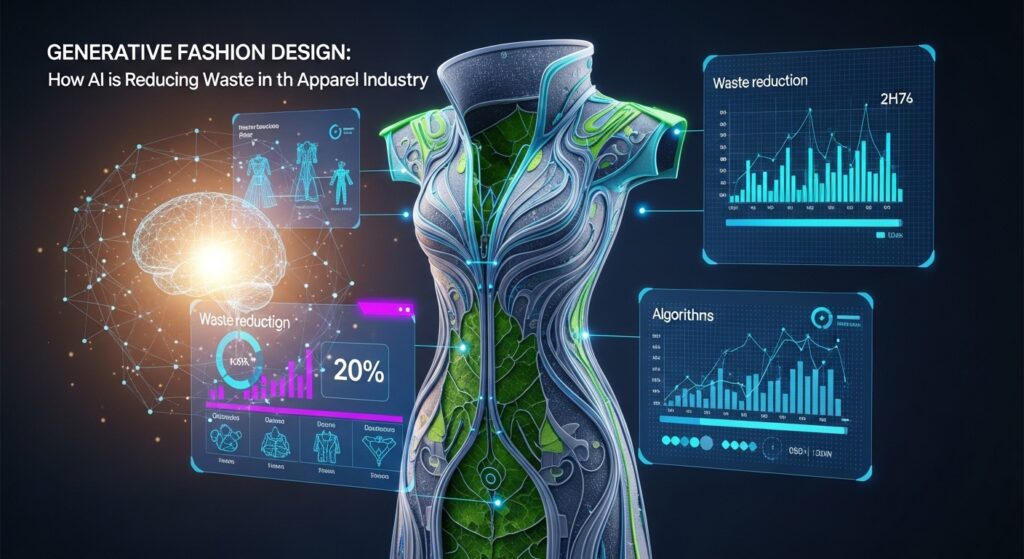
But a fundamental shift is underway. Generative AI is rewriting the rules of fashion design—moving from a linear “cut-and-discard” model to a circular “design-and-optimize” paradigm.
How Generative AI Is Reshaping Fashion Design
Generative AI refers to algorithms that can create new content—images, text, or in this case, garment patterns and designs—based on training data. In fashion, this translates to tools that can generate thousands of unique design variations in seconds, optimize fabric layouts, and predict how materials will behave before a single physical cut is made.
The core capabilities driving waste reduction include:
| AI Capability | Waste Reduction Mechanism |
|---|---|
| Generative Design | Produces zero-waste pattern layouts automatically |
| Virtual Sampling | Eliminates physical prototypes, saving fabric and energy |
| Material Prediction | Predicts fiber performance before production, reducing trial-and-error waste |
| Supply Chain Optimization | Matches production precisely to demand, reducing overproduction |
A recent study from the AAAI Symposium Series validated that generative AI pipelines—using models like Stable Diffusion with LoRA enhancements—can preserve fabric texture and structural accuracy while giving designers greater creative control and reducing the need for physical samples, thereby minimizing process waste .

Zero-Waste Pattern Cutting: The SXD Revolution
One of the most promising innovations comes from SXD, a company that won the H&M Foundation’s Global Change Award. Their patent-published SXD AI technology achieves approximately 10x greater material savings compared to any existing solution .
How SXD works:
Traditional pattern cutting arranges pattern pieces on fabric like a jigsaw puzzle. Even with skilled human markers, significant fabric goes to waste. SXD’s AI algorithms optimize this layout mathematically, finding arrangements that human pattern-makers would never consider.
The results are dramatic:
- 69% reduction in material consumption
- 80% reduction in CO2 emissions
- Significant water savings
Perhaps most remarkably, SXD can use leftover or wasted material from the past to create zero-waste designs for the future. The technology has already helped 16 major global fashion brands develop zero-waste collections .
The industry is taking notice. Leading automotive and furniture companies have reached out to SXD to understand how zero-waste technologies could apply to their own manufacturing processes .
From Days to Seconds: AIGC in Textile Design
On the design side, generative AI is compressing timelines from days to seconds—with corresponding reductions in waste.
At the 2026 New York Fashion Week, designer Kate Barton demonstrated the power of IBM’s watsonx platform. The generative AI tools allowed rapid exploration of fabric textures and structural possibilities, transforming complex geometric shapes into producible garment patterns without endless physical sampling .
The scale of this transformation is staggering. In China, the AIGC花型大模型 (AIGC Pattern Large Model) has been trained on a database of 700,000 patterns. The result: the ability to generate 100,000 unique, non-repeating scarf designs for every person on Earth—design cycles compressed from days to seconds .
This is not just about speed. It is about eliminating the waste inherent in traditional design iteration. Every digital variation tested is a physical sample not produced, fabric not cut, and water not consumed.

Beyond Surface Design: AI-Powered Material Innovation
Generative design extends beyond pattern creation into material science itself.
Everbloom, a New York-based materials start-up backed by climate-focused investors connected to Bill Gates, has developed Braid.AI, a proprietary platform that turns inconsistent protein waste streams into predictable, luxury-grade textile fibers .
The fashion industry generates an estimated 20 billion pounds of pre-consumer protein waste annually from food, agriculture, and industrial processing. Most of this material has been impossible to reuse at scale because biological waste streams are inherently inconsistent. For luxury textile manufacturing, even slight variations can disqualify a material .
Braid.AI solves this by combining thermoplastic protein engineering with statistical modeling, mapping how discarded proteins behave across environmental and manufacturing variables. The system predicts key performance attributes—softness, strength, texture, dyeability—before production begins.
The environmental impact:
- 99% reduction in water and land use compared to conventional animal-based fibers
- 80% reduction in greenhouse gas emissions
- Development timelines cut from two months to two weeks
As Everbloom’s CTO Richard Freundlich stated: “AI isn’t solving the unpredictability of fashion waste—it’s defining its predictability” .
Design for Disassembly: MIT and Adobe’s Refashion
Another groundbreaking approach addresses waste at the end of a garment’s life. MIT’s CSAIL and Adobe have collaborated on Refashion, software designed to create adaptable, multi-purpose garments from the start .
The concept is elegantly simple: Use modular shapes (rectangles, triangles) and replace permanent stitching with removable fasteners like Velcro or metal snaps. A designer can create a pattern for pants that reconfigure into a dress, or a mini dress that converts to a maxi dress .
Why this matters for waste reduction:
Traditional garments are “static”—they serve one purpose, fit one body type, and are discarded when no longer wanted. Refashioned garments can be resized, repaired, or restyled into different outfits, dramatically extending their useful life.
One tester used Refashion to create maternity wear that adapts throughout pregnancy. Another designed a dress that can be “scrunched” to add textural interest for different occasions .
As lead researcher Rebecca Lin explained: “We wanted to create garments that consider reuse from the start. Refashion instead makes the most of our garments by helping us design items that can be easily resized, repaired or restyled into different outfits” .
The Production Floor: AI-Controlled Denim Finishing
The waste-reducing potential of AI extends to manufacturing processes themselves.
At Kingpins Amsterdam 2026, Jeanologia showcased “Billy,” an AI-based design tool that transforms denim finishing. Traditionally, achieving vintage wash effects requires dozens of manual, water-intensive, and chemically harsh processes—each prone to error and waste .
Billy changes this. Designers work directly from reference images. The AI translates visual inspiration into production-ready laser designs. Those designs execute on Jeanologia’s laser technology, ensuring consistency without retouching. When combined with ozone technology (G2) and the ATMOS process, the system dramatically reduces water, chemical, and energy consumption .
As Fernando Cardona, head of Brainbox at Jeanologia, stated: “With Billy, we move from interpreting vintage denim to designing it directly for production, connecting inspiration and execution in a single process” .
The Smart Factory: AI-Powered Production
The integration of AI extends across the entire production chain, not just isolated processes.
In China, advances in AI柔性生产装备 (AI flexible production equipment), such as 无水印染一体机 (waterless printing and dyeing integrated machines), are achieving remarkable results :
- 99% reduction in wastewater emissions
- 40-50% energy savings
- Production cycles shortened from 15 days to under 2 days
The same technologies enable on-demand, personalized production. Consumers can design custom scarves through AIGC platforms, with delivery in as little as 7 minutes from design to finished product . This “make-what-is-ordered” model eliminates the overproduction waste that plagues traditional fashion.
Challenges to Widespread Adoption
Despite these breakthroughs, significant barriers remain. As highlighted by Chinese textile industry representatives, the sector faces three critical challenges :
1. The Innovation Gap
Industry R&D intensity is only 1.22% , far below the manufacturing average. Over 90% of small and medium enterprises lack original design capabilities, resulting in severe product homogenization. AI has not yet deeply penetrated high-value areas like biomaterials or degradable textiles.
2. Green Technology Adoption Hurdles
Although breakthrough technologies like waterless dyeing exist, they struggle to scale. There are no unified standards for green process data or carbon footprint certification. Consumers cannot easily identify “green textiles,” so the premium for sustainable products remains unrecognized by the market.
3. Fragmented Digitalization
While China’s textile equipment digitalization rate of 57.4% exceeds the manufacturing average, applications remain isolated to single machines. The full “user demand – intelligent design – flexible production – precision marketing” chain remains unconnected. Over 90% of SMEs face the dilemma of “dare not transform, don’t know how to transform, can’t transform” .
Proposed Solutions: Policy and Standards
To accelerate AI adoption in sustainable fashion, concrete policy measures have been proposed :
For Design: Establish national-level AIGC innovation platforms opening lightweight design tools to SMEs. Integrate AIGC personalized products into “Digital Product” promotion cases.
For Production: Include AI-powered green equipment in equipment upgrade subsidy programs. Develop unified standards for textile green printing and dyeing process data and AI-driven carbon footprint certification. Create “one-code traceability” systems allowing consumers to scan and view carbon reduction data.
For Industry: Build national demonstration projects for “AI Agents + Flexible Supply Chains.” Transform high-threshold AI transformation into modular, low-cost, “plug-and-play” services through “one-region pilot, nationwide replication” pathways.
The Future of Sustainable Fashion Design
The trajectory is clear. AI is not merely an efficiency tool—it is a fundamental redesign of how fashion is conceived, produced, and consumed.
Academic research confirms the direction. A comprehensive 2026 study published in the Proceedings of the ICCID concluded that AI “holds significant potential to create a circular, environmentally-friendly fashion industry” through generative design tools that produce collections based on optimized fabric usage, supply chain transparency, and recycling of post-consumer waste .
The same research acknowledges challenges—technological limitations, resistance to change, and ethical concerns—but emphasizes that AI’s disruptive potential to promote a “more sustainable and ethical fashion market” is undeniable .
What This Means for You
Whether you are a fashion industry professional or a conscious consumer, these changes matter.
For designers and brands: AI tools are becoming accessible and affordable. Start with AI-assisted pattern optimization or virtual sampling. The ROI is measurable in fabric savings, faster time-to-market, and reduced environmental footprint.
For consumers: Demand transparency. Look for Digital Product Passports (DPP) that use blockchain and AI to verify sustainability claims . Support brands adopting zero-waste AI design.
For investors and entrepreneurs: The intersection of AI and sustainable fashion represents a massive opportunity. SXD’s 69% material savings, Everbloom’s 99% water reduction, and the broader shift toward circularity signal a fundamental market transformation.
Frequently Asked Questions
Q: Can AI really eliminate textile waste completely?
A: While complete elimination is ambitious, SXD’s technology already achieves 69% material savings . Combined with on-demand production and circular design, waste reduction of 80-90% appears achievable.
Q: Is generative AI replacing fashion designers?
A: No. AI handles computational tasks—pattern optimization, virtual sampling, material prediction—freeing designers to focus on creativity, emotion, and aesthetics . AI augments rather than replaces human talent.
Q: How expensive are these AI tools?
A: Costs vary. Enterprise solutions like IBM watsonx are premium, but lightweight AIGC design tools are becoming accessible to SMEs through national innovation platforms and open-source models .
Q: Does AI-generated design sacrifice quality?
A: Studies show the best AI models (like Realistic Vision v5.1) achieve excellent visual quality, structural similarity, and semantic alignment—matching or exceeding traditional methods while eliminating waste .
Q: How do I know if a brand is genuinely using AI for sustainability or just greenwashing?
A: Look for verifiable claims backed by blockchain-based Digital Product Passports (DPP) and independent certifications. Fiducia AI’s platform, for example, automatically verifies supplier sustainability certifications and creates tamper-proof traceability records .
Target Keywords (for SEO):
- Generative fashion design
- AI textile waste reduction
- Zero waste pattern cutting
- Sustainable fashion AI
- AIGC textile design
- Circular fashion technology
- AI material innovation
- Digital product passport fashion
Internal Linking Suggestions:
- Link to a post on “Blockchain for Fashion Supply Chain Transparency”
- Link to a post on “Circular Economy Business Models for Apparel”
- Link to a post on “The Environmental Impact of Fast Fashion”
The fashion industry stands at a crossroads. One path continues the linear “take-make-waste” model that fills landfills and poisons waterways. The other path—powered by generative AI, smart manufacturing, and circular design—leads to a future where waste is designed out of the system from the very first sketch. The technology exists. The economic case is proven. The only question is how quickly the industry will embrace it.