Logistics AI: Optimizing Cold-Chain Supply Routes for Perishable Goods
Logistics AI: Optimizing Cold-Chain Supply Routes, Discover how AI-driven optimization is revolutionizing cold chain logistics. Explore virtual sensors, whale optimization algorithms, and digital twin frameworks that reduce food loss and energy consumption in perishable goods transport.
The $750 Billion Spoilage Problem
Every year, the global economy loses an estimated $750 billion to food spoilage during post-harvest circulation. Fruits and vegetables suffer loss rates of 28–55%, while the cold chain infrastructure responsible for preserving these goods generates 1.32 gigatons of CO2 equivalent annually—more than the emissions of most countries.
The cold chain faces a brutal paradox: maintaining low temperatures reduces food loss but requires massive energy consumption. Refrigeration systems, transport vehicles, and storage facilities must operate continuously, creating what researchers call “ubiquitous conflicts among multiple sustainable goals”—food quality, economic efficiency, and environmental impact are perpetually at odds.
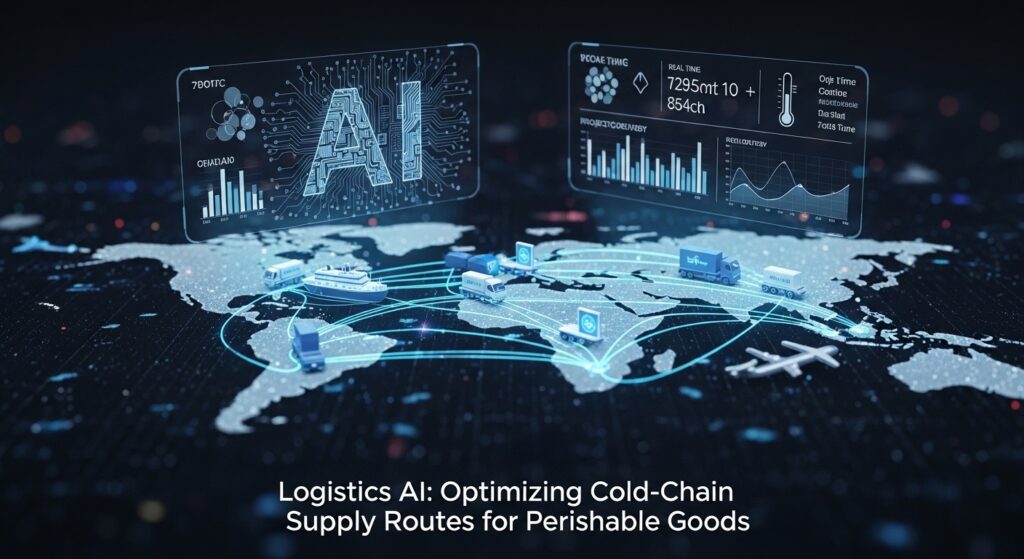
This is where artificial intelligence is transforming the landscape. From virtual sensor systems that predict temperatures without physical probes to clustered whale optimization algorithms that solve complex routing problems, AI is enabling a new generation of cold chain logistics that balances preservation, cost, and carbon emissions.
This guide explores how logistics AI is optimizing cold-chain supply routes for perishable goods, the technologies driving the transformation, and what industry leaders are implementing today.
The Three Pillars of Cold Chain AI Optimization
Modern cold chain optimization rests on three interconnected technological pillars, each addressing a different dimension of the logistics challenge.
| Pillar | Function | Key Technologies |
|---|---|---|
| Intelligent Monitoring | Tracks temperature and quality in real time | Virtual sensors, IoT, BiLSTM networks |
| Route Optimization | Minimizes distance, time, and energy consumption | Whale Optimization Algorithm, Ant Colony, Genetic Algorithms |
| System Integration | Coordinates multi-agent, multi-stage logistics | Digital twins, AI agents, blockchain |
These pillars work together to address the “multi-scale” nature of cold chain sustainability—from fundamental refrigeration mechanisms at the micro level to industry-wide policy coordination at the macro level.
Intelligent Temperature Monitoring: The Virtual Sensor Revolution
The first challenge in cold chain optimization is simply knowing the temperature of your product at every point along the journey. Physical sensors are expensive, and comprehensive deployment is often economically prohibitive.

The Sensor Gap Problem
For comprehensive temperature mapping in refrigerated containers, 20 to 30 sensors are typically required. Global long-distance transport would demand approximately 1 billion sensor modules—an impossible scale.
Moreover, most refrigerated containers track ambient rather than food temperatures. This introduces significant management errors because food temperatures can be highly heterogeneous relative to the surrounding environment. Fruit cooling rates, for example, can vary by up to 42% between packages in the same shipment.
Data-Driven Virtual Sensor Systems
The solution is Data-Driven Virtual Sensor Systems (DD-VSS) —deep learning frameworks that estimate temperatures at unmeasured locations using data from a limited number of strategically placed sensors.
How it works: The DD-VSS framework operates through three layers:
- Perception Layer: Multisource data—temperature, operational records, product attributes—are collected and preprocessed
- Network Computation Layer: A Bidirectional LSTM (BiLSTM) with attention mechanism performs temperature estimation
- Application Layer: Estimated temperatures enable dynamic monitoring, shelf-life estimation, and threshold-based alerting
Performance results: With a fixed number of physical sensors, increasing the virtual-to-physical sensor ratio from 16 to 32 maintains root mean square error below 0.3°C. Critically, sensor placement within pallets has minimal impact on performance—what matters is the choice of data sources and model architecture.

This means cold chain operators can achieve comprehensive temperature monitoring with substantially fewer physical sensors, dramatically reducing deployment costs while maintaining accuracy.
Route Optimization: From NP-Hard Problems to Practical Solutions
The vehicle routing problem for cold chain logistics is notoriously complex. Unlike standard logistics, cold chain routes must account for:
- Refrigeration costs (energy consumption varies with ambient temperature)
- Cargo damage rates (product quality degrades over time)
- Carbon emissions (increasingly subject to regulations and carbon pricing)
- Traffic conditions (delays increase both spoilage and energy use)
- Vehicle load (heavier loads consume more fuel)
Traditional deterministic optimization methods struggle with these stochastic, multi-constraint dynamics.
The Clustered Whale Optimization Algorithm (CWOA)
Researchers have developed an innovative approach called the Clustered Whale Optimization Algorithm (CWOA) , which significantly outperforms traditional methods.
Why the Whale Optimization Algorithm (WOA) was chosen as the foundation:
| Advantage | Explanation |
|---|---|
| Low Parameter Sensitivity | Minimal hyperparameter tuning, adaptable across scenarios |
| Rapid Convergence | Spiral search mechanism quickly finds near-optimal solutions |
| Low Complexity | O(n log n) per iteration, efficient for large-scale problems |
The CWOA innovations:
- DBSCAN Clustering dynamically reorganizes the whale population, enabling the algorithm to avoid local optima
- Sine-Cosine Oscillation Operator replaces linear search strategies, enhancing individual search flexibility
- Path encoding rules based on search agent addresses link solution vectors to actual route sequences
Validation results: On 23 benchmark functions from the IEEE Congress on Evolutionary Computation, CWOA demonstrated significantly faster convergence and higher precision than standard WOA and eight other optimization algorithms.
Real-World Application: Yangtze River Delta Case Study
When applied to cold chain logistics distribution in China’s Yangtze River Delta urban cluster, CWOA effectively avoided the issues of slow convergence speed and low convergence accuracy that plague other algorithms.
The model incorporates:
- Traffic condition monitoring using a triple hybrid neural network for dynamic road status prediction
- Vehicle load impact on energy dissipation and operational costs
- Refrigeration parameters, cargo damage rates, and carbon emission factors
Alternative Metaheuristic Approaches
For agricultural cold storage routing, researchers have compared multiple computational intelligence algorithms for solving the Traveling Salesperson Problem (TSP) across cold storage facilities:
| Algorithm | Performance |
|---|---|
| Ant Colony Optimization (ACO) | Superior outcomes |
| Particle Swarm Optimization (PSO) | Strong performance |
| Simulated Annealing | Moderate |
| Greedy Algorithm | Fast but less accurate |
The most effective approach proved to be a Hybrid ACO with 2-opt optimization, which integrates local search strategies to refine ACO solutions, reducing average path costs significantly.
Scenario Analysis: Four Strategic Pathways
Research on fresh fruit distribution networks has identified four scenarios for cold chain optimization, with clear winners.
| Scenario | Approach | Results |
|---|---|---|
| Basic | Standard routing heuristics | Baseline performance |
| Adaptive | Dynamic adjustment to conditions | 33% reduction in shipping costs and distance |
| Collaborative | Shared capacity across stakeholders | Improved utilization |
| Technological | AI + blockchain + IoT integration | Most optimal—ensures cost-efficiency, truck utilization, fulfillment rate, minimal product loss |
The technological scenario integrating AI, blockchain, and IoT proved most effective, enabling predictive systems, hybrid transportation, joint capacity investments, and adaptive refrigeration.
Using the sweep heuristic algorithm—a specialized approach for vehicle routing—the study achieved:
- 33.02% reduction in shipping costs and distances
- 41.7% reduction in maximum travel time
- 29.49% reduction in energy use
Digital Twins and Multi-Agent Coordination
The next frontier in cold chain AI is the digital twin—a virtual replica of the physical supply chain that enables real-time simulation, prediction, and optimization.
The Digital Twin Architecture
A human-centric, AI-enabled digital twin framework for cold chain logistics integrates:
| Layer | Function |
|---|---|
| Real-time operational data | IoT sensors, GPS tracking, temperature monitors |
| Energy-aware system modeling | Refrigeration efficiency, load impacts |
| AI-driven optimization | Route planning, inventory coordination |
| Human-in-the-loop decision support | Explainable AI, managerial override |
Key principle: “Technological intelligence augments rather than replaces managerial judgment.” The framework emphasizes human accountability and explainable AI, ensuring that automated recommendations can be understood, questioned, and overridden when necessary.
Multi-Agent Collaborative Frameworks
Current research emphasizes that effective cold chain optimization requires coordination across multiple agents and stages:
- Multi-stage dynamics: From harvest to processing to transport to storage to retail
- Multi-agent interactions: Growers, logistics providers, distributors, retailers, consumers
- Multi-region coordination: Regional adaptation, infrastructure planning, policy alignment
Future breakthroughs are expected in multimodal information fusion, demand-driven supply coordination, and spatiotemporal resource matching—advancing toward “sustainable self-optimization” of cold chain systems.
Warehouse Automation: Robots in the Freezer
Optimization extends beyond routes to warehouse operations. At Modex 2026, LG CNS unveiled the Mobile Shuttle, a logistics robot designed for continuous operation in temperatures as low as minus 26 degrees Celsius.
Technical specifications:
| Feature | Capability |
|---|---|
| Speed | Up to 1.5 meters per second |
| Load capacity | Up to 1,500 kilograms |
| Movement | Four-way directional (forward, backward, sideways, vertical) |
| Storage efficiency | 30% higher density than conventional systems |
AI integration:
- AI agent enables on-site control through natural language chatbot commands
- Real-time traffic optimization reduces bottlenecks
- Malfunction diagnosis with automated corrective action proposals
The system has received UL certification for the US market and is already deployed at a Paris Baguette factory in Texas and LG affiliate facilities across North America.
Sustainability: The Carbon-Efficiency Trade-Off
The cold chain’s environmental impact cannot be ignored. Estimated GHG emissions from food cold chain logistics reached 1.32 Gt CO2eq in 2022, up from 0.52 Gt in 2000.
The Optimization Paradox
Intelligent optimization creates a fundamental tension: reducing food loss (a sustainability goal) may increase energy consumption (an environmental cost). The most effective frameworks explicitly balance:
| Objective | Metric |
|---|---|
| Food quality | Shelf-life remaining, damage rates |
| Economic efficiency | Operating costs, capital expenditure |
| Environmental impact | Carbon emissions, energy consumption, refrigerant GWP |
CBAM-Ready Supply Chains
For emerging markets, the challenge is compounded by evolving carbon-linked trade mechanisms. The EU’s Carbon Border Adjustment Mechanism (CBAM) requires reliable, auditable emission information across logistics operations.
AI-enabled digital twins provide a pathway to carbon transparency—linking operational optimization with sustainability reporting and future carbon compliance. This transforms cold chain logistics from a cost center into a strategic asset for exporters navigating global carbon regulations.
Implementation Roadmap for Logistics Operators
Based on current research and industry deployments, here is a practical adoption framework.
Phase 1: Intelligent Monitoring (Months 1-6)
Goal: Reduce sensor costs while improving temperature visibility
Actions:
- Deploy limited physical sensors (1 per pallet or per container zone)
- Implement DD-VSS with BiLSTM + attention architecture
- Calibrate using historical temperature data
Expected outcome: Comprehensive temperature coverage at 50-75% lower sensor cost
Phase 2: Route Optimization (Months 3-9)
Goal: Minimize distance, time, and energy consumption
Actions:
- Integrate traffic prediction models (triple hybrid neural networks)
- Implement CWOA or hybrid ACO-2opt for routing
- Incorporate refrigeration costs and damage rates into objective function
Expected outcome: 30-40% reduction in shipping costs and energy use
Phase 3: Digital Twin Integration (Months 9-18)
Goal: Real-time simulation and predictive optimization
Actions:
- Build digital twin of cold chain operations
- Connect IoT data streams to simulation models
- Implement human-in-the-loop decision support
Expected outcome: Reduced spoilage, improved demand-response coordination
Phase 4: Multi-Agent Coordination (Months 12-24)
Goal: End-to-end supply chain optimization
Actions:
- Integrate supplier, logistics, and retailer systems
- Implement blockchain for traceability and transparency
- Deploy AI agents for automated exception handling
Expected outcome: Resilient, self-optimizing cold chain
Challenges and Future Directions
Despite rapid progress, significant challenges remain.
Current Challenges
| Challenge | Description |
|---|---|
| Data heterogeneity | Multi-source data from different formats and standards |
| Uncertainty management | Demand fluctuations, temperature disturbances, port delays |
| Infrastructure imbalance | Centralized vs. distributed facility planning |
| Privacy and security | Data sharing across competitors, cyber vulnerabilities |
| Regulatory gaps | Inconsistent standards across jurisdictions |
Future Trends (2026-2030)
Generative AI agents capable of autonomous decision-making across the cold chain, coordinating multiple objectives without human intervention.
Large model integration enabling natural language interaction with cold chain systems—warehouse workers controlling robots through chatbot commands, as already demonstrated by LG CNS.
Non-destructive quality analysis using AI to assess product freshness without opening packages, reducing waste and enabling dynamic shelf-life-based routing.
Predictive systems that anticipate disruptions before they occur—weather events, port congestion, equipment failures—and automatically reconfigure routes.
Frequently Asked Questions
Q: What is the most effective AI algorithm for cold chain route optimization?
A: The Clustered Whale Optimization Algorithm (CWOA) shows superior convergence and precision on complex, multi-constraint problems. For agricultural cold storage networks, Hybrid Ant Colony Optimization with 2-opt is highly effective.
Q: How many temperature sensors do I actually need?
A: Virtual sensor systems enable accurate temperature estimation with as few as one physical sensor per pallet. With a 32:1 virtual-to-physical ratio, error remains below 0.3°C.
Q: Can AI really reduce both food loss and energy consumption?
A: Yes. Multi-objective optimization frameworks explicitly balance these conflicting goals. One study achieved 33% reduction in costs and distance while also reducing energy use by 29.5% .
Q: Is this technology only for large logistics operators?
A: No. Cloud-based AI platforms and pay-per-use virtual sensor services make these capabilities accessible to smaller operators. The ROI is compelling at almost any scale given the $750 billion annual spoilage cost.
Q: How does AI handle seasonal variability in fresh produce distribution?
A: Advanced frameworks incorporate seasonal variability simulation, adjusting routes, refrigeration intensity, and inventory policies based on harvest cycles, weather patterns, and demand fluctuations.