Seedance 2.0: The AI Director That’s Redefining Cinematic Storytelling in 2026
Seedance 2.0: Just when we thought the AI video generation race had settled into a predictable rhythm—with快手可灵 dominating motion control, OpenAI’s Sora pushing realism, and Google Veo mastering physics—ByteDance has thrown a spectacular curveball.
Seedance 2.0 arrived on February 10, 2026, and the reaction from industry insiders has been nothing short of seismic . Game Science CEO Feng Ji, creator of the blockbuster Black Myth: Wukong, didn’t mince words: “Currently the world’s strongest video generation model” .
But hyperbole aside, what actually makes Seedance 2.0 different? Is it genuinely a paradigm shift, or just another impressive demo reel? Having analyzed the technical specifications and user reports flooding social media, the answer leans heavily toward the former.
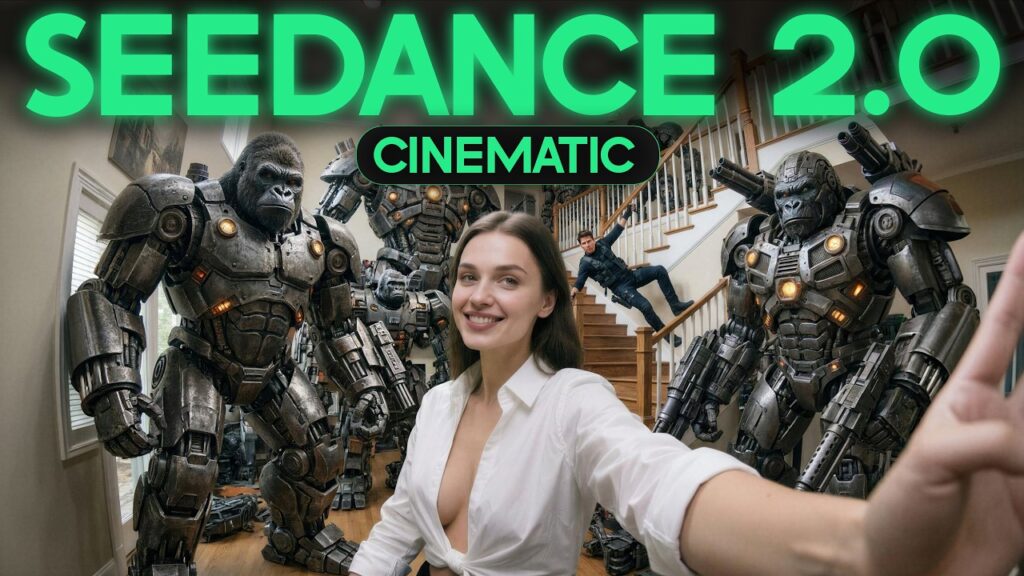
Welcome to the era of the AI Director, not just an AI generator.
1. The “Director’s Cut” Architecture
Previous AI video models, regardless of their quality, functioned primarily as 素材生成器 (material generators) . You would type a prompt, cross your fingers, and pray the “slot machine” spat out something usable. If you wanted a specific camera angle or a particular lighting condition, you were often left to brute-force the system with repeated attempts—a process users call “抽卡” (gacha-style pulling).
Seedance 2.0 fundamentally breaks this mold. Built on a “dual-branch diffusion transformer architecture,” the model processes visual and auditory signals simultaneously rather than sequentially .
But the real game-changer is the 12-way multimodal reference matrix . Creators can now input up to:
- 9 images
- 3 video clips
- 3 audio files
When you feed these into Seedance 2.0, you aren’t just “inspiring” the AI. You are giving it a production bible. It analyzes the composition of your images, the motion trajectory of your video references, and the rhythm of your audio to generate a scene that feels pre-visualized, not randomly assembled .
2. The End of the “Single Shot” Limitation
Perhaps the most significant leap forward is the death of the single, isolated clip.
Historically, AI video models excelled at generating beautiful 5-second loops but failed miserably when asked to tell a story. Shifting camera angles usually resulted in the main character morphing into a completely different person. This is known in the industry as identity drift .
Seedance 2.0 introduces multi-shot generation with locked character consistency .
Imagine this: You generate a 15-second clip. It starts with a wide shot of a spy entering a room. The camera cuts to a close-up of their hand grabbing a file. It cuts again to an over-the-shoulder shot as they read it. In older models, the spy’s face, clothes, and even the room layout would fluctuate wildly between these cuts. In Seedance 2.0, thanks to its “character identity locking” system (using the @Tag assignment syntax), the protagonist remains visually stable across every angle .

This transforms AI video from a novelty (look, a cat driving a car!) into a legitimate pre-visualization tool for actual filmmakers and commercial directors.
3. Audio That Breathes (And Syncs)
Sound design has always been the ugly stepchild of AI video generation. Most tools generate silent footage, forcing you to manually add foley and music later, praying it lines up. Sora 2 added native audio, but Seedance 2.0 has perfected the multimodal audio-video joint generation .
Seedance 2.0 utilizes dual-channel stereo technology to produce high-fidelity, spatial audio.
In practical terms, this means:
- Lip Sync is perfect: The model understands the relationship between mouth movements and phonetic sounds without the creepy “rubber mouth” effect .
- Foley is automatic: If you generate a video of someone scratching frosted glass or popping bubble wrap, the AI generates the specific, high-ASMR texture of that sound .
- Music is beat-aware: For marketing reels, you can feed the AI a song. It will analyze the BPM and structure and edit the visual cuts to land precisely on the snare hits or bass drops .
This is a massive time-saver for social media managers who need to produce Reels or TikToks that sync perfectly with trending audio.
4. The Integration Ecosystem (HeyGen & CapCut)
A tool is only as useful as its accessibility. ByteDance has done something very smart: they have integrated Seedance 2.0 deep into the existing creative ecosystems that creators already use.
- HeyGen Integration: Through a partnership with HeyGen, Seedance 2.0 is now the visual engine for digital avatars . You can take your verified AI twin and place them into a Seedance-generated environment. This is massive for corporate training and personalized marketing at scale.
- CapCut Workflow: As the flagship editing suite of ByteDance, CapCut now allows users to access Seedance 2.0 directly within the timeline . You don’t have to generate a clip, download it, and import it. You just prompt, generate, and edit—all in one place.
5. The Reality Check (Limitations & Governance)
No technology review is complete without addressing the “but.”
While Seedance 2.0 offers incredible control, the output resolution currently tops out at 1080p . For creators needing 4K broadcast quality, Google’s Veo 3.1 or Kling 3.0 might still be necessary for the final render .
Furthermore, the “terror” of the technology cannot be ignored. During testing, tech YouTuber Tim (of “影视飓风”) noted that Seedance 2.0 was able to generate the back of his office building and replicate his voice simply by looking at publicly available videos of him . It is estimated that the model was trained on massive datasets of creator content.
The Deepfake Dilemma:
ByteDance has reacted swiftly to these concerns. As of mid-February 2026, the API enforced strict copyright and content filters. Real-person face uploads were temporarily paused for verification, and the model now actively blocks the generation of named characters from franchises (Marvel, Disney, Anime IPs) unless authorized .
As one analyst put it, “AI video models need ‘guardrails’ to survive. Seedance 2.0 is proving that safety isn’t just a regulation; it’s a competitive advantage” .
Final Verdict: Should You Upgrade?
If you are a hobbyist making surreal memes, the free tier of Sora or Runway is probably sufficient. But if you are a content creator, brand manager, or short-film maker who is tired of fighting with “identity drift” and “prompt lottery,” Seedance 2.0 is the best tool of 2026.
It is the first model that feels less like a “prompt engineer” and more like a Director of Photography. It understands camera language, respects your references, and keeps your actors looking the same between shots.
The era of AI slop is over. The era of AI storytelling has begun.
Frequently Asked Questions (FAQ)
Q: How long can Seedance 2.0 videos be?
A: Seedance 2.0 can generate clips up to 15 seconds in a single pass, with extension features allowing for longer sequences .
Q: What is the pricing for Seedance 2.0?
A: Plans start from approximately $14 USD per month, though integration through platforms like HeyGen or CapCut may offer different pricing tiers .
Q: Can I use Seedance 2.0 to clone my face?
A: Strict identity verification is required for real-person references. The platform has implemented temporary freezes on unauthorized face uploads to prevent deepfake abuse .
Q: Which is better: Seedance 2.0 or Kling 3.0?
A: Seedance leads in audio-visual sync and reference control; Kling 3.0 leads in 4K resolution output. Choose based on your delivery needs .