Smart Contracts & AI: Automating Legal Agreements with Agentic Logic
Smart Contracts & AI: Discover how AI agents and smart contracts are converging to create autonomous legal agreements. Learn about agent-to-agent negotiation, the “separation of powers” governance model, and the future of contract law.
The End of Static Agreements
Imagine a supply chain contract that doesn’t just sit in a filing cabinet. It monitors inventory levels, detects a shortage, automatically negotiates with backup suppliers, executes a new purchase order, and updates the ledger—all without a single human clicking “approve.”
This is not science fiction. This is the convergence of smart contracts and agentic AI—and it is already reshaping how businesses form, execute, and enforce agreements.
The traditional contract is a static document. It records intent at a single moment in time. It requires humans to interpret its terms, notice when conditions are triggered, and take action. It is reactive by design.
The AI-augmented smart contract is dynamic. It lives on a blockchain. It monitors real-world conditions. It can negotiate with counterparty agents. It executes itself when conditions are met. It is autonomous by design.
This guide explores the cutting edge of legal automation: how AI agents are transforming smart contracts from passive code into active participants in the economy.
What Are Smart Contracts? A Quick Refresher
Smart contracts are self-executing agreements where the terms are written directly into code and deployed on a blockchain. When predetermined conditions are met, the contract automatically executes the agreed-upon action—transferring funds, releasing documents, updating records—without intermediary involvement.
Traditional smart contract limitations:
| Limitation | Description |
|---|---|
| Static logic | Once deployed, the contract follows fixed rules. It cannot adapt to novel situations. |
| No external awareness | Smart contracts cannot “see” the outside world without oracles. |
| No negotiation | Terms are fixed at deployment. There is no back-and-forth. |
| Human dependency | Someone must still draft the contract code. Someone must monitor for failures. |
Enter agentic AI. AI agents address every one of these limitations.
The AI Agent Revolution in Contracting
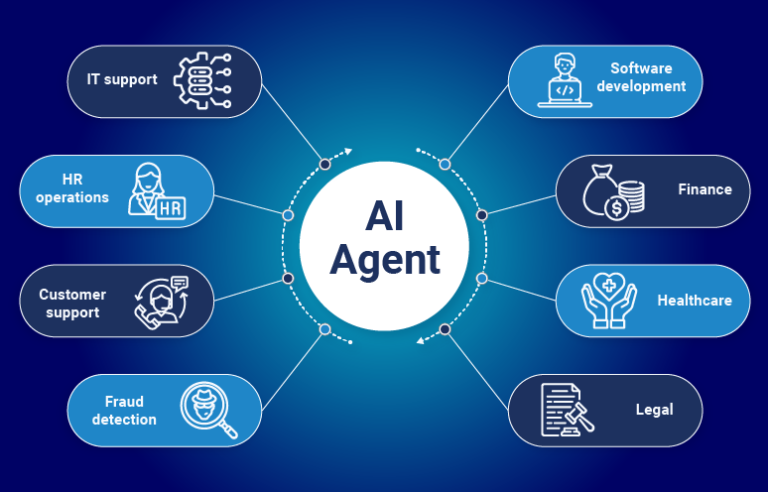
An AI agent is an autonomous system that can perceive its environment, make decisions, and take action to achieve goals. Applied to contracts, AI agents can:
- Negotiate terms with counterparty agents in real time
- Monitor external conditions (supply chain, market prices, regulatory changes)
- Trigger smart contract execution when conditions are met
- Learn from past negotiations to improve future performance
- Explain their decisions with transparent reasoning
The key distinction is autonomy. Traditional contract management requires humans to initiate every action. AI agents can work toward outcomes independently, only looping in humans when their judgment is needed.
Agent-to-Agent Contracting
The most advanced implementations enable agent-to-agent negotiation—two AI agents representing different parties haggling over terms without human involvement.
Luminance’s Autonomous Negotiation is the only platform capable of 100% AI-powered, agent-to-agent contract negotiation with zero human intervention required. The system:
- Reads and analyzes the contract
- Remediates areas of risk
- Manages negotiation workflows
- Sends revised drafts to counterparties
- Tracks responses
- Reacts in real time to changes made by the counterparty’s AI
The entire negotiation lifecycle runs autonomously. Teams that want control can involve humans at any point—”autonomous by default, human in the loop by choice”.
What makes this possible? Luminance retains negotiation history and legal decision-making logic across all enterprise contracts, solving what they call “enterprise amnesia”—the long-standing gap where AI systems captured outcomes but discarded the context behind them.
The Legal Architecture: From Digital Will to Automated Contracting
The convergence of AI and smart contracts raises profound legal questions. A 2026 study published in the Journal of Islamic Sciences and Civilization explored exactly this terrain.
The core tension: Traditional contract law is built on the concept of contractual will—the meeting of the minds, the intention to be bound. When an AI agent negotiates and executes a contract autonomously, whose intent governs? How do courts attribute intent when no human was involved in the specific transaction?
Key legal challenges identified:
| Challenge | Description |
|---|---|
| Attribution of intent | Can an AI agent form the requisite “meeting of the minds”? |
| Liability for errors | Who pays when an agent makes a mistake—the principal, the developer, or no one? |
| Evidentiary value | Will courts accept blockchain records as proof of agreement? |
| Cross-border enforcement | Which jurisdiction governs when parties are distributed globally? |
| Consumer protection | How do mandatory consumer laws apply to automated transactions? |
The study concludes with an urgent call: “a clear legal framework that reconciles innovation with legal certainty to protect contracting parties in the digital age” is needed.
The UTAOS Framework: Treaty-Aware AI Governance
One of the most ambitious projects in this space is the Universal Treaty-Aware Operating System (UTAOS) , patented in July 2025. UTAOS provides a scalable, modular, and legally compliant framework for executing, governing, and revoking AI-generated digital assets and software applications.
The five-layer architecture:
| Layer | Function |
|---|---|
| Issuance Layer | Generates tokenized software objects with cryptographic sovereignty |
| TreatyChain Compliance Layer | Enforces jurisdictional and licensing rules via WASM-encoded smart contracts |
| Execution Layer | Runs AI-generated applications via machine agents |
| AI Agent Layer | Facilitates autonomous agent interactions with programmable legal consent |
| Legal Memory Layer | Stores non-falsifiable audit trails and event hashes |
The key innovation: UTAOS treats legal compliance as programmable logic. When an AI agent executes a transaction, the system checks jurisdictional rules, license requirements, and disclosure obligations in real time—under 50 milliseconds for standard checks.
Zero-knowledge privacy: The system uses zk-SNARKs to verify compliance without disclosing sensitive information. Machines submit cryptographic proofs that are verified in approximately 10 milliseconds.
Performance metrics:
- Throughput: 1,000 transactions per second (scalable to 10,000 TPS)
- Latency: <100 ms for ZKP verification
- Gas cost: <0.01 ETH per transaction via zk-rollups
UTAOS is the world’s first execution architecture designed to legally bind AI-native entities across programmable treaty-compliant networks.
The Governance Problem: Preventing “Logic Monopoly”
When AI agents operate autonomously across organizational boundaries, a new problem emerges: logic monopoly—the phenomenon where agent societies become so complex that no single human can fully observe, audit, or govern their emergent behavior.
Researchers from a 2026 paper introduced a solution: the Separation of Powers (SoP) governance model, deployed on a public blockchain.
The three powers:
| Power | Responsible Party | Function |
|---|---|---|
| Legislative | AI agents (via smart contracts) | Define operating rules |
| Executive | Deterministic software | Execute contract terms |
| Judicial | Humans (via ownership chains) | Adjudicate disputes and assign accountability |
The core principle: “alignment-through-accountability.” Every agent must be traceable to a human owner through an unbroken ownership chain. When an agent acts, someone is ultimately responsible. The researchers validated this framework in a “public goods production economy” with 50 to 1,000 agents.
Smart contract as law: In this model, the smart contract is not just a tool—it is the law itself. It is “both the actual legislative outcome of agent production and the fundamental norm regulating its own behavior”.
Commercial Platforms: What Is Available Now
The theoretical frameworks are becoming reality. Multiple platforms now offer AI-powered contract automation.
Docusign + Anthropic
Docusign partnered with Anthropic to bring its Intelligent Agreement Management (IAM) platform to Cowork, Anthropic’s agentic workspace. Users can now create, review, send, and manage agreements through natural language prompts.
What teams can accomplish:
- Draft a contract from a Master Service Agreement template, populate business details, and route for review—all by typing a sentence
- Surface all customer contracts expiring in the next 90 days with a price increase clause, and take action directly from results
- Review AI-suggested redlines, align them to company policy, and trigger vendor review workflows
- Request summary reports of active contracts with specific clauses, formatted and ready to share
The integration is built on the Model Context Protocol (MCP) , ensuring enterprise-grade security. Businesses must authenticate, access is permission-based, and agreement data remains private.
Ironclad: Contract Intelligence
Ironclad, surpassing $200 million in annual recurring revenue, has launched contract intelligence capabilities that turn static agreements into actionable insights.
The Ironclad Assistant allows teams to conversationally interact with contracts—both signed and in motion. Users can ask complex questions and receive grounded responses drawn from both executed and in-flight agreements.
Three new AI agents:
| Agent | Function |
|---|---|
| Renewal Agent | Provides context and recommendations for upcoming renewals |
| Cost Savings Agent | Surfaces potential savings (volume discounts, rebates, bundles) |
| Archive Agent | Streamlines metadata extraction during contract archival |
Real results: Over 65% of customers have adopted Ironclad’s AI capabilities. The Intake Agent reduced average submission time by 50%.
Icertis: AI-Native Contract Transformation
Icertis 26R1 introduced a framework organized around three pillars:
| Pillar | Function |
|---|---|
| Engage | Agent-powered contracting with intelligent redlining, risk review, and conversational guidance |
| Operate | End-to-end contract lifecycle management with embedded automation |
| Analyze | AI-driven insights across the contract ecosystem to surface risk and uncover value |
Clio Vincent: Agentic Legal Workflows
For legal professionals, Clio’s Vincent platform now offers agentic capabilities that execute complex, multi-step legal tasks from a single instruction.
The shift: Rather than guiding Vincent step by step, users describe the outcome they want, and Vincent works toward that result independently. The system interprets the goal, determines required steps, and executes across them in a continuous flow.
Adoption context: Approximately 84% of AI queries are now submitted as freeform, goal-based requests rather than structured commands. Vincent is built to match how legal work is actually described.
Fadada + Seeyon: Chinese Market Innovation
In China, Fadada has partnered with Seeyon to launch an AI-driven contract lifecycle solution. The platform integrates Fadada’s legal vertical LLM with Seeyon’s collaboration platform, delivering four core intelligent scenarios:
- Smart drafting: Generate standardized contract drafts from natural language descriptions in seconds
- Smart review: Multi-dimensional risk review covering format, corporate policy, industry rules, and regulations
- Smart comparison: Identify differences across multiple versions and formats
- Smart performance monitoring: Extract key terms (amounts, deadlines, milestones) and automatically trigger alerts
The solution is already deployed across property management, finance, automotive manufacturing, internet, education, retail, and agriculture sectors.
The Legal Hurdles Ahead
Despite technological progress, significant legal barriers remain.
Contractual Intent
Traditional contract law requires a “meeting of the minds.” When an AI agent negotiates autonomously, it is unclear whether the necessary intent exists. Courts have not yet definitively ruled on whether AI-generated agreements are enforceable.
Liability Attribution
If an AI agent enters a bad contract—overpays, accepts unfavorable terms, fails to notice a hidden liability—who is responsible? The principal who deployed the agent? The developer who wrote the code? The agent itself (which has no legal personhood)?
Regulatory Fragmentation
The US, EU, and Asia have different approaches to both AI and blockchain. The EU AI Act imposes strict requirements on high-risk AI systems. The TRUMP AMERICA AI Act requires annual third-party audits. Smart contracts operating across jurisdictions must satisfy multiple, sometimes conflicting, regulatory regimes.
The “Black Box” Problem
Even with explainable AI, the complexity of agent decision-making can outrun human comprehension. The SoP framework addresses this by ensuring every agent is traceable to a human owner, but the underlying opacity remains a concern.
Implementation Framework for Enterprises
For organizations ready to adopt AI-smart contract integration, a phased approach is recommended.
Phase 1: Internal Automation
Start with AI agents that operate within your own organization. Drafting assistance, clause extraction, obligation monitoring—these use cases improve efficiency without crossing legal boundaries.
Phase 2: Supervised External Interaction
Allow agents to negotiate with counterparty agents, but with human oversight. Luminance’s “autonomous by default, human in the loop by choice” model is ideal for this phase.
Phase 3: Full Autonomy for Low-Risk Agreements
For routine, low-stakes agreements (NDAs, standard purchase orders), deploy fully autonomous agent-to-agent negotiation. Reserve human review for high-value or novel contracts.
Phase 4: Blockchain Integration
Deploy smart contracts on permissioned or public blockchains for agreements where trustless execution provides clear value—supply chain payments, royalty distributions, insurance claims.
Governance Requirements
Throughout all phases, maintain:
- Clear ownership chains linking every agent to a responsible human
- Audit trails recording every decision and its reasoning
- Revocation mechanisms to terminate agent authority when needed
- Regular compliance reviews against applicable regulations
The Future: What to Expect by 2028
Standardized agent communication protocols. Just as SMTP standardized email, expect emerging standards for agent-to-agent contract negotiation. The Model Context Protocol (MCP) is an early example.
Regulatory recognition. Courts will begin recognizing AI-generated agreements as enforceable, likely with heightened evidentiary requirements (e.g., mandatory audit trails).
DAO-governed arbitration. Disputes arising from agent contracts may be resolved by decentralized autonomous organizations (DAOs) rather than traditional courts.
Cross-border treaty integration. UTAOS-style frameworks that automatically comply with international treaties will become the norm for global enterprises.
The “constitutional” agent. Every AI agent will come with embedded governance rules—its “constitution”—defining what it can and cannot do, enforced at the code level.
Frequently Asked Questions
Q: Are AI-negotiated contracts legally enforceable today?
A: It depends on jurisdiction. No court has definitively ruled on fully autonomous agent-to-agent agreements. Most experts recommend human review and signature for high-value contracts. However, the trajectory is toward recognition as the technology matures.
Q: What is the difference between a smart contract and an AI agent?
A: A smart contract is passive code that executes when conditions are met. An AI agent is active—it perceives, decides, and acts autonomously. The two are complementary: agents can negotiate and monitor; smart contracts execute.
Q: Can AI agents be held liable for bad contracts?
A: No. AI agents lack legal personhood. Liability flows to the principal who deployed the agent, the developer who wrote the code, or both. This is why ownership chains and audit trails are critical.
Q: How do I ensure my AI agent complies with regulations?
A: Use platforms with built-in compliance checking (like UTAOS) or implement your own rule-based guardrails. Regularly audit agent decisions. Maintain human oversight for regulated activities.
Q: What is the cost of implementing AI contract automation?
A: Costs vary widely. Enterprise platforms like Ironclad and Icertis have custom pricing. Docusign’s integration is available to existing customers. Open-source frameworks like UTAOS are still emerging. Expect to invest in both technology and legal review.