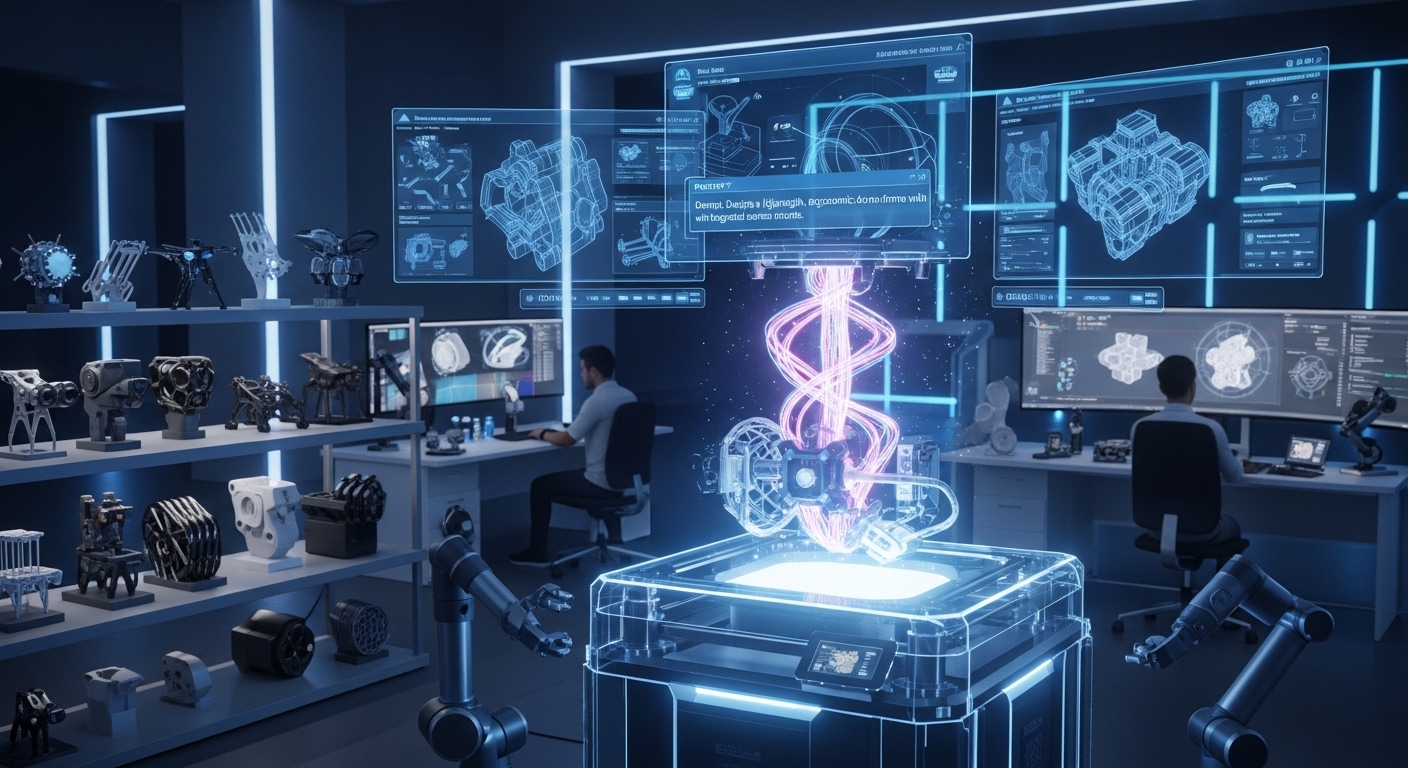
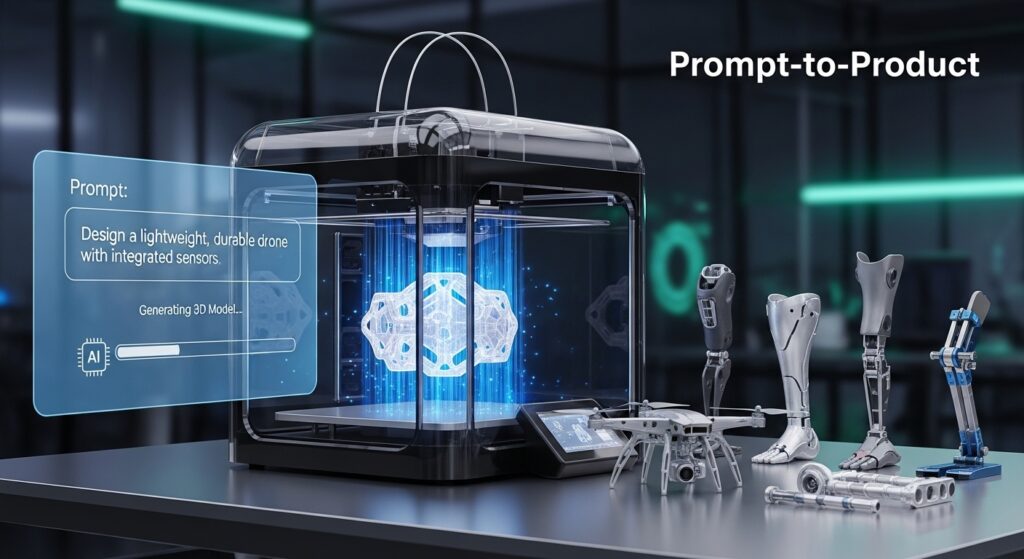
The Future of “Prompt-to-Product”: Using AI for 3D Printing and Rapid Prototyping
The Future of “Prompt-to-Product”: Discover how prompt-to-product AI is transforming 3D printing and rapid prototyping. Explore platforms like Meshy AI Creative Lab, MIT’s PhysiOpt, and Autodesk Wonder 3D that generate print-ready models from text prompts.
The New Manufacturing Magic
You type: “Cyberpunk cat with neon blue armor, ready to be printed as a figurine.”
Thirty seconds later, you have a watertight, full-color 3D model. One more click, and it is sent to manufacturing. A week later, a professional-grade collectible arrives at your door.
This is not a vision of the distant future. It is happening right now.
At CES 2026, Meshy unveiled the AI Creative Lab, the industry’s first AI-native platform that transforms generative 3D models into premium, full-color ready-to-3D-print files with a single click . The company’s founder, Ethan Hu, put it simply: “Anyone who can type a prompt can hold a professional-grade collectible in their hand” .
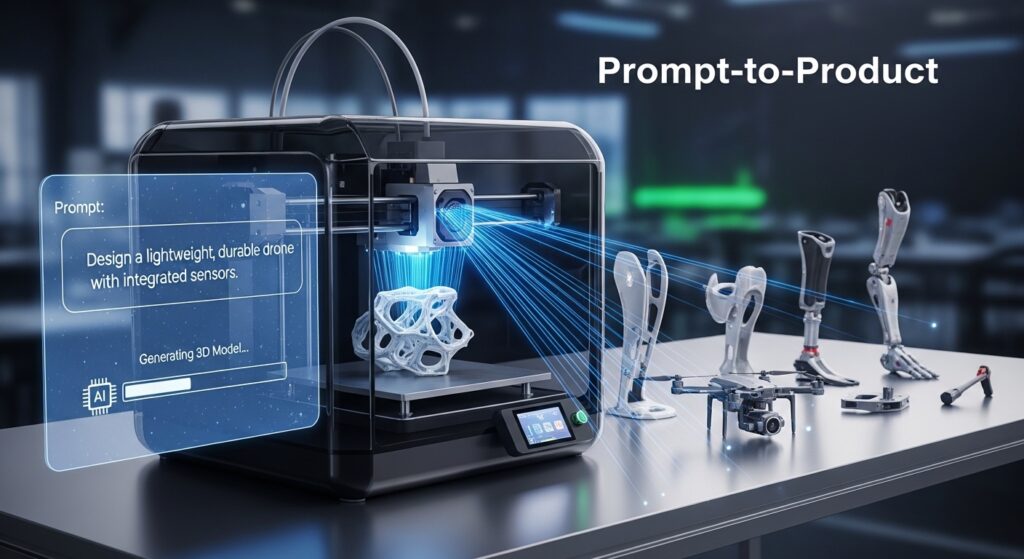
The “prompt-to-product” era has officially arrived. And it is democratizing manufacturing in ways that would have seemed impossible just three years ago.
The Three Pillars of Prompt-to-Product
The journey from text prompt to physical object rests on three technological pillars, each advancing at breakneck speed.
Pillar 1: AI-Powered 3D Generation
The first step is turning words into 3D models. Multiple platforms now excel at this.
Meshy AI Creative Lab allows users to generate high-quality 3D models directly within the Meshy Workspace using text or image prompts. With a single click, the interface transitions from a digital creation environment to a physical production workshop . The system automatically adapts models to fit real-world product constraints across categories like figurines, keychains, and fridge magnets.
Autodesk Wonder 3D, launched in March 2026, brings similar capabilities to professional creators. The platform offers Text to 3D, Image to 3D, and Text to Image generation, all within Autodesk Flow Studio. Models export as USD, STL, or OBJ files, making them ready for further refinement or direct printing .
Nikola Todorovic, co-founder of Wonder Dynamics, explained the vision: “We created Wonder 3D to help remove pain points and help creators of all skill levels generate and iterate on 3D assets quickly, without slowing down production” .
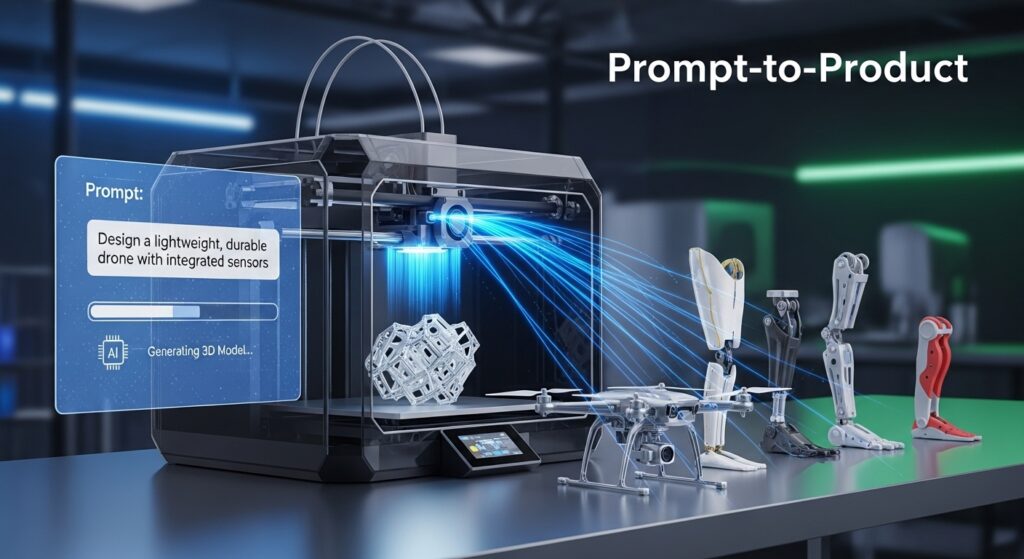
Womp offers a web-based alternative, providing over 200 tested basic models that can be adapted in scale and structure. The platform supports full-color and multi-material models, allowing complex shapes with different surfaces to be simulated .
Pillar 2: Physics-Aware Optimization
Generating a beautiful 3D model is one thing. Generating one that can survive being printed and used is another entirely.
Generative AI models often lack an understanding of physics. A tool like Microsoft’s TRELLIS might generate a beautiful chair design with disconnected parts or unstable geometry. Print it, and it falls apart when someone sits down .
MIT CSAIL’s PhysiOpt solves this problem by augmenting generative AI with physics simulations. The system rapidly tests whether a 3D model’s structure is viable, gently modifying shapes while preserving the overall appearance and function of the design .
Here is how it works: You type what you want to create and what it will be used for. You specify how much force or weight the object should handle and what materials you will fabricate it with. PhysiOpt then runs a physics simulation called “finite element analysis” (FEA) to stress-test the design, providing a heat map that indicates where the blueprint is not well-supported .
The researchers demonstrated the system by generating a “flamingo-shaped glass for drinking,” which they 3D-printed into a functional drinking glass with a handle and base resembling the tropical bird’s leg . PhysiOpt is nearly 10 times faster per iteration than comparable methods while creating more realistic objects .
SEG (Support-Effective Generation) , a framework accepted by IEEE Robotics and Automation Letters, tackles a different physics problem: support structures. Many 3D-printed objects require temporary supports during printing, which waste material and increase production time. SEG integrates Direct Preference Optimization into the 3D generation pipeline to directly optimize models for minimal support material usage .
Pillar 3: Print-Ready Fulfillment
The final pillar is the bridge from digital file to physical object.
Meshy’s partnership with Formlabs Form Now creates a continuous workflow from text prompt to ordered printed part. Users create a model in Meshy, which is already checked and optimized for printability and material compatibility during generation. The model then transfers directly to Form Now, where users select material and color without leaving the platform or manually moving files .
As Johnny Li, Head of 3D Printing Products at Meshy.ai, put it: “What we’ve learned is that the magic moment isn’t the model on the screen. It’s the physical object in their hand” .
The Complete Workflow: From Prompt to Product
Here is how these technologies come together in a unified workflow.
| Step | Action | Technology | Time |
|---|---|---|---|
| 1 | Type or upload reference image | Meshy, Autodesk Wonder 3D | Seconds |
| 2 | AI generates 3D model | Generative AI | 30-60 seconds |
| 3 | Physics validation | PhysiOpt, SEG | 30 seconds |
| 4 | Printability optimization | Automated mesh repair | Real-time |
| 5 | Order fulfillment | Formlabs, manufacturing partners | 3-7 days |
The process eliminates former barriers such as complex mesh repair, slicing, material selection, and manual painting . As Meshy’s documentation notes, the system acts simultaneously like a modern production consultant and creative director .
The Technical Deep Dive: What Makes This Work
For those who want to understand what is happening under the hood, the technology stack is fascinating.
Generative Design for Additive Manufacturing
A comprehensive review published in Materials & Design (Volume 262, February 2026) positions generative design as a “process-aware and human-in-the-loop framework for exploring high-dimensional design spaces under coupled functional requirements and manufacturable constraints” .
The review identifies two complementary approaches :
| Approach | Strengths | Limitations |
|---|---|---|
| Physical model-based | Interpretable, constraint-faithful guidance grounded in mechanics | Slower, limited to known archetypes |
| Data-driven | Extends design coverage, accelerates iteration | Requires training data, potential for hallucinations |
The most effective systems combine both, using physics-informed evaluators to guide data-driven generators .
Support Optimization via Offset Direct Preference Optimization
The SEG framework represents a breakthrough in printability optimization. By incorporating support structure simulation directly into the training process, SEG encourages the generation of geometries that inherently require fewer supports .
In tests on benchmark datasets Thingi10k-Val and GPT-3DP-Val, SEG significantly outperformed baseline models like TRELLIS, DPO, and DRO in terms of support volume reduction and printability . The key insight: optimize for printability during generation, not after.
Agentic AI for Manufacturing Workflows
The Department of Energy’s Oak Ridge National Laboratory is exploring the use of agentic AI to orchestrate end-to-end additive manufacturing workflows. These autonomous agents manage tasks such as toolpath generation, predictive simulations, in-situ process control, and real-time data summarization for qualification .
The goal is to “eliminate cumulative frictions” across the design-plan-print-qualify continuum, dramatically accelerating innovation cycles for safety-critical applications .
Real-World Impact: Who Is Using This?
The prompt-to-product revolution is not theoretical. It is already changing how people create.
For Hobbyists and Makers
Individual creators can now design and print custom items without any CAD expertise. A tabletop gamer can generate a unique miniature for their character. A cosplayer can design custom props. A homeowner can create personalized decorations .
For Small Businesses
Entrepreneurs can rapidly prototype products without expensive tooling or manufacturing minimums. As one industry observer noted, “any company will have access to mass customization” . This democratizes physical product creation in the same way that desktop publishing democratized media.
For Professional Designers
Even experienced designers benefit. Wonder 3D is designed to “reduce the time required to create characters and props and remove workflow bottlenecks that delay production teams” . The AI handles the heavy lifting of initial generation; designers focus on refinement and creative direction.
For Accessibility and Assistive Devices
MIT’s research extends to assistive applications. The same physics-aware optimization that ensures a flamingo-shaped glass is drinkable can ensure that a custom finger splint or utensil grip is both functional and comfortable .
The MIT VisiPrint Breakthrough: Seeing Before Printing
One of the most persistent problems in 3D printing is the gap between what you see on screen and what you get from the printer. Color, texture, and shading often differ dramatically from digital previews, leading to multiple reprints that waste time, effort, and material .
MIT’s VisiPrint solves this with an AI-powered preview tool that generates accurate, aesthetics-first renderings of how an object will look before it is printed .
How it works: Users upload a screenshot of the object from their 3D-printing software, along with a single image of the print material. A computer vision model extracts features from the material sample—not just color, but also gloss, translucency, and how the fabrication process affects appearance. A generative AI model then computes the final rendering, incorporating the “slicing” pattern the nozzle will follow .
The results: In user studies, nearly all participants said VisiPrint provided better overall appearance and more textural similarity with printed objects compared to other approaches. The preview process takes about one minute on average—more than twice as fast as any competing method .
Lead author Maxine Perroni-Scharf explained the sustainability angle: “Some studies estimate that as much as a third of the material used goes straight to the landfill, often from prototypes the user ends up discarding. To make 3D printing more sustainable, we want to reduce the number of tries it takes to get the prototype you want” .
The Economics: What Does This Cost?
Pricing varies across platforms, but the trend is toward accessibility.
| Platform | Pricing Model | Best For |
|---|---|---|
| Meshy AI Creative Lab | Per-model or subscription | General consumers, hobbyists |
| Autodesk Wonder 3D | Included in Flow Studio subscription | Professionals, studios |
| Womp | Freemium with print-on-demand | Beginners, occasional users |
The most significant cost is often the printing itself. Meshy partners with premium manufacturing partners for fulfillment; Womp uses stereolithographic (SLA) processes with high-quality synthetic resins .
Limitations and Challenges
For all the progress, significant challenges remain.
Structural Integrity
As MIT’s PhysiOpt research demonstrates, generative AI models often lack “an understanding of physics” . While tools like PhysiOpt and SEG address this, they add computational overhead and cannot guarantee perfection for every design.
Printability Validation
Even with automated optimization, not every AI-generated model prints successfully. Meshy claims “watertight, manifold meshes and a high proportion of models that can be processed in the slicer without additional reworking” —but “high proportion” is not “all.”
Material Limitations
Current platforms offer limited material choices. Womp offers two materials: White Prototyping Plastic (WPP) and Clear Resin (CR) . Meshy’s Formlabs integration expands options but remains constrained compared to traditional manufacturing.
The Hallucination Problem
AI models can still generate physically impossible geometries. While physics validation catches many issues, edge cases remain. The academic literature emphasizes “human-in-the-loop” frameworks for precisely this reason .
The Future: What to Expect by 2028
The trajectory is clear and accelerating.
Fully autonomous design-to-print pipelines. Agentic AI will orchestrate the entire workflow from prompt to finished product, with minimal human intervention except for high-level creative decisions .
Multi-material and multi-color printing. As hardware improves, AI generation will natively support complex, multi-material designs without manual segmentation.
Real-time physics feedback. Instead of post-generation validation, physics constraints will be baked directly into the generation process—”physics-in-the-loop” rather than “physics-after-the-fact.”
Sustainable optimization. SEG’s support-minimization approach will expand to optimize for material efficiency, energy consumption, and recyclability .
Democratization of manufacturing. The cost barrier will continue to fall. What cost $1,000 and required expert knowledge in 2024 will cost $10 and require only a text prompt by 2028.
Getting Started Today
You do not need to be a 3D printing expert to start using these tools.
Step 1: Choose a platform. For beginners, Meshi AI Creative Lab or Womp offer the lowest friction. For professionals, Autodesk Wonder 3D integrates with existing workflows.
Step 2: Start with a simple prompt. “A small elephant figurine” or “A coffee mug with geometric patterns.” See what the AI generates.
Step 3: Review and refine. Most platforms allow you to adjust the generated model before committing to print.
Step 4: Order or print. Use the platform’s integrated printing service, or download the STL/OBJ file and print locally.
Step 5: Iterate. The beauty of rapid prototyping is speed. Try different prompts. Compare results. Learn what works.
Frequently Asked Questions
Q: Do I need CAD experience to use these tools?
A: No. Prompt-to-product platforms are designed for users with zero CAD knowledge. The AI handles all geometry generation .
Q: How long does it take to go from prompt to physical product?
A: Generation takes 30-60 seconds. Printing and shipping typically take 3-7 days depending on the service .
Q: Are AI-generated models actually printable?
A: Leading platforms include automated printability validation. Meshy claims “watertight, manifold meshes” ready for slicing . However, complex designs may still require manual adjustment.
Q: How much does this cost?
A: Pricing varies. Some platforms offer freemium models; others charge per generation or require subscriptions. Printing costs depend on material, size, and complexity.
Q: Can I use these for commercial products?
A: Yes. Platforms like Autodesk Wonder 3D are explicitly designed for professional and commercial use .