The AI Data Center Boom: How Tech Infrastructure Is Rewriting Global Construction Economics
The AI data center boom is reshaping construction economics—massive 300 MW facilities, $7T in investment, labor shortages, and skyrocketing copper prices. Here’s what contractors need to know.
Introduction: The New Industrial Revolution
For two decades, construction has been one of the least digitized industries on the planet. Now, ironically, the digital revolution is driving one of the largest physical construction booms in history.
The global AI infrastructure buildout is entering what industry analysts call “the largest technology infrastructure buildout in human history” . Major technology companies are expected to spend around $700 billion this year on AI-related infrastructure, including data centers and advanced manufacturing facilities. According to a report by McKinsey & Company, global investment in data centers could approach $7 trillion by the end of the decade .
This is not a niche market. It is a fundamental reshaping of construction economics—from material costs to labor markets to project timelines. And for contractors not building data centers, the ripple effects are impossible to ignore.
In this article, we will examine the latest mega-projects driving this boom, how they are distorting labor and materials markets, and what every contractor needs to know to navigate the new landscape.
Part 1: By the Numbers – The Scale of the AI Buildout
1.1 The Investment Tsunami
The numbers are staggering, and they are climbing rapidly:
| Metric | Value | Source |
|---|---|---|
| 2026 AI infrastructure spend | ~$700 billion | McKinsey |
| Cumulative investment by 2030 | ~$7 trillion | McKinsey |
| Hyperscaler AI capex (2026) | ~$600-700 billion | Amazon, Microsoft, Google, Meta |
| 14 largest data center operators (FY2026) | ~$750 billion | BloombergNEF |
| Data center IT capacity under construction | 23.1 GW | BloombergNEF |
| Active construction sites globally | 831 | BloombergNEF |
As BloombergNEF reports, capital expenditure estimates for the 14 largest public data center developers in FY2027 have climbed by 56% between August 2025 and February 2026 . This builds on already significant growth—capex jumped two-thirds from FY2024 to FY2025 and is expected to climb by the same margin into FY2026.
1.2 The US Dominates, But Grid Constraints Bite
The United States alone hosts 15.9 GW of ongoing data center construction—nearly 70% of the global total . The Americas region as a whole accounts for 17 GW across 311 locations, while EMEA and APAC together hold just 6.1 GW across 541 sites .
However, the pipeline is not the same as shovels in the ground. Sightline Climate tracks roughly 16 GW slated for 2026 delivery across about 140 projects, but only about 5 GW is actually under construction today. Sightline estimates 30–50% of that pipeline will slip into 2027 or later .
Part 2: The Mega-Project Spotlight – Bell AI Fabric’s 300 MW Saskatchewan Facility
2.1 Project Overview
On May 13, 2026, Bell Canada announced the latest development and construction partners for Bell AI Fabric’s 300 MW data centre in the Rural Municipality of Sherwood, Saskatchewan . This facility, first announced in March, is a cornerstone of Bell’s strategy to deliver sovereign, made-in-Canada AI infrastructure.
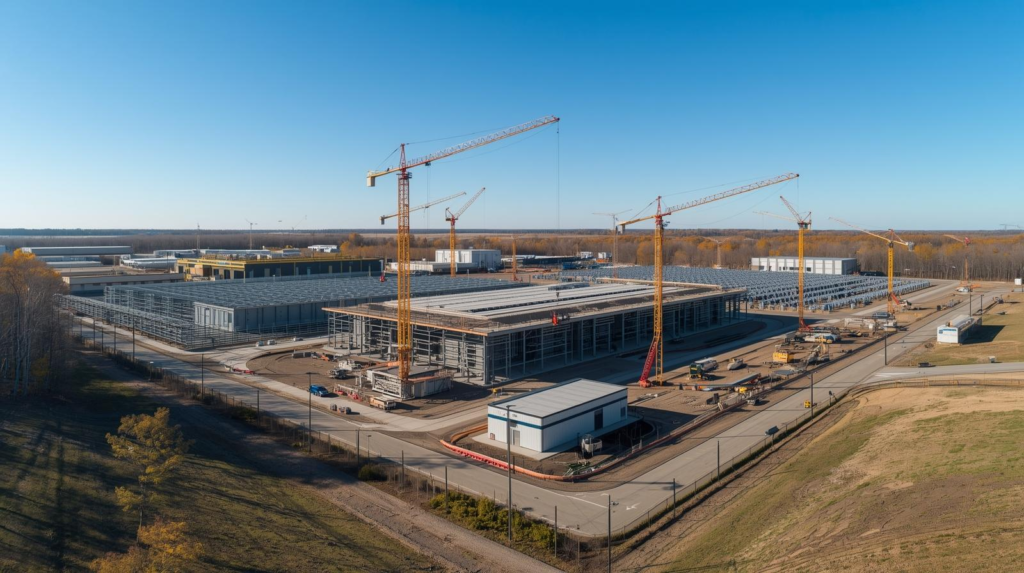
The project will provide capacity to AI customers Cerebras and CoreWeave, with the first phase expected to come online in the first half of 2027 .
2.2 The Construction Partners
Bell has assembled a notable team for the Sherwood facility:
- Bird Construction Inc. – Lead construction partner, selected as Bell’s preferred construction partner for a multi-year, Canada-wide AI data centre buildout
- Alton Tangedal Architect Ltd. (ATAL) – Architect of Record, a Regina-based firm with over 25 years of experience
- George Gordon Developments Ltd. (GGDL) – Site services, part of Bell’s Indigenous procurement participation agreement with George Gordon First Nation
- Hipperson Construction – Early-phase contractor, also Regina-based
2.3 The Long-Term Strategic Partnership
The Sherwood facility is the first project under a long-term strategic partnership between Bell and Bird Construction. Under the agreement, Bird will serve as Bell’s preferred construction partner for potential future AI data centre projects supporting Bell AI Fabric’s nationwide buildout .
As part of this partnership, Bird Construction will issue warrants to Bell, authorizing it to subscribe for up to 2,625,000 Bird Construction common shares. The warrants are exercisable at $52.00 per share, with 750,000 warrants vesting upon completion of the Sherwood facility and the remainder vesting as future AI data centre projects proceed .
Dan Rink, President of Bell AI Infrastructure and Strategy, stated: “Canada’s AI economy needs world-class digital infrastructure, and we need partners with the scale, discipline and Canadian footprint to build it on time. The team announced today gives us that foundation in Saskatchewan” .
Part 3: The Resource War – How AI Data Centers Are Reshaping Construction Labor and Materials
3.1 Labor: The “New Collar” Workforce
The AI data center boom is not just creating jobs for software engineers. It is creating a massive demand for skilled trades.
Speaking at Carnegie Mellon University’s 2026 commencement, NVIDIA CEO Jensen Huang declared: “Electricians, plumbers, iron workers, technicians, builders—this is your time. AI is not just creating a new computing industry, it is creating a new industrial era” .
The labor demand numbers tell the story:
| Trade | Demand Increase (2022-2026) |
|---|---|
| Robotics technicians | +107% |
| HVAC systems engineers | +67% |
| Industrial automation technicians | +51% |
| Construction workers | +27-30% |
| Welders | +25% |
| Electricians | +18% |
Source: Randstad analysis of 50 million global job postings
The surge is driven by the unique requirements of AI data centers. Unlike traditional commercial buildings, these facilities require:
- High-density electrical systems – power distribution at scales previously seen only in industrial plants
- Advanced liquid cooling – mechanical and plumbing expertise for closed-loop cooling systems
- Complex HVAC – managing the thermal loads of thousands of GPUs running at full capacity
- Precision structural work – accommodating heavy equipment and vibration-sensitive hardware
3.2 The Talent War: Cross-Industry Poaching
The demand for skilled trades is so intense that industries are now competing for the same workers.
Mike Mathews, Digital Infrastructure Lead at Marsh (a professional services firm), describes these roles as “new collar” work—where traditional blue-collar trades work alongside white-collar network engineers, both equally valued .
The competition is fierce. Data center developers are pulling talent from:
- Nuclear power – electrical and mechanical expertise translates directly
- Military and aerospace – precision equipment installation and commissioning
- Oil and gas – experience with large-scale industrial infrastructure
Laura Laltrello, COO of data center developer Applied Digital, told IEEE Spectrum that her company is “now looking at talent from nuclear, military, and aerospace” to fill the gap .
The compensation reflects the scarcity. Kelly Services reports that professionals entering the data center sector typically see salary increases of 25-30% . HVAC engineers have seen wages rise 10-15% over the past four years .
3.3 The Aging Workforce Problem
Compounding the shortage is demographics. According to Randstad CEO Sander van’t Noordende, approximately one-quarter of the global workforce is nearing retirement age, and the talent pipeline is not replacing them fast enough .
Unlike software developers who can work remotely, electricians and pipefitters cannot. They must be physically present on the jobsite, which limits the available labor pool to local geographies.
One AI startup founder told a Chinese news outlet: “In North America, you find the power, you find the site, you buy all the equipment—and then the construction crew tells you their schedule is 16 months, 18 months, or even more than two years out” .
3.4 Materials: Copper Leads the Surge
After nearly three years of relative stability following the pandemic-era surge, construction materials costs are heating up again—driven primarily by copper and electrical components .
Copper is the critical vulnerability. As Sam Giffin, principal product manager at Gordian, explained: “Copper is one of the few benchmark materials in which the cost borne by stakeholders in the construction industry is typically shaped by demand factors outside of it. We have continued electrification of equipment and facilities across the country, plus a huge surge in the growth of data centers and all the surrounding electrical grids. It’s bringing up a massive demand spike for copper” .
Why this matters for standard contractors:
- Copper is essential for electrical wiring, transformers, switchgear, and bus ducts
- Long lead times for copper-intensive equipment (transformers, chillers) have intensified price appreciation
- China consumes roughly half of the world’s copper supply, and new copper mines take an average of 17 years from discovery to active production
- Giffin expects copper prices to continue climbing as supply-side constraints persist
3.5 Steel, Aluminum, and the Tariff Effect
Steel and aluminum are also under pressure. While steel pricing has shown more stability—what analysts call “supply-side discipline”—prices began edging higher again in 2025 as trade frictions, energy costs, and freight rates constrained supply .
ConstructConnect Chief Economist Michael Guckes reported that data center construction spending has “surged fivefold in two years,” with year-to-date starts through November 2025 hitting $53.7 billion, up 138.6% from the same period a year earlier .
The link between data centers and metal demand runs through power infrastructure. Data centers require enormous power capacity, and where there is power infrastructure, metals play a significant role—transmission towers, cables, and transformers use steel, aluminum, and copper extensively .
ConstructConnect expects power infrastructure spending to rebound to $27.8 billion in 2026, up from $16.5 billion in 2025, adding further momentum to demand for steel, copper, and aluminum .
Part 4: The Construction Reality – Permitting, Power, and Pipeline Risk
4.1 The “Permit Illusion”
The most important concept for contractors to understand in 2026 is the gap between announced MW and buildable MW.
Sightline Climate tracks roughly 16 GW of data center capacity slated for 2026 delivery. Only about 5 GW is actively under construction. The rest is caught in what industry analysts call the “permit illusion” .
CBRE’s year-end 2025 snapshot confirms the slowdown: US primary-market capacity under construction fell 5.7% year-over-year—the first contraction since 2020. Northern Virginia dropped 29% year-on-year; Hillsboro, Oregon fell 15%; Silicon Valley fell 14% .
The primary constraints? Permitting, zoning, and power procurement delays .
4.2 The Grid is the Bottleneck
Power deliverability now determines where data center work is real. Grid connection waits are staggering:
| Market | Grid Wait Time (50 MW facility) |
|---|---|
| London | ~8 years |
| Amsterdam | ~10 years |
| Dublin | Requires on-site generation for new connections |
| US primary hubs | 4+ years, plus local moratoriums blocking $64B in projects |
Sources: JLL Research, Sightline Climate, CBRE
In Frankfurt, there are 2.8 GW of pending grid connection requests—more than the entire city’s current grid capacity .
For contractors, this means: Do not price a project based on the announcement. Verify the power commitment first.
4.3 Long-Lead Equipment: The New Critical Path
Even when power is secured, equipment delivery timelines have become a project risk in their own right:
| Equipment | Lead Time (Order to Site) |
|---|---|
| Large power transformers | 128 weeks average |
| Generator step-up units | 144 weeks average |
| Average across all categories | 33 weeks (50% above pre-2020) |
Sources: Wood Mackenzie Q2 2025 survey, JLL
A 52-week factory quote can become 74 weeks to site once submittal revisions, missed factory acceptance test slots, and logistics delays are factored in.
4.4 The Cost of Slippage
On a 60 MW facility, a one-month schedule slip costs the owner roughly $14.2 million in lost revenue . This number sharpens every conversation about float and contingency.
As the Archdesk report notes: “Price and programme to a power-ready date, not a start-on-site date. The gap between ‘announced MW’ and ‘buildable MW’ is where margin leaks” .
Part 5: What This Means for Standard Contractors
5.1 The Margin Squeeze
Contractors not building data centers are still feeling the effects.
According to ConstructConnect’s Chief Economist: “Contractors are facing a perfect storm of rising material costs, persistent wage growth, and tight labor markets. Approximately 70% of a typical project’s total expenses are increasing substantially faster than bid prices, leaving firms with little room to absorb additional shocks. This is the third major margin squeeze in a decade, and it’s forcing the industry to rethink how it manages risk and pricing” .
5.2 Shorter Bid Validity Windows
In response to metal price volatility, contractors are:
- Shortening bid validity periods
- Introducing escalation clauses
- Locking in steel and electrical purchases earlier in preconstruction
- More actively managing materials risk
5.3 The Labor Competition
Even if you are not building data centers, your electricians, welders, and HVAC technicians are being recruited. The wage differential—25-30% higher in many cases—is pulling skilled trades toward data center work .
For standard commercial and residential contractors, this means:
- Higher labor costs to retain skilled workers
- Longer lead times for electrical and mechanical subcontractors
- More difficulty finding qualified trades for smaller projects
5.4 A Strategic Opportunity
The flip side of the labor shortage is an opportunity to train and certify workers in data center-adjacent skills. Electrical workers who understand high-density power distribution, or mechanical workers familiar with liquid cooling systems, are commanding premium rates.
As Pure Data Centres CEO Gary Wojtaszek noted: “AI won’t replace any of these jobs—someone has to operate the machines. These are very important roles” .
Part 6: The Outlook – What to Expect Through 2030
6.1 Continued Growth, but Not Smooth
McKinsey estimates global AI data center capacity demand will increase approximately 3.5 times by 2030, with AI workloads accounting for about 70% of total data center demand .
However, the path will not be smooth. Sightline estimates 30–50% of the 2026 pipeline will miss schedule . The 26% of expected 2025 capacity that slipped, plus a further 10% that pushed back commercial operation dates quietly, serves as a cautionary tale .
6.2 The Grid and Permitting Constraint Will Bite
The critical question for the industry is not whether demand exists—it is whether power can be delivered fast enough. Without sufficient power infrastructure and permitting reform, the growth of data centers could face significant constraints .
Expect more projects to move toward off-grid and privately developed power solutions—on-site generation, dedicated renewable facilities, and direct connections to utility-scale solar and wind .
6.3 Diverging Markets
The market is now split between places that can energize new load inside 24-48 months and places that cannot get a firm grid date at any price . Contractors should pay close attention to which markets are buildable—not just which markets have announced projects.
6.4 Equipment Lead Times Will Remain Elevated
Wood Mackenzie’s survey suggests transformer and switchgear lead times are unlikely to return to pre-2020 levels in the near term. The supply chain for large electrical equipment simply cannot scale fast enough to meet data center demand .
Conclusion: The Buildout That Changes Everything
The AI data center boom is not a niche story for technology journalists. It is a fundamental restructuring of construction economics that every contractor—whether building data centers or not—must understand.
The Bell AI Fabric 300 MW facility in Saskatchewan is one project among thousands. But it represents a pattern: massive scale, tight timelines, intense competition for skilled labor, and relentless pressure on electrical and mechanical supply chains.
For contractors who can navigate these challenges—who can secure labor, manage long-lead procurement, and deliver on aggressive schedules—the opportunity is unprecedented.
For those who cannot, the margin squeeze will only intensify.
As Jensen Huang said: “This is the largest technology infrastructure buildout in human history and a once-in-a-generation opportunity to reindustrialize” . Whether you are building the data centers themselves or just competing for the same resources, this buildout will define construction economics for the rest of the decade.
Frequently Asked Questions (FAQ)
How big is the Bell AI Fabric Saskatchewan data centre?
The facility is a 300 MW data centre in the Rural Municipality of Sherwood, Saskatchewan, with first phase expected online in the first half of 2027 .
Who is building it?
Bird Construction Inc. is the lead construction partner, with Alton Tangedal Architect Ltd. as Architect of Record and George Gordon Developments Ltd. providing site services .
Why is copper so important to data center construction?
Copper is essential for electrical wiring, transformers, switchgear, and bus ducts. Data centers and the power infrastructure supporting them consume enormous quantities of copper, driving up prices .
How much are skilled trades wages rising due to data center demand?
HVAC engineers have seen 10-15% wage increases over four years, and professionals entering data center construction can expect 25-30% salary increases .
What is the biggest risk to data center construction timelines?
Power deliverability and long-lead equipment. Grid connection waits exceed 8 years in London and 10 years in Amsterdam. Large power transformers average 128 weeks from order to delivery .
Are data center construction costs still rising?
Yes. Shell and core costs have risen from $7.7 million per MW in 2020 to $11.3 million in 2026. AI-optimized facilities exceed $20 million per MW, and full GPU fit-out can reach $30-40 million per MW .
Call to Action (CTA)
Are you feeling the pressure of the AI data center boom on your projects—whether through material costs, labor shortages, or competition for skilled trades? Share your experience in the comments below. And if you found this analysis valuable, share it with a colleague navigating these turbulent markets.