The AI Factory Boom: Why NVIDIA is the New Giant of Heavy Construction
The AI Factory Boom: Why NVIDIA is the New Giant of Heavy Construction There is a new force reshaping the American industrial landscape, and it doesn’t operate bulldozers or pour concrete. It designs chips.
NVIDIA, the $2 trillion semiconductor giant best known for powering the generative AI revolution, has quietly become one of the most influential players in heavy construction. Through a blitz of partnerships, direct investments, and massive infrastructure deals, the company is not just supplying the brains of the AI era—it is actively building the body.
From fiber optic factories in North Carolina to supercomputing hubs in Taiwan and a new headquarters in Taipei, CEO Jensen Huang is executing a strategy that turns “AI factories” into physical assets. This is the story of how a chip designer became a construction mogul.
1. The Corning Commitment: Building the Fiber Backbone
The most concrete evidence of this shift arrived on May 7, 2026. NVIDIA announced a multi-year, multi-billion dollar partnership with Corning, the century-old glass and ceramics giant, to dramatically expand U.S. manufacturing of optical connectivity solutions .
Under the terms of the deal, Corning will build three new advanced manufacturing facilities in North Carolina and Texas . The scale of the expansion is staggering: it will increase Corning’s U.S. optical connectivity capacity by a factor of ten and boost domestic fiber production by more than 50% . This expansion is expected to create more than 3,000 new high-paying American jobs .
For NVIDIA, this isn’t charity or venture capital—it is survival. Modern AI workloads require clusters of tens of thousands of GPUs. Moving data between these chips at the speed of light requires “unprecedented volumes” of high-performance optical fiber . As the AI factories scale, copper wiring becomes a bottleneck. NVIDIA is paying billions of dollars upfront not just to buy glass, but to secure the supply chain and ensure the factories exist .
“This is the single largest infrastructure buildout in human history,” Huang told CNBC, framing the partnership as a chance to “revitalize American manufacturing for the first time in several generations” .
The Domino Effect: A $700 Billion Market
NVIDIA’s push is happening against a backdrop of explosive capital expenditure. In February 2026, Huang predicted that spending on AI data centers would exceed the $700 billion that hyperscalers (Amazon, Google, Microsoft) budgeted for the year . He argues that the shift from “classical computing” to accelerated computing requires a 1,000-fold increase in computation, forcing the world to rebuild its digital infrastructure from the ground up .
For traditional construction firms, this is a gold rush. Contractors like Turner Construction (owned by Spain’s ACS Group) reported 19.7% revenue growth driven almost entirely by data center projects . The AI boom is directly funding the heavy lifting of the construction sector.
2. The AI Super Factory: Foxconn and Texas
Beyond fiber, NVIDIA is reshaping the hardware assembly line.
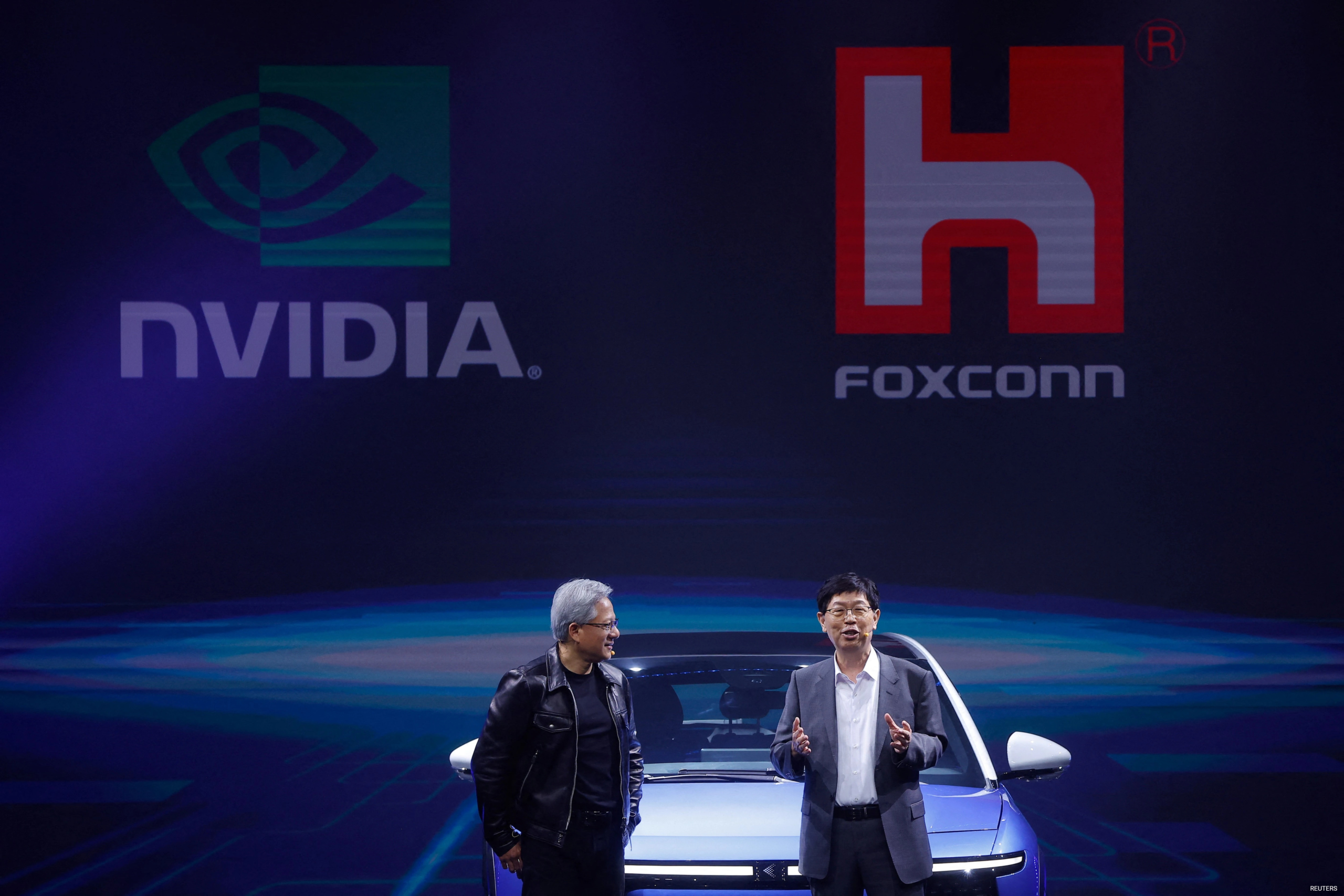
In 2024, Foxconn (the iPhone assembler) announced plans to build an advanced computing center in Kaohsiung, Taiwan, using NVIDIA’s next-generation Blackwell GB200 servers . The facility will house 4,608 GPUs across 64 racks and is slated for completion in 2026 . This isn’t just a data center; it is a manufacturing partner integrating NVIDIA’s Omniverse digital twin platform to build AI-powered robotics .
Furthermore, reports of a “Superchip factory” for NVIDIA suggest the buildout of the world’s largest Nvidia GB200 chip manufacturing facility to meet surging demand for the Blackwell platform .
3. The Physical Footprint: Taipei and Beyond
The construction boom extends to NVIDIA’s own corporate real estate. In February 2026, NVIDIA finalized a deal with the Taipei City Government to acquire a 50-year leasehold on a plot of land in the Beitou Shilin Technology Park (北士科) .
The company plans to invest over NT$40 billion (approx. $1.2 billion USD) to build its new headquarters in Taiwan . The facility is expected to create more than 10,000 job opportunities and is slated to break ground in mid-2026, with Taipei Mayor Chiang Wan-an expressing hope that Jensen Huang himself will attend the groundbreaking ceremony during the Computex tech expo in June .
4. The Engineering Paradigm: Liquid Cooling and Power
Building an “AI Factory” is fundamentally different from building a traditional data center. These facilities consume massive amounts of energy and generate unprecedented heat.
According to industry research from TrendForce, the rapid scaling of AI factories is forcing a complete overhaul of power and cooling infrastructure . Independent power racks are being introduced to stabilize delivery, while the long-term roadmap points to centralized High-Voltage Direct Current (HVDC) grids.
Most importantly, liquid cooling is shifting from optional to essential. Next-gen AI architectures are fully adopting direct-to-chip liquid cooling to manage thermal loads . This means the construction of these sites now requires specialized plumbing and thermal engineering that was irrelevant in the server rooms of the past decade. For heavy construction, this is a new, highly specialized vertical.
Conclusion
NVIDIA is no longer just a technology company. It is a prime mover in the industrial economy.
By guaranteeing billions to glass makers like Corning and coordinating with giants like Foxconn, NVIDIA is using its balance sheet to de-risk the supply chain for the AI era. Jensen Huang is treating AI infrastructure like a utility—something so fundamental that it requires an entirely new physical plant, from fiber factories in North Carolina to liquid-cooled racks in Texas.
The “AI Factory Boom” is not coming. It is already pouring concrete.
Frequently Asked Questions (FAQ)
Q: Why is NVIDIA building factories if it only designs chips?
NVIDIA’s primary business is chip design, but the scale of AI demand requires it to secure the entire manufacturing chain. By partnering with Corning, Foxconn, and others, NVIDIA ensures it has enough fiber optics, server racks, and assembly capacity to deliver its systems to customers like Microsoft and Google .
Q: How many jobs is the AI construction boom creating?
Significantly. The Corning partnership alone is creating 3,000 direct manufacturing jobs, while Jensen Huang notes that every one manufacturing job creates roughly six support jobs . Additionally, NVIDIA’s new Taiwan headquarters is expected to support over 10,000 roles .
Q: What is an “AI Factory”?
An AI Factory is a next-generation data center designed specifically to handle generative AI training and inference. Unlike traditional data centers, they require massive GPU clusters, high-speed optical networking, and advanced liquid cooling systems . They are the physical infrastructure designed to “produce” intelligence.
Q: Where are the new Corning factories being built?
The three new advanced manufacturing facilities will be located in North Carolina and Texas .
Q: How much is being spent on AI infrastructure?
NVIDIA’s CEO predicts that capital expenditure on AI data centers will surpass the $700 billion budgeted by hyperscalers in 2026, signaling a multi-trillion dollar buildout over the coming decade .