From Foundations to Fusion: The Race to Scale the Kursk 2 Nuclear Plant
From Foundations to Fusion: The Race to Scale the Kursk 2 Nuclear Plant On the banks of the Seym River, just 60 kilometers from the Ukrainian border, a new era in Russian energy is taking shape. The Kursk II Nuclear Power Plant—a $900 million-plus engineering saga—is no longer a blueprint or a promise. After nearly a decade of construction, the first of four next-generation reactors has entered commercial operation, while its sibling units race to catch up .
This is the story of that race: a narrative of concrete poured ahead of schedule, of “information blackouts” shrouding a sensitive military frontier, and of a nation’s urgent bid to replace the aging legacy of Chernobyl-era technology with the most powerful reactors in its fleet .
Here is the current state of play at one of the world’s most strategically vital—and secretive—construction sites.
1. The Handover: Unit 1 Enters Commercial Life
Just two weeks ago, on April 27, 2026, the state nuclear corporation Rosatom signed the documents officially bringing the first unit of Kursk II into industrial operation . It was a moment eight years in the making.
The timeline leading to this handover was a masterclass in incremental pressure. First came first criticality in May 2025, followed by synchronization with the national grid on New Year’s Eve 2025 . Throughout the early months of 2026, engineers at the VVER-TOI reactor methodically ramped up the heat and pressure, climbing from 40% to 100% capacity.
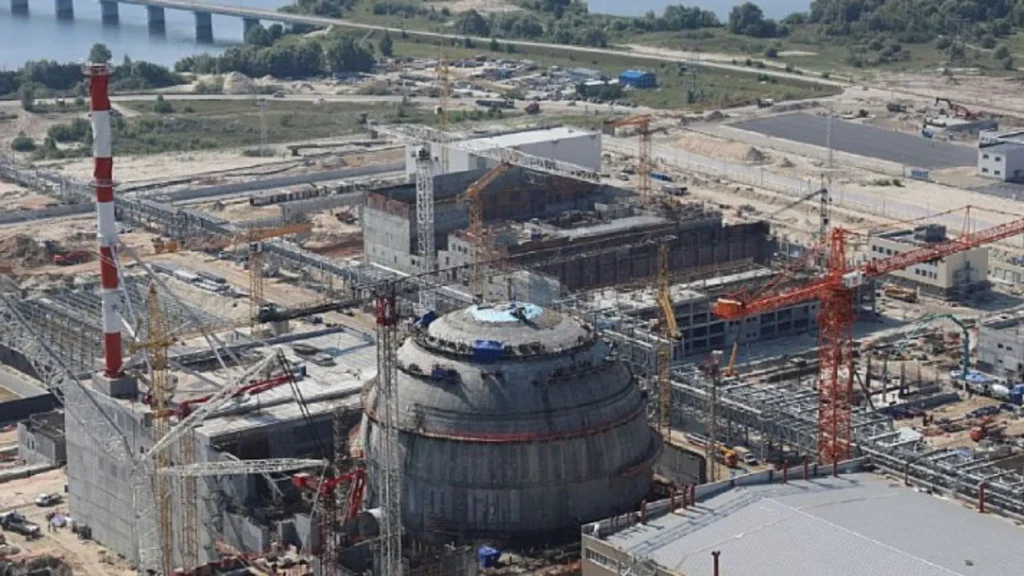
“The safety and stability of any facility, especially one as complex as a nuclear power plant, depends on its foundation,” said Alexander Uvakin, the plant’s director, reflecting on the milestone . Unit 1 has already generated over 1.6 billion kilowatt-hours of electricity . But this is just the beginning. This reactor is the pilot for the VVER-TOI design—a “standard optimised informatised” water-cooled reactor that Rosatom hopes to export globally.
2. The Engine: Why the VVER-TOI is a “Megawatt Monster”
To understand the rush to finish Units 2, 3, and 4, one must look at what is actually sitting inside Unit 1.
The VVER-TOI is the latest evolution of Russian pressurized water reactor technology. It represents a significant leap over the older VVER-1000 models. Compared to its predecessors, this new machine offers a 25% increase in capacity , pushing out 1,250 MW (net) per unit .
“The first block is our gift to the Motherland for May Day,” Rosatom chief Alexei Likhachev said at the commissioning ceremony, emphasizing that this is the “most powerful and largest in terms of unit capacity” in the country . The service life of the main equipment has doubled, designed to run for 60 years with the potential for a 20-year extension . It is a balance of power and longevity, built to withstand physical challenges it was not necessarily designed for when the blueprints were first drawn.
3. The Scale-Up: Pouring the Future at Unit 3
While Unit 1 is live and Unit 2 is advancing through equipment installation, the most visible action on the ground right now is at Unit 3.
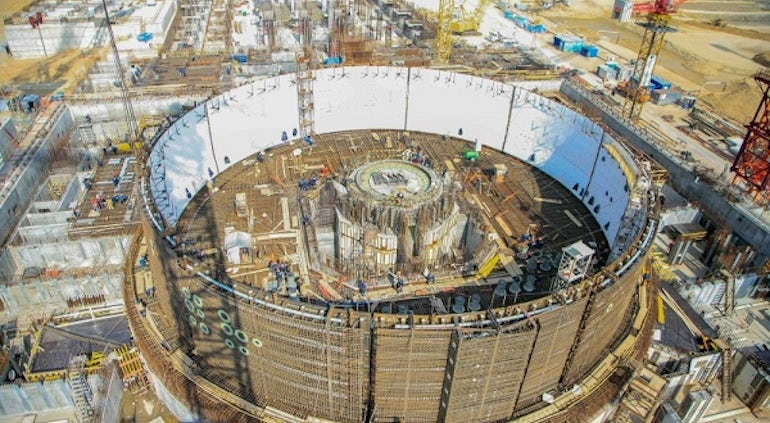
In a significant logistical feat, Rosatom announced last week that workers have finished pouring the massive foundation slab for the third reactor . This is the bedrock upon which the entire structure sits. The slab measures a staggering 5,400 square meters . For four months, about 200 specialized workers engaged in a continuous, multi-layered quality control process to ensure the concrete would set perfectly .
But the story of this foundation is far more intriguing—and secretive—than the press releases suggest.
4. The “Weird Data” and the December Secret
If you read the International Atomic Energy Agency’s (IAEA) official database, it lists the “first concrete” date for Unit 3 as January 31, 2026 . However, investigative reports and photographic evidence suggest the real date was much earlier.
Following Russia’s invasion of Ukraine, Kursk became a front-line region. The plant is now the closest nuclear facility to active combat, located roughly 37 miles from the border . Consequently, Rosatom has instituted a strict “information blackout” regarding construction milestones .
Investigative journalism has pieced together a different timeline. The official Telegram channel of the Kursk region governor posted a “historic” photo of a ceremonial helmet reading “First Concrete” . Weather analysis of the photos (showing breath in cold air but no snow cover) and the governor’s partially written date on the helmet suggest the ceremony likely occurred on December 24, 2025 —a full month before the IAEA was officially notified . This “weird data” reveals a deliberate strategy by Rosatom to obscure the pace of expansion on the western frontier, keeping the physical start of Units 3 and 4 out of the headlines as long as possible .
5. The Roadmap: Replacing the RBMK Legacy
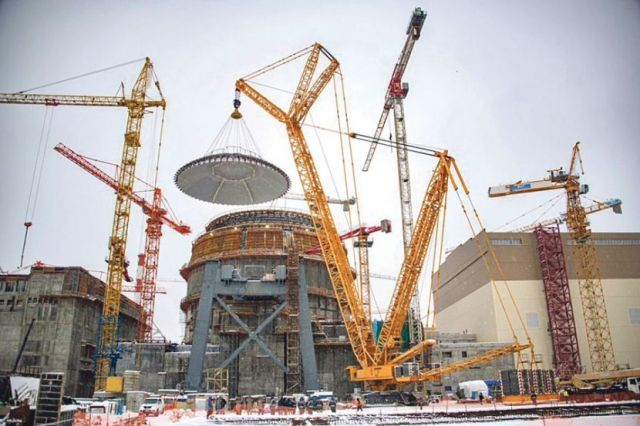
With the foundation set, the project moves into its next phase. At Unit 3, specialists have moved from concreting to the installation of reinforced walls for the main power unit building . The race is now on to get this unit enclosed before the harsh winter returns.
The ultimate goal is the complete retirement of the old station next door. The original Kursk plant utilizes RBMK-1000 reactors—the same design as the Chernobyl plant . Unit 1 of the old plant was shut down in 2021, and Unit 2 followed in 2024 . By the time all four new VVER-TOI units are humming—targeted for completion by 2034 —the twilight of the RBMK era in western Russia will be complete.
Conclusion
The Kursk II plant is a study in contradictions. On one hand, it is a state-of-the-art engineering triumph, showcasing Russia’s ability to deploy Generation III+ reactors on a compressed timeline. On the other, it is a fortress under a communications lockdown, building a future of clean energy while the ground around it trembles with the uncertainty of war.
With Unit 1 now paying back its energy debt to the grid and Unit 3 rising from its massive foundation, the race to scale Kursk II has entered its most critical lap. The foundations are laid; now the fusion of power must follow.
Frequently Asked Questions (FAQ)
Q: What type of reactor is used at Kursk II?
A: The plant features the VVER-TOI (Vodo-Vodyanoi Energetichesky Reactor – Typical Optimized Informational). It is a Generation III+ pressurized water reactor (PWR) with a capacity of 1,250 MW .
Q: How far is Kursk II from the Ukrainian border?
A: The plant is located approximately 60 kilometers (37.5 miles) from the Ukraine border, making it the closest Russian nuclear plant to the current conflict zone .
Q: When will Units 3 and 4 be finished?
A: Rosatom has stated its target for all four units to be in operation is 2034 . The pouring of the concrete foundation for Unit 3 was completed in early May 2026 .
Q: Why is there confusion regarding the start date of Unit 3?
A: Due to security concerns related to its proximity to the front lines, Rosatom has implemented an information blackout. Official data submitted to the IAEA (January 31, 2026) contradicts photographic evidence and weather reports pointing to a ceremony held in December 2025 .