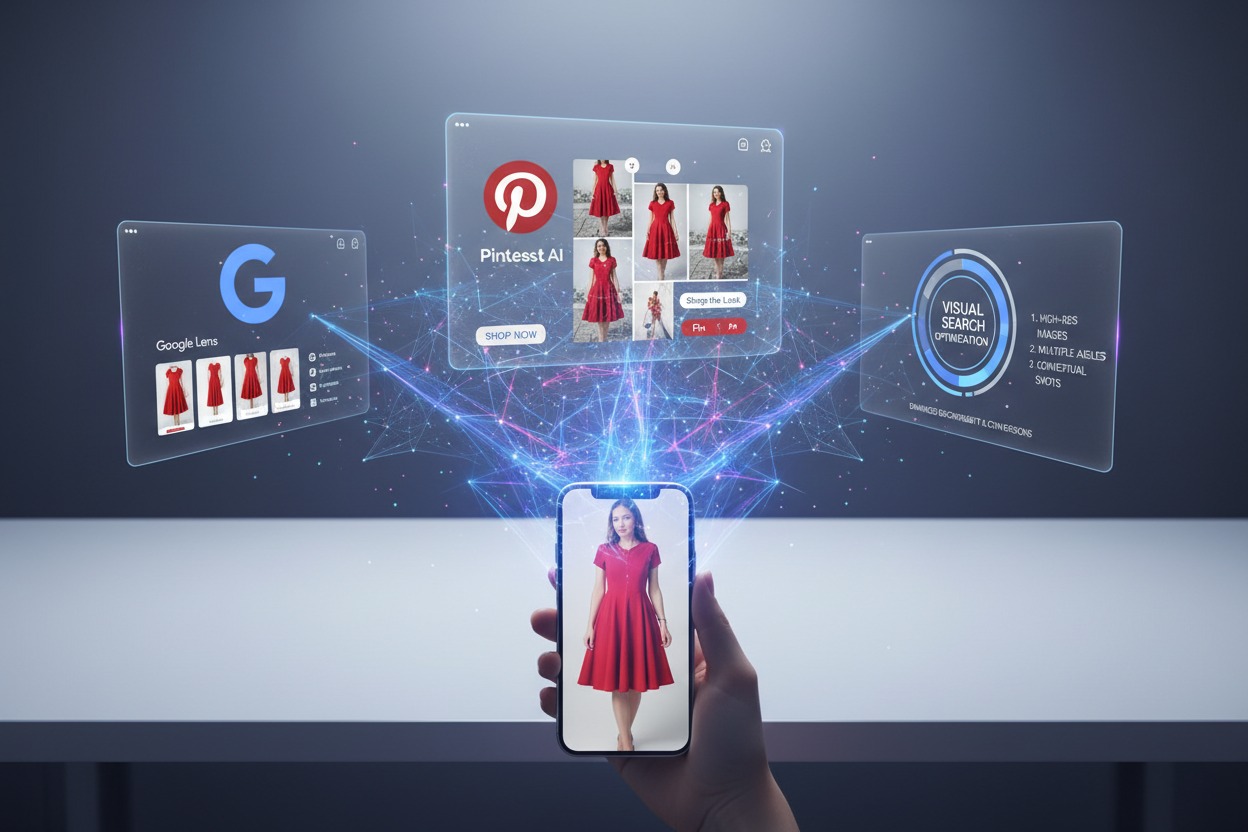
Visual Search Evolution: Optimizing Your Brand for Google Lens and Pinterest AI
Visual Search Evolution: Optimizing Your Brand for Google Lens and Pinterest AI, The way consumers search has fundamentally changed. Instead of typing keywords into a search bar, millions of users now point their smartphone cameras at products, landmarks, and objects to find what they’re looking for instantly. This shift from text-based to visual search represents one of the most significant changes in consumer behavior since the rise of mobile search itself .
In 2026, visual search is no longer a novelty—it’s a necessity. Google Lens alone now processes billions of visual searches monthly, while Pinterest reports that visual searches have increased by over 300% year-over-year . For brands that fail to optimize for this new reality, the cost is invisible: your products simply won’t be found when customers go looking.
This guide covers everything you need to know about visual search optimization for the two dominant platforms—Google Lens and Pinterest AI—with actionable strategies, technical requirements, and emerging trends that will shape the future of discovery.
Why Visual Search Matters Now
Visual search adoption is accelerating faster in mobile-first markets, but the trend is global and undeniable. Several converging forces explain why:
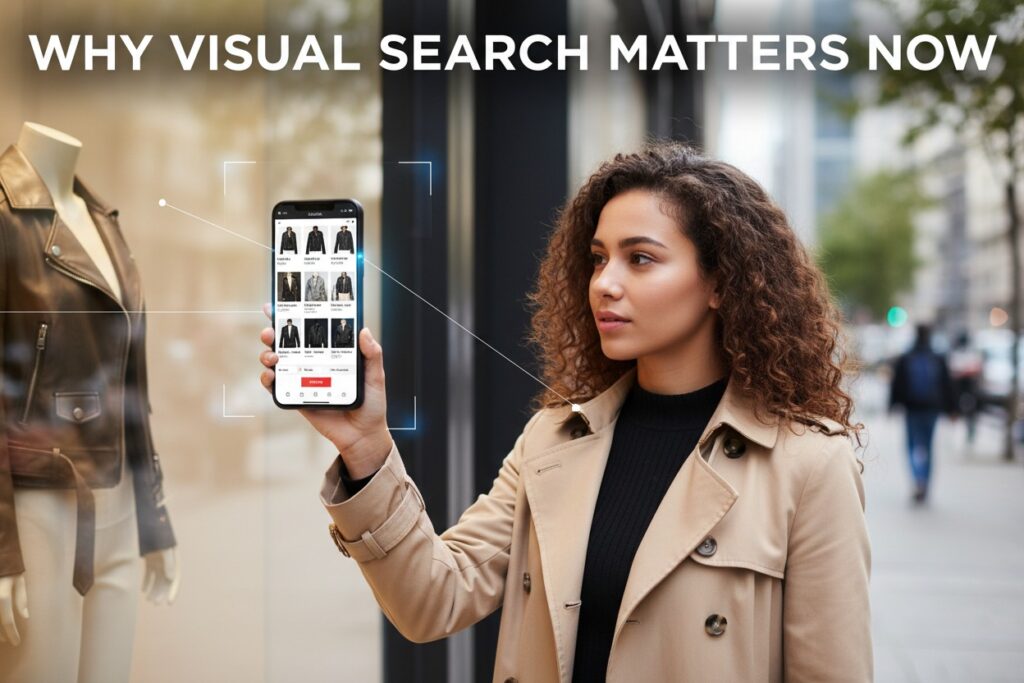
Mobile-First Behavior: Consumers across all demographics prefer visual over text searches when using mobile devices. Pointing a camera is faster, more intuitive, and eliminates typing errors.
Language Barriers Eliminated: Visual search transcends language, making it particularly powerful in multilingual markets where consumers may struggle to find the right text query .
Higher Purchase Intent: Visitors arriving through visual search convert at rates 30-40% higher than traditional search traffic. Why? Because visual search captures high-intent users who know exactly what they want .
The Zero-Click Challenge: Traditional search is increasingly plagued by “zero-click” results where AI Overviews answer questions directly, eliminating clicks to publisher sites. Visual search operates differently—discovery leads naturally to action rather than providing direct answers that end the journey .
As Kate Hamill, VP of North America enterprise sales at Pinterest, explains: “Social search plays a critical role in demand creation, not just demand capture. Visual search helps brands engage consumers before preferences are fully formed” .
Google Lens: The Broadest Visual Search Platform
What Is Google Lens?
Launched in 2017, Google Lens is a visual search tool powered by artificial intelligence that allows users to “search what they see.” Users can upload a photo or use their camera to identify objects, translate text, and find products instantly .
Today, Google Lens has evolved into a powerful assistant with three main capabilities:
| Capability | What It Does |
|---|---|
| Shopping | Connects to Google’s Shopping Graph (containing over 45 billion listings) so users can find and buy items just by taking a picture |
| Local Discovery | Uses AR to recognize storefronts, displaying business hours and reviews as users walk past |
| Smart Answers | Works with AI Overviews and video search—users can film moving objects or ask complex questions about images |
How Google Lens Ranks Images
Google Lens builds relevance differently than classic image search. Instead of pixel-to-pixel matching, the system extracts features and converts them into visual embeddings—vectors that describe the meaning of an image .
Four groups of signals affect ranking:
- The image itself and its quality (resolution, clarity, subject focus)
- Surrounding text (headlines, captions, content around the image)
- Structured data and metadata (schema.org, ImageObject)
- User signals (clicks, dwell time, saves)
A strong “image + context” pairing increases the likelihood of appearing in visual snippets and helps Google Lens determine product category, brand, model, and variation with confidence .
Optimization Strategies for Google Lens
1. Optimize Product Images
Your images are the foundation. Google Lens needs high-quality visuals to recognize and match your products .
Requirements:
- High resolution: Use well-lit images that clearly showcase products
- Multiple angles: Upload several images from different perspectives so Lens understands what the product looks like from every side
- Clean background: The subject should occupy at least 60% of the frame
- Consistent composition: Similar framing across product variants helps recognition
2. Implement Structured Data
Schema markup provides Google with explicit information about your images and products .
Essential schema elements:
Productschema with name, description, brand, SKU, GTINImageObjectschema with contentUrl, caption, license, creatorOfferschema with price, priceCurrency, availability
Example JSON-LD structure for a product card:
{
  "@context": "https://schema.org",
  "@type": "Product",
  "name": "Product Name",
  "brand": "Brand Name",
  "sku": "ABC123",
  "image": {
    "@type": "ImageObject",
    "contentUrl": "https://example.com/image.jpg",
    "caption": "Product Name in Color/Finish",
    "license": "https://example.com/license"
  },
  "offers": {
    "@type": "Offer",
    "price": "99.99",
    "priceCurrency": "USD",
    "availability": "https://schema.org/InStock"
  }
}
3. Optimize Alt Text and File Names
Search engines can’t “see” images the way humans do. They rely on alt text and filenames to understand content .
Alt text best practices:
- Use structure: “product type + brand + model/color + key feature”
- Length: 8-16 words (descriptive but not verbose)
- No keyword stuffing—write for humans first
File naming:
- Use descriptive filenames with hyphens:
nike-air-max-2026-white.jpg - Never use default camera names like
IMG_4927.jpg
4. Focus on Local SEO
Google Lens is heavily used for local discovery—users point their cameras at storefronts to find business hours, reviews, and directions .
Local optimization steps:
- Optimize your Google Business Profile with accurate hours, contact details, and location
- Upload high-quality photos of your storefront and interior
- Use a clear, unique logo on digital and physical assets
- Ensure your business appears in Google Shopping with up-to-date product data
5. Technical Image Optimization
Page speed directly impacts visual search visibility .
Technical requirements:
- Formats: Prioritize WebP and AVIF (up to 34% smaller than JPEG with comparable quality)
- Responsive images: Use
srcsetandsizesattributes to serve appropriately sized images by device - Lazy loading: Enable for off-screen images
- Preload: Preload LCP (Largest Contentful Paint) images
- CDN: Use a CDN with thoughtful cache-control headers
6. Create Image Sitemaps
Help Google find and index your images faster .
Best practices:
- Add an image sitemap listing up to 1,000 images per URL
- Grant access to
/images/folders inrobots.txt - Use
Last-ModifiedandETagheaders for efficient crawling - Regularly ping sitemaps during mass upload periods
Leveraging Google Lens Shopping
Google Lens connects directly to Google’s Shopping Graph. To appear in shopping results :
- Ensure all products appear in Google Shopping
- Keep product information current (availability, pricing, reviews)
- Use Google Performance Max campaigns to reach visual search users
- Run visual-centric ad campaigns that appeal to image-based queries
Pinterest AI: The Discovery Engine for Product Brands
How Pinterest Is Different
Pinterest operates differently from Google because users arrive with a discovery mindset rather than specific search intent. They’re exploring ideas, gathering inspiration, and planning future purchases—not executing immediate transactions .
This behavioral difference is critical. As the #paid and Pinterest partnership announcement explains: “People don’t come to Pinterest to be interrupted, they come to decide” .
Key Pinterest statistics for 2026:
- 96% unbranded search rate—users explore categories without brand preference, creating massive opportunities for discovery
- 40% more likely to love shopping than non-Pinterest users
- 75% more likely to say they’re always shopping
- 45% more affiliate traffic from mobile than desktop
Pinterest Lens: Visual Search for Inspiration
Pinterest Lens allows users to identify objects within Pins and discover similar products and ideas. When a user finds inspiration in an image—whether it’s a kitchen renovation, outfit, or recipe—they can instantly identify and purchase the specific items through affiliate links and Product Pins .
The platform’s AI-powered visual search eliminates friction that exists in traditional affiliate flows, where consumers must translate written descriptions into visual products. With Pinterest Lens, what you see is what you can buy.
Optimization Strategies for Pinterest AI
1. Create Pin-Worthy Images
Pinterest’s algorithm favors specific image characteristics :
| Requirement | Specification |
|---|---|
| Aspect ratio | 2:3 vertical (1000×1500 pixels optimal) |
| Quality | Bright, colorful, visually distinctive |
| Style | Lifestyle imagery (shows products in aspirational contexts) |
| Text overlays | Perform exceptionally well (e.g., “10 Ways to Style…”) |
Unlike Google Lens, Pinterest Lens responds well to lifestyle imagery because users are seeking inspiration, not just product identification.
2. Implement Rich Pins and Product Catalogs
Rich Pins automatically sync information from your website to your Pins, ensuring prices, availability, and descriptions remain current .
For e-commerce brands, Product Rich Pins are essential:
- Display real-time pricing and stock status
- Transform Pinterest from inspiration platform to shopping destination
- Enable automatic Pin creation from your product catalog
Uploading your complete product catalog to Pinterest means your items can surface in visual searches even without manually creating Pins for each product—critical scalability for brands with extensive product lines.
3. Leverage Pinterest’s Shopping Features
Pinterest has evolved into a significant commerce platform :
- Shopping Ads allow verified merchants to promote products in visual search results
- Product Pins deliver 15% higher return on ad spend and 2.6x higher conversion rates than standard pins
- Idea Ads blend creator content seamlessly into the discovery experience
4. Partner with Pinterest Creators
In March 2026, #paid announced a strategic partnership with Pinterest to power creator-led commerce . Through this partnership, brands can activate creators across key verticals (beauty, fashion, food, home, lifestyle) to produce platform-native content.
Why creator partnerships matter:
- Creators function as trusted experts and guides, not just influencers
- Users are 40% more likely to say they love shopping—creator content taps into this mindset
- Idea Ads with paid partnership blend expertise, inspiration, and utility
5. Use Pinterest Predicts for Trend Intelligence
Pinterest Predicts has achieved 80% accuracy in forecasting emerging trends, providing actionable intelligence about consumer interest before mainstream adoption .
2026 trend signals include:
- “Cool Blue” aesthetics
- “Opera Aesthetic” luxury positioning
- “Afrobohemian” home decor
This predictive edge allows brands to position products ahead of demand curves rather than reacting to established trends.
6. Think Long-Term
Unlike algorithm-dependent social feeds, Pinterest rewards long-term thinking. Pins from months or years past can suddenly gain traction when matching trending searches. The platform’s absence of chronological feed ordering means quality content maintains relevance indefinitely .
The AI Shopping Agent Revolution
Beyond traditional visual search, a more profound shift is underway: AI shopping agents are becoming the gatekeepers between brands and consumers .
The Rise of Agentic Commerce
Botify data shows AI bot traffic to retail sites increased 5.4x in 2025, while consumer adoption continues to rise—73% now use AI assistants and 38% already use them for shopping tasks .
AI agents don’t discover products the way search engines do. They evaluate your web content and structured data to make decisions. As Joe Doran, Chief Product Officer at Botify, explains: “AI agents don’t discover products the way search engines do; they evaluate your web content and structured data to make decisions” .
New Protocols for AI Shopping
Major platforms are introducing new protocols for agent-driven shopping:
| Protocol | Provider | Purpose |
|---|---|---|
| Agentic Commerce Protocol (ACP) | OpenAI | Standard for AI shopping agents |
| Universal Commerce Protocol (UCP) | Unified commerce data standard |
Legacy product feeds lack the depth and adaptability required by these emerging protocols. Even high-quality products may be underrepresented or excluded from AI-driven recommendations, costing brands revenue and ceding competitive advantage to those better optimized for AI search .
Preparing for Agentic Commerce
To remain visible as AI agents become the primary discovery mechanism :
1. Enrich product feeds with contextual data
- Reviews, Q&As, specifications, and usage information
- AI agents need more than basic SKU and price data
2. Implement structured data at scale
- Schema markup helps AI agents understand your products
- Treat structured data as foundational infrastructure
3. Monitor AI visibility
- Track how your brand appears across AI systems (Google AI Overviews, Gemini, etc.)
- Measure presence in agent-driven recommendations
Measurement and Attribution
The Attribution Challenge
Visual search and AI-driven discovery create measurement challenges. When consumers use ChatGPT, Perplexity, or Google’s AI Overviews to research products, the influence driving their eventual purchase occurs before any trackable click happens .
Traditional affiliate tracking systems, built on the assumption that influence requires a click, simply cannot see this upper-funnel activity.
Modern Measurement Approaches
Kate Hamill from Pinterest emphasizes that “modern measurement approaches—including MMM (Media Mix Modeling), MTA (Multi-Touch Attribution), and incrementality—matter more than last-click attribution as consumers shop across weeks and devices” .
Recommended measurement stack:
- Incrementality testing: Measure the true lift from visual search channels
- Triangulated measurement: Combine multiple attribution models for complete picture
- Platform-specific tracking: Use Pinterest Tag and Conversions API for accurate attribution
Key Metrics to Track
| Metric | Why It Matters |
|---|---|
| Image impression share | How often your images appear in visual search results |
| Visual search CTR | Click-through rate from image results |
| Conversion rate (visual search) | 30-40% higher than text search—track separately |
| Save rate (Pinterest) | Saves indicate long-term intent and future conversion potential |
| AI visibility score | How often your products appear in AI agent recommendations |
Implementation Roadmap
Immediate Steps (30 Days)
- Audit your current images across all platforms. Identify low-quality images, missing alt text, and poor file naming .
- Optimize alt text for your 50 most important product images using the structure: “product type + brand + model/color + key feature.”
- Implement basic schema markup (Product + ImageObject) for key product pages.
- Claim and optimize your Google Business Profile with high-quality photos and accurate information.
- Install Pinterest Tag and Conversions API for accurate tracking.
Short-Term (60 Days)
- Convert key images to WebP or AVIF format to improve page speed.
- Create an image sitemap and submit to Google Search Console.
- Upload your product catalog to Pinterest and enable Rich Pins.
- Recruit 3-5 Pinterest creators through #paid or direct outreach to test creator-led campaigns .
- Enable responsive images with
srcsetandsizesattributes.
Long-Term (90+ Days)
- Implement AI-ready product feeds compatible with emerging protocols (ACP/UCP) .
- Develop Pinterest Predicts-aligned content based on trend forecasts for your category .
- Scale visual search optimization across your entire catalog (500+ products).
- Implement incrementality testing to measure true impact of visual search channels.
- Monitor AI visibility dashboards (Botify AI Visibility, Google Search Console) to track presence across AI systems .
The Bottom Line
Visual search has evolved from a novelty to a fundamental channel for consumer discovery. Google Lens processes billions of searches monthly. Pinterest Lens drives discovery for high-intent shoppers. And emerging AI agents are becoming the new gatekeepers between brands and consumers.
The brands that win in 2026 and beyond will be those that treat visual content as a strategic asset—not an afterthought. They’ll optimize images with care, implement structured data at scale, and prepare for an agentic commerce future where AI systems evaluate product data to make purchasing recommendations.
As one industry observer noted, “The window for strategic positioning remains open but is narrowing. The question facing brands is not whether visual platforms matter but whether they will establish presence proactively or reactively” .
Start now. Audit your images. Implement schema. Optimize for Google Lens. Activate Pinterest creators. The tools are available. The audience is searching visually. The only question is whether they’ll find you.