The Impact of AI on the Global Job Market: Skills You Need to Stay Relevant
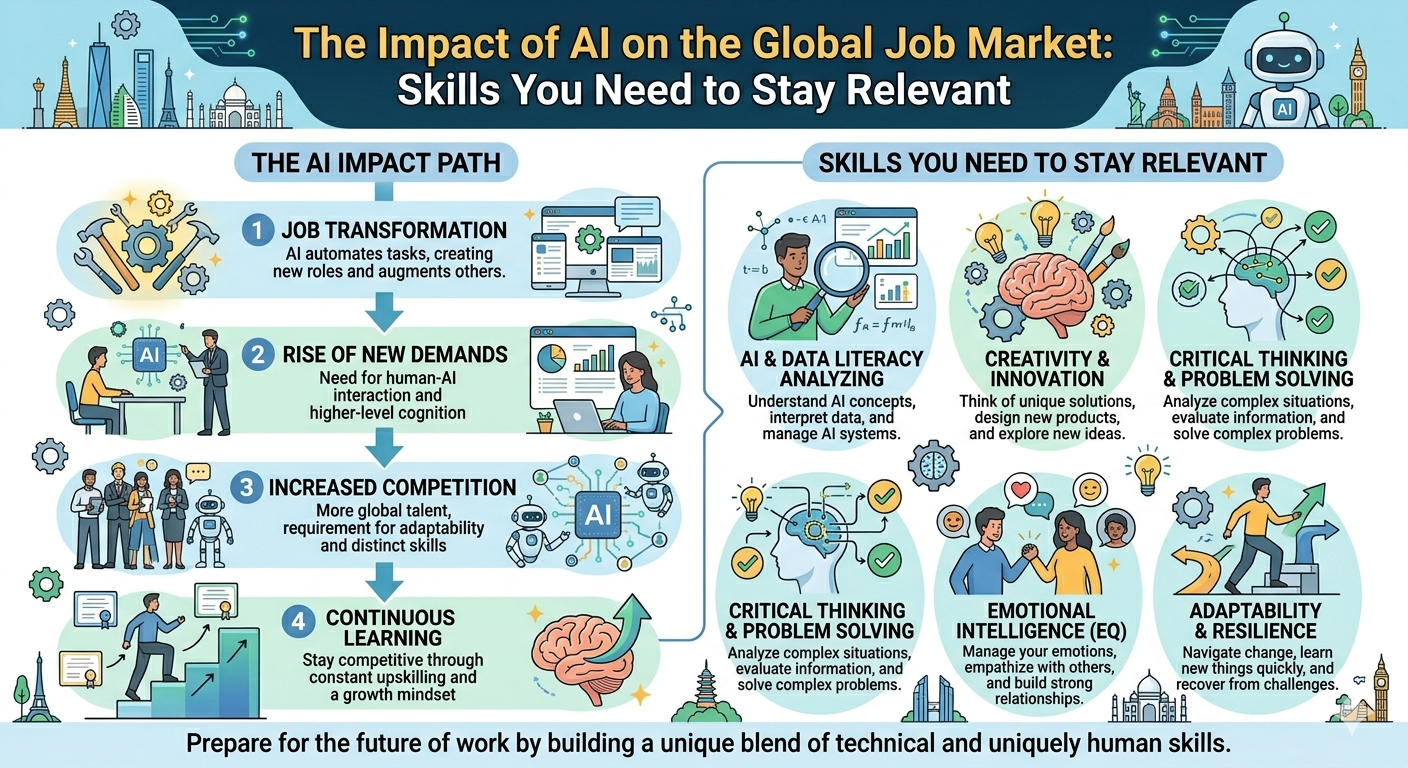
The Impact of AI on the Global Job Market: Skills You Need to Stay Relevant in 2026, The conversation around artificial intelligence and employment has shifted dramatically. In 2023, the dominant narrative was fear—headlines screamed about mass unemployment and the obsolescence of human workers. By 2026, the discourse has matured into something more nuanced: AI is not replacing jobs wholesale, but it is fundamentally reshaping them.
According to the World Economic Forum’s Future of Jobs Report 2025, 23% of jobs will be disrupted in the next five years—a figure that sounds alarming until you examine the underlying data. For every job displaced by automation, new roles emerge. The net effect is not mass unemployment but mass transformation.
The critical question is no longer “Will AI take my job?” but rather “How do I adapt to work alongside AI?” This guide explores the evolving landscape of work in 2026, identifies the skills that matter most, and provides a roadmap for professionals across industries to stay relevant in an AI-augmented world.
The AI Job Market: Reality vs. Hype
What the Data Actually Shows
Let’s start with the numbers. The Future of Jobs Report 2025 surveyed 1,000+ companies representing 14 million workers across 22 industries and 55 economies. Key findings:
| Metric | 2023 | 2025 | 2030 (Projected) |
|---|---|---|---|
| Jobs displaced by automation | 10% | 15% | 23% |
| Jobs created by AI | 8% | 12% | 19% |
| Jobs transformed (not displaced) | 30% | 42% | 58% |
The headline figure—23% disruption—is significant. But the story is in the details:
- Displacement is concentrated in predictable, repetitive roles
- Creation is concentrated in roles requiring human judgment, creativity, and interpersonal skills
- Transformation is the dominant trend—most jobs will change significantly without disappearing
Who Is Most Affected?
High-Risk Occupations (High Automation Potential):
- Data entry clerks
- Telemarketers
- Customer service representatives (routine inquiries)
- Bookkeepers and accounting technicians
- Administrative assistants (basic scheduling)
- Warehouse pickers and packers
- Translators (routine content)
Low-Risk Occupations (Low Automation Potential):
- Healthcare professionals (doctors, nurses, therapists)
- Skilled trades (electricians, plumbers, construction)
- Teachers and educators
- Creative professionals (writers, designers, artists—augmented, not replaced)
- Management and leadership roles
- Mental health professionals
- Scientists and researchers
The common thread is not “white collar versus blue collar” but predictability versus complexity. Jobs with high predictability—same inputs, same processes, same outputs—are most vulnerable. Jobs requiring judgment, adaptability, creativity, and human connection are most resilient.
The Acceleration of AI Adoption
Several factors have accelerated AI integration into the workplace since 2024:
Cost Collapse: The cost of AI inference dropped approximately 85% between 2023 and 2025, making AI economically viable for mid-sized businesses and even individual professionals. What required a dedicated data science team in 2022 now requires a $20/month subscription.
Workflow Integration: AI is no longer a separate tool you “use.” It’s embedded in the software you already work with—Microsoft 365, Google Workspace, Salesforce, Adobe Creative Cloud, GitHub, and thousands of vertical SaaS applications. Using AI is often unavoidable.
Proven ROI: Early adopters have demonstrated clear productivity gains. Companies that effectively integrated AI report 20-40% productivity improvements in knowledge work, creating competitive pressure for laggards to follow suit.
How AI Is Transforming Different Sectors
Understanding sector-specific impacts helps professionals anticipate changes in their industries.
Technology and Software Development
The software development landscape has been transformed more than perhaps any other field. AI coding assistants have moved from novelty to necessity.
What’s Changed:
- Productivity leap: Developers report 30-50% faster coding with AI assistants
- Skill shift: Writing code from scratch is less valued; debugging, architecture, and code review are more valued
- Role evolution: The “10x developer” is now the “developer who effectively leverages AI tools”
Skills in Demand:
- Prompt engineering and AI tool proficiency
- System architecture and design
- Code review and quality assurance
- Security and compliance expertise
- Understanding of AI limitations and risks
The 2026 Reality: Entry-level programming jobs have not disappeared, but expectations have changed. A junior developer is now expected to produce work that would have required mid-level skills a few years ago—augmented by AI tools. The barrier to entry is higher, but the ceiling for what one developer can accomplish has risen dramatically.
Healthcare
Healthcare represents a fascinating case of AI augmentation rather than replacement. The human element remains irreplaceable, but AI handles an increasing share of diagnostic and administrative tasks.
What’s Changed:
- Diagnostic assistance: AI systems now match or exceed human radiologists in detecting certain conditions from medical images
- Administrative burden: Documentation, scheduling, and billing are increasingly automated
- Drug discovery: AI has accelerated pharmaceutical R&D timelines by 30-40%
Skills in Demand:
- Clinical judgment and patient communication (still core)
- AI literacy—understanding what AI tools can and cannot do
- Data interpretation—validating AI recommendations
- Empathy and bedside manner (increasingly valued as AI handles technical tasks)
The 2026 Reality: Healthcare professionals spend less time on paperwork and more time with patients. The role has shifted toward interpretation, validation, and human connection—the very aspects that cannot be automated.
Education
Education has undergone perhaps the most contentious AI transition. The initial reaction—banning AI tools to prevent cheating—has given way to integration and adaptation.
What’s Changed:
- Personalized learning: AI tutors provide individualized instruction at scale
- Assessment evolution: Take-home essays are being replaced by in-class work, oral assessments, and project-based evaluation
- Teacher augmentation: AI handles grading, lesson planning, and administrative tasks
Skills in Demand:
- AI literacy—teaching students to use AI responsibly
- Critical thinking and media literacy
- Emotional intelligence and mentorship
- Curriculum design for an AI-augmented world
The 2026 Reality: The teacher’s role has shifted from information transmitter to learning facilitator. Students have access to infinite information and AI tutors; the teacher’s value is in guiding interpretation, fostering critical thinking, and providing human connection.
Creative Industries
Contrary to early fears, AI has not eliminated creative jobs. It has, however, fundamentally changed what creativity means in practice.
What’s Changed:
- Speed and iteration: What took days of manual work now takes hours of AI-augmented work
- Concept development: AI generates dozens of concepts for human refinement
- Technical execution: The barrier to entry has lowered; taste and direction matter more than technical skill
Skills in Demand:
- Creative direction and curation
- Taste and aesthetic judgment
- Storytelling and narrative structure
- AI tool proficiency
- Understanding of intellectual property and licensing
The 2026 Reality: The “starving artist” with technical skills but no business acumen faces pressure. The successful creative professional combines artistic vision with AI literacy, business understanding, and the ability to direct AI tools toward desired outcomes.
Finance and Accounting
Finance has embraced AI for pattern recognition, risk assessment, and fraud detection, but human judgment remains central.
What’s Changed:
- Automated analysis: AI processes vast datasets for insights
- Fraud detection: Machine learning models identify suspicious patterns
- Regulatory compliance: AI monitors transactions and flags issues
Skills in Demand:
- Strategic financial analysis
- Risk judgment and interpretation
- Regulatory expertise
- Client relationships and advisory skills
- AI tool validation
The 2026 Reality: Entry-level accounting roles focused on data entry and basic reconciliation have diminished. The profession has shifted toward analysis, strategy, and advisory—roles that require judgment AI cannot replicate.
Manufacturing and Logistics
Physical labor has seen significant automation, but the pattern is augmentation, not pure replacement.
What’s Changed:
- Robotics integration: Collaborative robots (cobots) work alongside humans
- Predictive maintenance: AI predicts equipment failures before they occur
- Supply chain optimization: AI manages inventory and routing
Skills in Demand:
- Robotics operation and maintenance
- Systems thinking and process optimization
- Troubleshooting and problem-solving
- Digital literacy
The 2026 Reality: Manufacturing roles increasingly require comfort with digital tools and interfaces. The “dumb labor” stereotype is obsolete; modern manufacturing workers are technical professionals operating sophisticated equipment.
The Skills That Matter in 2026
Across industries, certain skill categories have emerged as essential for career resilience.
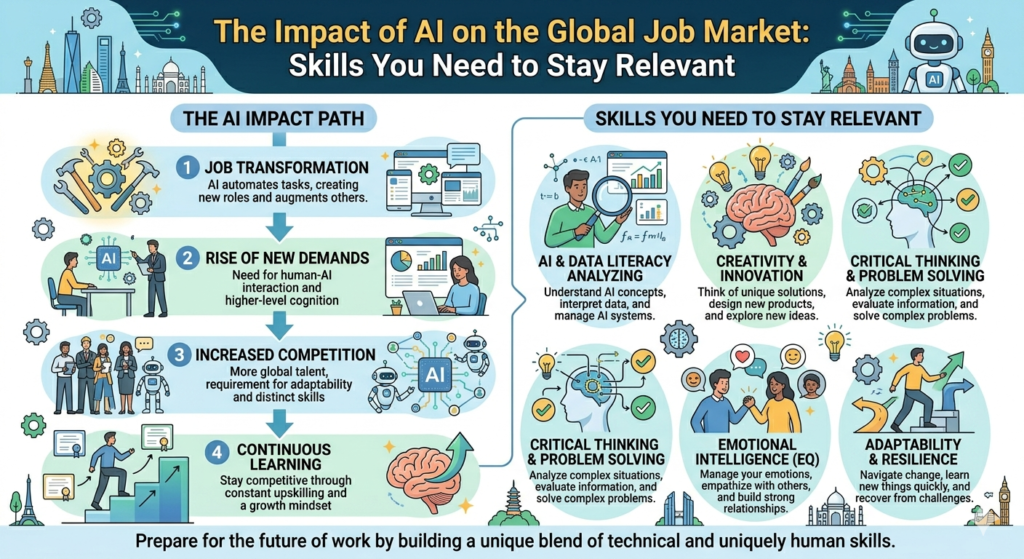
Category 1: AI Literacy (The New Digital Literacy)
AI literacy is no longer optional. It’s as fundamental as basic computer literacy was in the 1990s.
What AI Literacy Includes:
| Skill | Why It Matters |
|---|---|
| Understanding AI capabilities and limitations | Knowing when to trust AI and when to verify prevents costly errors |
| Prompt engineering | Getting useful outputs requires knowing how to ask |
| Output evaluation | Recognizing hallucinations, biases, and errors |
| Tool selection | Different tasks require different AI tools |
| Ethical considerations | Understanding bias, privacy, and intellectual property |
How to Build This Skill:
- Use AI tools daily in your work (hands-on experience is irreplaceable)
- Follow AI developments relevant to your industry
- Take structured courses (many universities now offer AI literacy certificates)
- Learn basic prompt engineering techniques
Category 2: Critical Thinking and Analysis
As AI handles more information processing, the human role shifts to evaluation, synthesis, and judgment.
What Critical Thinking Includes:
| Skill | Why It Matters |
|---|---|
| Evaluating AI outputs | AI can be wrong confidently; humans must detect errors |
| Synthesizing across sources | AI may miss connections that humans see |
| Identifying bias | AI reflects training data biases |
| Questioning assumptions | AI optimizes within given assumptions; humans must challenge them |
How to Build This Skill:
- Practice structured analysis frameworks (like SWOT, root cause analysis)
- Seek out contradictory viewpoints deliberately
- Develop expertise in your domain (you can’t evaluate what you don’t understand)
- Practice explaining your reasoning to others
Category 3: Emotional Intelligence and Interpersonal Skills
The jobs least vulnerable to AI are those requiring genuine human connection.
What Emotional Intelligence Includes:
| Skill | Why It Matters |
|---|---|
| Empathy | Understanding and responding to others’ emotions |
| Communication | Clear, persuasive, context-aware expression |
| Collaboration | Working effectively with diverse teams |
| Conflict resolution | Navigating disagreements productively |
| Mentorship and coaching | Developing others’ capabilities |
How to Build This Skill:
- Seek roles involving direct human interaction
- Practice active listening
- Request feedback on your interpersonal effectiveness
- Consider formal training in communication or coaching
Category 4: Adaptability and Continuous Learning
The pace of change means that skills learned today may be obsolete in five years. The ability to learn continuously is itself the most valuable skill.
What Adaptability Includes:
| Skill | Why It Matters |
|---|---|
| Learning how to learn | Efficient skill acquisition is a meta-skill |
| Comfort with ambiguity | Many career paths are no longer linear |
| Resilience | Bouncing back from disruption |
| Curiosity | Actively seeking new knowledge |
How to Build This Skill:
- Allocate time weekly for learning (10% rule: spend 10% of work time on skill development)
- Experiment with new tools and approaches
- Build a learning network of peers
- Embrace failure as learning
Category 5: Technical Fluency (Beyond AI)
While not everyone needs to become a programmer, technical fluency—understanding how systems work—is increasingly valuable.
What Technical Fluency Includes:
| Skill | Why It Matters |
|---|---|
| Data literacy | Understanding data concepts, not just spreadsheets |
| Systems thinking | How components interact in complex systems |
| Basic programming concepts | Understanding logic, not necessarily writing code |
| Digital tool proficiency | Mastering the tools of your trade |
How to Build This Skill:
- Take introductory data science or programming courses
- Understand the systems you work with at a deeper level
- Learn to ask technical questions effectively
Strategies for Career Resilience
Understanding the skills is one thing. Developing them is another. Here are actionable strategies for different career stages.
For Early-Career Professionals
Strategy 1: AI-Augment Your Entry Level
Entry-level roles are changing. Instead of hiding your AI use, demonstrate how you use AI to produce higher-quality work faster. Employers increasingly expect AI literacy from new hires.
Action Steps:
- Learn the AI tools relevant to your field before applying
- Build a portfolio that demonstrates AI-augmented work
- Be transparent about how you use AI (it signals competence, not cheating)
Strategy 2: Build Your Network
AI can’t replicate genuine professional relationships. Early-career professionals who build strong networks have more opportunities and better information about industry shifts.
Action Steps:
- Attend industry events (virtual and in-person)
- Seek mentors proactively
- Contribute to professional communities
For Mid-Career Professionals
Strategy 1: Deepen Domain Expertise
Mid-career professionals are most vulnerable if their role is predictable. The most secure path is becoming a genuine expert—someone whose judgment is trusted.
Action Steps:
- Pursue advanced certifications or specialized knowledge
- Develop a niche where you’re the go-to expert
- Publish, speak, or teach to build your reputation
Strategy 2: Learn to Manage AI Tools
Mid-career professionals who master AI tools can achieve extraordinary productivity. The combination of domain expertise and AI fluency is particularly powerful.
Action Steps:
- Identify the AI tools most relevant to your field
- Invest time in learning them deeply (not just surface-level)
- Develop workflows that combine your expertise with AI capabilities
For Late-Career Professionals
Strategy 1: Leverage Experience
Experience and judgment remain irreplaceable. Late-career professionals who understand AI’s limitations are uniquely positioned to guide organizations through AI adoption.
Action Steps:
- Position yourself as a strategic advisor on AI implementation
- Share your institutional knowledge (AI cannot replicate context)
- Mentor younger professionals (transferring knowledge is increasingly valuable)
Strategy 2: Embrace Tools That Extend Your Capabilities
AI can help experienced professionals do more with less effort. The goal is not to become a technical expert but to leverage tools that amplify your existing strengths.
Action Steps:
- Learn AI tools that reduce administrative burden
- Use AI to help with tasks that previously required delegation
- Focus your time on the work only you can do
The Role of Employers and Governments
Individual adaptation is necessary but not sufficient. Employers and governments have critical roles to play.
What Employers Should Do
Reskilling, Not Replacement: The most successful organizations are those that retrain workers rather than replace them. The cost of reskilling is often lower than the cost of hiring and the loss of institutional knowledge.
Upskilling Infrastructure: Provide employees with access to training, time to learn, and clear pathways for skill development.
Redesigning Roles: Instead of “automating away” tasks, redesign roles to combine human strengths with AI capabilities.
Ethical AI Implementation: Establish clear policies about AI use, data privacy, and transparency.
What Governments Should Do
Education System Reform: K-12 and higher education must evolve to teach AI literacy, critical thinking, and adaptability alongside traditional subjects.
Reskilling Programs: Government-funded programs for displaced workers can ease transitions.
Social Safety Nets: As transitions become more frequent, portable benefits, unemployment insurance modernization, and support for lifelong learning become essential.
Regulatory Clarity: Clear rules about AI use in employment, intellectual property, and data privacy reduce uncertainty for workers and employers alike.
The Human Advantage: What AI Cannot Do
Amid all the discussion of skills and adaptation, it’s worth remembering what AI cannot do—the enduring human advantage.
Genuine Creativity: AI remixes existing patterns; humans create truly novel concepts, art, and ideas. The spark of genuine originality remains uniquely human.
Empathy and Connection: AI can simulate empathy but cannot genuinely feel it. Human connection—the comfort of a caring presence, the understanding of shared experience—is irreplaceable.
Ethical Judgment: AI optimizes for specified objectives; humans wrestle with what those objectives should be. Moral reasoning, value judgments, and ethical trade-offs require human wisdom.
Purpose and Meaning: AI has no inherent purpose. Humans imbue work with meaning, create value beyond efficiency, and find purpose in contribution.
Physical Presence: For all the advances in robotics, human physical capability and dexterity remain unmatched in many contexts—from skilled trades to healthcare to hospitality.
The most resilient careers in the AI era are those that leverage these human strengths while using AI to handle what it does best.
Conclusion: The Augmented Professional
The narrative of AI as a job destroyer has given way to a more nuanced reality. AI is not eliminating work; it’s eliminating certain tasks within work. The distinction matters profoundly.
A radiologist doesn’t lose their job to AI that reads X-rays; they become more valuable because they can focus on patient communication, complex case interpretation, and integrating AI findings into treatment plans. A writer doesn’t lose their job to AI that generates text; they become more valuable because they can focus on creativity, structure, and voice while AI handles research and first drafts.
The professionals thriving in 2026 are not those who resisted AI or pretended it didn’t exist. They are those who embraced it, learned to work alongside it, and focused on the skills AI cannot replicate. They are the augmented professionals—human judgment amplified by machine capability.
The future of work is not human versus machine. It is human with machine. The question is not whether you will work alongside AI. You already do, whether you realize it or not. The question is whether you will work effectively alongside AI—whether you will develop the skills, adopt the tools, and cultivate the uniquely human capabilities that make you invaluable in an AI-augmented world.
The tools are available. The skills are learnable. The future is being written now. What role will you play in it?