Copyright Laws and AI Art: Who Truly Owns a Prompt-Generated Image?
Copyright Laws and AI Art: Who Truly Owns a Prompt-Generated Image? The question seems straightforward: if you type a prompt into an AI image generator and a stunning image emerges, surely you own it, right? After all, you provided the creative direction, the vision, the carefully crafted words that brought the image to life.
But the legal reality is far more complex—and in many cases, the answer is no.
In March 2026, the United States Supreme Court delivered a landmark decision that has fundamentally shaped how AI-generated art is treated under copyright law. The Court declined to hear the case of Thaler v. Perlmutter, leaving in place lower court rulings that established a clear principle: works created entirely by artificial intelligence, without meaningful human involvement, cannot receive copyright protection under current U.S. law .
This decision has sent shockwaves through the creative community, raising urgent questions for artists, businesses, and anyone using AI tools to generate images. This guide unpacks what you need to know about copyright ownership of AI-generated art in 2026, with practical strategies for protecting your work.
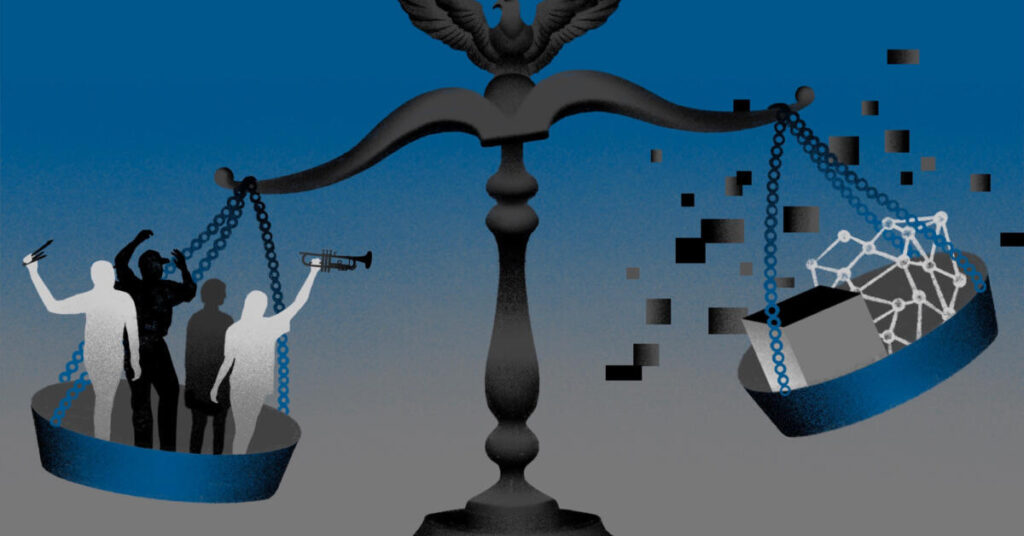
The Core Principle: Human Authorship Is Non-Negotiable
The foundational principle of U.S. copyright law is simple: only works created by a human author are eligible for protection . This isn’t a new rule invented to address AI—it’s a doctrine that has existed for centuries, now being applied to novel technology.
The Thaler case originated with Dr. Stephen Thaler, a computer scientist who sought to register copyright for a visual artwork titled “A Recent Entrance to Paradise.” In his application, Thaler listed his AI system, the “Creativity Machine,” as the sole author. He did not claim any human authorship—no prompting, no editing, no creative input .
The U.S. Copyright Office rejected the application, and the D.C. Circuit Court of Appeals affirmed that decision, holding that “authorship” under the Copyright Act necessarily implies human creativity . When Thaler appealed to the Supreme Court, the justices declined to hear the case, allowing the lower court’s ruling to stand .
What This Means for AI Art
The practical implications are significant:
| Scenario | Copyright Status Under U.S. Law |
|---|---|
| Pure AI generation (no human creative input) | ❌ No copyright protection |
| AI-assisted with significant human creative contribution | ✅ Protection for human-authored portions |
| Prompts alone, regardless of detail | ❌ Insufficient for protection |
| Substantial editing/modification after generation | ✅ Potentially protectable |
The Copyright Office’s January 2025 report on AI copyrightability clarified that “prompts do not alone provide sufficient control” over expressive outcomes . Even highly detailed prompts—hundreds or thousands of them—may not meet the threshold for human authorship .
How Much Human Input Is Enough?
This is the million-dollar question, and unfortunately, there’s no bright-line answer. The Copyright Office evaluates applications on a case-by-case basis, but recent decisions illustrate a strict standard .
The Zarya of the Dawn Case
In one notable case involving a comic book called Zarya of the Dawn, the Copyright Office refused to grant copyright protection for images even though the creator had provided “hundreds or thousands of descriptive prompts” to achieve the desired result. The Office determined that despite the extensive prompting, the images lacked sufficient human authorship .
The Théâtre D’opéra Spatial Case
Similarly, in a case involving the digital artwork Théâtre D’opéra Spatial, copyright was denied despite the creator entering more than 624 text prompts with detailed instructions on genre, tone, color, and style. The sheer volume and specificity of the prompts were not enough .
What Does Qualify?
According to the Copyright Office’s guidance, registrable human contributions may include :
- Incorporation of original human-authored expression in the input (e.g., uploading a sketch you drew, then having AI refine it)
- Creative selection, coordination, or arrangement of AI-generated content (like a collage or composite work)
- Substantial modification of AI outputs into a final protectable work (using AI as a starting point, then significantly editing)
The key is human creative control over the expressive elements—not mere initiation of an automated process .
International Divergence: A Patchwork of Rules
One of the most challenging aspects of AI copyright law is its inconsistency across borders. What’s true in the United States may not hold elsewhere.
United Kingdom
The UK takes a notably different approach. Under UK law, copyright can be granted to “the person by whom the arrangements necessary for the creation of the work are undertaken” . This language was designed to accommodate computer-generated works and may extend to AI-generated content.
However, the landscape is evolving. In November 2025, the UK High Court issued a significant ruling in Getty Images v Stability AI. While the court found that the Stable Diffusion AI model itself was not an “infringing copy” for secondary copyright purposes, the case highlighted the complex questions still unresolved . The UK government has since announced it will not introduce broad copyright exceptions for AI training at this time, instead focusing on transparency, licensing, and creator control .
European Union
The EU’s position is still crystallizing. In March 2026, the European Parliament adopted recommendations calling for:
- Fair remuneration when copyrighted works are used to train AI
- Greater transparency about training uses
- New licensing markets
- Mechanisms enabling rightsholders to exclude their works from AI training
- A statement that content fully generated by AI should not be protected by copyright
These recommendations are not yet binding law, but they indicate the direction of the European debate.
China
China has taken a more permissive approach. Chinese courts have recognized that AI-generated images may be eligible for copyright protection, reflecting a different policy orientation that seeks to encourage AI innovation .
What This Means for Global Creators
If you’re creating AI art and distributing it internationally, your work might be protected in some jurisdictions but not others. A work that qualifies for copyright in the UK could be freely copied in the United States. This creates significant complexity for global businesses and artists .
The Training Data Problem: A Separate Legal Battle
While the ownership of AI outputs is one question, a separate legal battle is raging over the inputs: the copyrighted works used to train AI models.
The Getty Images v. Stability AI Case
This landmark UK case represents the most significant legal challenge to AI training practices. Getty Images sued Stability AI, alleging that the company scraped millions of copyrighted images from Getty’s website without permission to train its Stable Diffusion model .
At trial, Getty dropped its primary copyright infringement claims due to evidential challenges, but the case still produced important rulings:
- The court found that Stable Diffusion was not itself an “infringing copy” because it does not store copies of copyrighted works within its model weights
- However, the court confirmed that intangible items like AI models can constitute “articles” under UK law, opening the door for future secondary infringement claims
- On trademark claims, Getty had limited success where AI outputs displayed the Getty Images watermark
The outcome was described as “not a full victory for either side” , and Getty’s parallel case against Stability AI continues in the United States .
The GEMA v. OpenAI Case in Germany
A week after the Getty decision, a German court in Munich reached a different conclusion. In GEMA v. OpenAI, the court found that ChatGPT did “memorize” and “reproducibly contain” certain song lyrics, amounting to copyright infringement . This suggests that the question of whether AI models store copyrighted works may depend on the specific architecture of the model and the evidence presented.
The UK Government’s Response
Following a consultation that received over 11,500 responses (with only about 3% supporting a broad copyright exception), the UK government announced in March 2026 that it will not introduce new copyright exceptions for AI training at this time . Instead, it will focus on:
- Digital replicas
- Labeling AI-generated content
- Creator control and transparency
- Establishing a Creative Content Exchange marketplace
This represents a significant victory for creators and rights holders who argued that AI companies should license, not simply take, copyrighted works for training .
The Secondary Infringement Question
One of the most important legal questions is whether companies can avoid copyright liability by training their AI models outside of restrictive jurisdictions and then importing the finished models.
The UK High Court addressed this in the Getty case. Under sections 22 and 23 of the Copyright, Designs and Patents Act 1988, importing or dealing with an “infringing copy” constitutes secondary infringement .
The court found that while the Stable Diffusion model was an “article” that could theoretically be infringing, it was not actually an “infringing copy” because the model itself never stored copies of Getty’s copyrighted works .
This decision—if upheld on appeal—could encourage AI developers to train their models in AI-friendly jurisdictions and then import them into markets like the UK without running secondary infringement risk. As one legal commentator noted, this may run counter to the UK government’s ambition to be a global leader in AI development, rather than merely an importer of AI technology .
What This Means for Artists and Creators
If You Use AI to Generate Images
Assume your pure AI outputs are unprotected. Under current U.S. law, if you simply type prompts and accept the output, you likely have no copyright protection. Others can copy, distribute, and even sell your AI-generated images without your permission .
Document your creative process. If you want to claim copyright, you must demonstrate meaningful human creative contribution. Maintain records of:
- Original sketches or input images you created
- Multiple iterations and curation decisions
- Substantial edits and modifications after generation
- Selection and arrangement of multiple AI outputs
Consider alternative protection strategies. For AI-generated content that lacks human authorship, explore :
- Trade secret protection: Control access to your most valuable AI-generated assets
- Contractual restrictions: Use license terms to limit how others can use your content
- Design patents: For certain visual works, design patent protection may be available
If You’re an Artist Concerned About Your Work Being Used for Training
Review how your work is published online. The terms under which your work is made available may affect whether AI companies can scrape it for training .
Use clear contractual language. Where possible, expressly reserve rights and prohibit the use of your work for AI training. Some platforms now offer “opt-out” mechanisms .
Join collective advocacy. Organizations like DACS are advocating for transparency, licensing, and fair remuneration when artists’ works are used for AI training .
Seek legal advice. The landscape is complex and evolving. Professional guidance can help you understand your rights and options .
If You’re a Business Using AI-Generated Content
Audit your AI content pipeline. Identify which assets are pure AI outputs versus human-created or significantly modified works .
Build human creativity into your process. Ensure identifiable human contributions are part of conception, selection, arrangement, or editing for any work you intend to protect .
Document everything. Maintain records of prompts, iterations, curation decisions, and edits to support potential copyright registration applications .
Be accurate in copyright applications. When registering works involving AI, clearly distinguish between human-authored and AI-generated material. Inaccurate disclosures can jeopardize registration .
Consider geographic strategy. If your work has international value, understand that protection may vary by jurisdiction. You might have copyright in the UK but not the United States .
The Future: What’s Coming Next
Pending Cases to Watch
Several cases may provide further clarity on the human authorship requirement:
- Allen v. Perlmutter: The plaintiff has challenged the Copyright Office’s refusal to register a work generated with more than 600 prompts. This case may help establish where the line falls between insufficient prompting and sufficient human authorship .
- Getty Images v. Stability AI (US): The parallel case in the Northern District of California continues, potentially addressing primary copyright infringement claims that were dropped in the UK .
Potential Legislative Action
The Supreme Court’s decision not to hear the Thaler case leaves room for Congress to act. As the D.C. Circuit noted, “There will be time enough for Congress and the Copyright Office to tackle those issues when they arise” . Whether Congress will create a new category of protection for AI-generated works remains an open question.
Emerging Industry Standards
The UK government’s proposed Creative Content Exchange and efforts around labeling AI-generated content suggest that transparency and licensing, rather than pure legal prohibition, may shape the future landscape .
Practical Guidance: Protecting Your AI Art Today
Based on the current legal landscape, here’s a practical framework for creators using AI tools:
The Safe Harbor Approach
| Step | Action | Why It Matters |
|---|---|---|
| 1 | Start with human-created elements | Establishes a baseline of human authorship |
| 2 | Use AI as a tool, not the creator | Maintains human creative control throughout |
| 3 | Make substantial modifications after generation | Transforms AI output into human-authored work |
| 4 | Document every creative decision | Provides evidence for registration and enforcement |
| 5 | Disclose AI use accurately | Maintains credibility with Copyright Office |
The “AI-Only” Content Approach
If you choose to publish pure AI-generated content (no significant human authorship):
- Understand that you have no copyright protection in the U.S.
- Consider whether trade secret or contractual protections can fill the gap
- Recognize that competitors can lawfully copy your work
- Factor this into your business model—perhaps AI content serves as marketing, not your core protected asset
Conclusion: Creativity in the Age of Collaboration
The Supreme Court’s refusal to hear the Thaler case leaves U.S. law firmly aligned with a core principle: copyright protects the fruits of human intellectual labor . An AI system cannot be an author, and prompts alone—no matter how detailed—cannot confer authorship on the person who typed them.
But this does not mean AI has no place in creative work. The Copyright Office’s guidance makes clear that “the human authorship requirement does not prohibit copyrighting work that was made by or with the assistance of artificial intelligence. The rule requires only that the author of that work be a human being—the person who created, operated, or used artificial intelligence—and not the machine itself” .
The distinction is between using AI as a tool and ceding creative control to AI as the author. When you are the one creating, directing, selecting, arranging, and substantially modifying, your work may qualify for protection. When you simply press “generate” and accept what emerges, it does not.
As one court noted in language that may prove prescient: “Humans at some point might produce creative non-humans… Science fiction is replete with examples of creative machines that far exceed the capacities of current generative artificial intelligence. There will be time enough for Congress and the Copyright Office to tackle those issues when they arise” .
For now, the law draws a bright line: AI can assist, but only humans can author. Creators who understand this distinction—and structure their workflows accordingly—will be best positioned to protect their work in an era of unprecedented creative possibility.