Deepfake Defense: How Businesses Protect Executive Identities in 2026
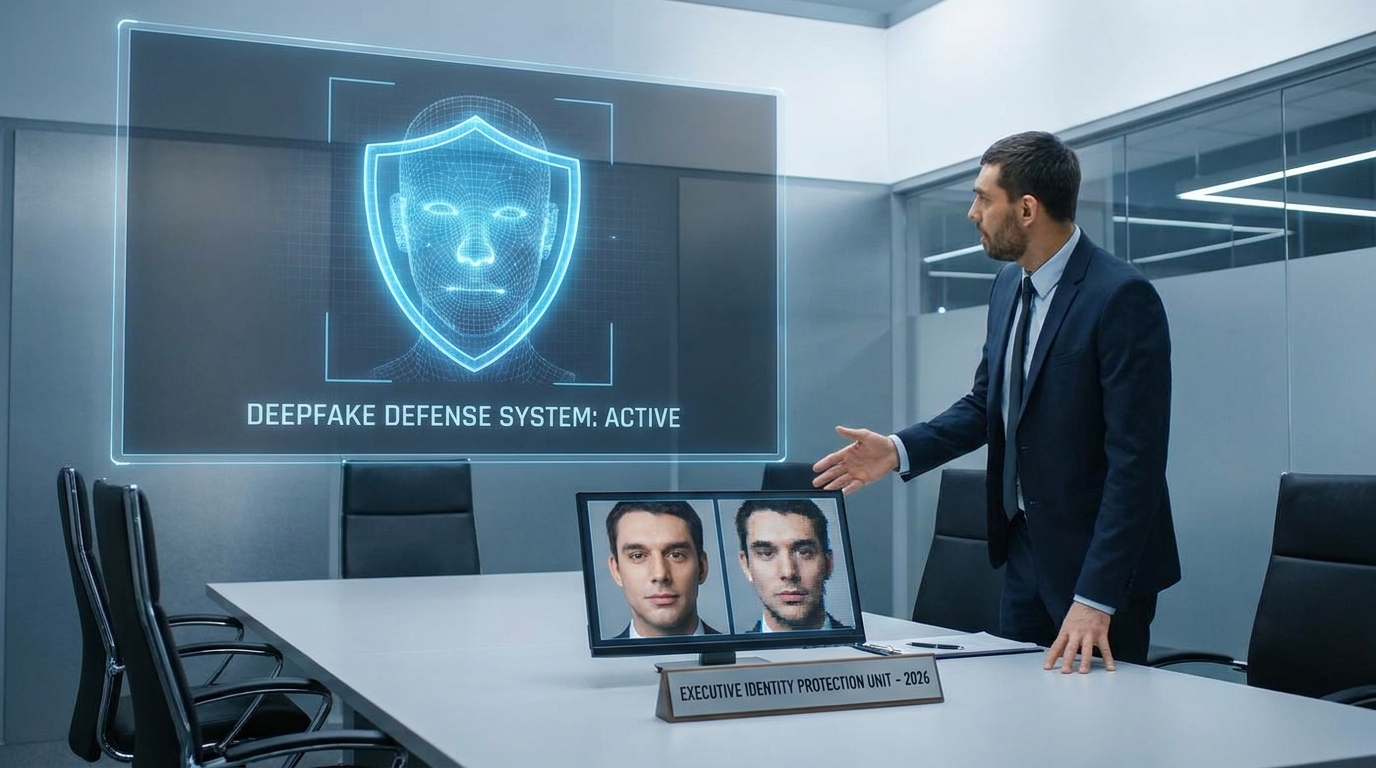
Deepfake attacks on executives surged over 1,300% in 2026. Discover enterprise-grade defense strategies including AI detection, context-based attestation, and zero-trust identity verification.
The $950,000 Voice Call
A contact center agent at a multinational financial institution received a call from someone claiming to be a regional director. The request: an urgent wire transfer. Voice biometrics returned a plausible match. The caller knew the director’s name, reporting line, and recent travel schedule.
The voice was synthetic—generated from publicly available audio clips scraped from YouTube and earnings calls. But nothing in the existing security stack flagged it .
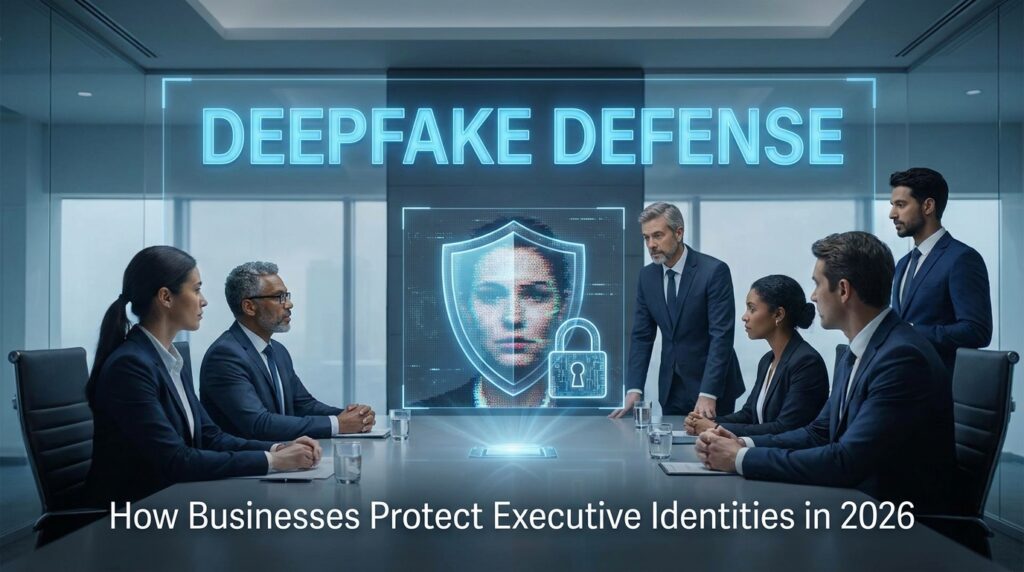
This is not a hypothetical scenario. It is the operational reality facing enterprises in 2026. Deepfake attacks have surged more than 1,300% year-over-year, and nearly one in six job applicants now shows signs of fraud . Executives—with their public-facing profiles, abundant digital footprints, and authority to approve sensitive transactions—have become the primary targets.
Welcome to the era of AI-driven identity warfare. Here is how businesses are fighting back.
The Evolving Threat Landscape: Beyond the “Fake CEO Video”
When most people hear “deepfake,” they think of poorly lip-synced celebrity videos or political disinformation. Enterprise threats have moved far beyond that.
Voice Cloning (Vishing)
Attackers now replicate speech patterns, tone, cadence, and accent with minimal source material—sometimes just three seconds of audio from a public earnings call or social media video . These cloned voices are used to authorize wire transfers, override internal controls, or extract sensitive information.
Recent example: Threat actors impersonated senior US government officials, including voices represented as the White House Chief of Staff and the US Secretary of State, in calls targeting congressional representatives, governors, and senior state officials. Recipients believed the calls were legitimate because of the voice accuracy and contextual knowledge displayed .
Synthetic Identity Fraud
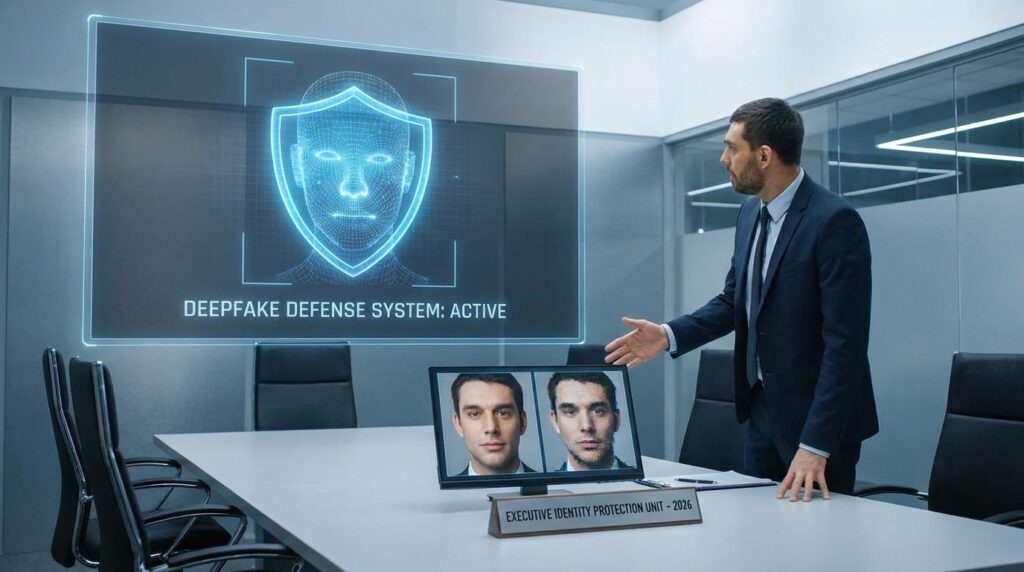
Beyond voice, attackers are now creating complete synthetic identities—AI-generated faces, fabricated employment histories, and deepfake interview performances—to infiltrate organizations through the hiring process.
The scale: Gartner projects that by 2028, one in four candidate profiles will be fake . These deepfake candidates can pass initial screening, ace video interviews, and potentially gain access to sensitive systems before their true nature is discovered.
Real-Time Meeting Impersonation
Attackers are no longer limited to pre-recorded content. Live video deepfakes can now be deployed during Zoom, Microsoft Teams, or Webex meetings—swapping a face, cloning a voice, and impersonating an executive in real time .
Multi-Channel Attacks
Modern attackers blend tactics across platforms. An executive’s LinkedIn profile provides personal details. A leaked database supplies internal terminology. A dark web forum offers cloned voice samples. The attack might begin with a phishing email, continue with a fake Slack message, and culminate in a deepfake voice call—all appearing to come from trusted internal sources .
Why Traditional Security Measures Fail
Legacy security tools were not designed for AI-generated threats. Here is why they are falling short:
| Traditional Measure | Why It Fails Against Deepfakes |
|---|---|
| Passwords & MFA | Session hijacking and cookie theft bypass these controls. Deepfakes target the human, not the system. |
| Voice Biometrics | AI-generated voices can now achieve “plausible matches” against biometric profiles . |
| Document Authentication | Synthetic identity documents are increasingly indistinguishable from genuine ones. |
| Employee Training | Human vigilance cannot keep pace with rapidly evolving AI generation quality. |
| Post-Incident Investigation | Deepfake attacks exploit real-time trust; detection must happen during the interaction, not after. |
The fundamental problem is that these tools ask the wrong question: “Does this credential match?” Instead, security teams must ask: “Is this person real?”
The 2026 Enterprise Defense Stack: 6 Layers of Protection
Forward-thinking organizations are building defense-in-depth strategies specifically designed for AI-generated threats. Here are the six essential layers.
Layer 1: Real-Time Deepfake Detection for Communications
The first line of defense is technology that analyzes live audio and video streams during meetings and calls, flagging synthetic content as it occurs.
Pindrop Pulse for Meetings continuously analyzes live audio and video streams on platforms including Zoom, Microsoft Teams, and Webex to detect synthetic voices, manipulated video, replay attacks, and human impersonation in real time. Its AI models are trained on 1.5 billion real-world interactions annually, enabling the system to detect 99% of known deepfakes and over 90% of emerging AI-generated threats .
isVerified focuses specifically on executive voice protection, providing real-time one-to-one voice authentication for sensitive inbound and outbound communications. The platform uses proprietary detection methods that look for indicators associated with AI-generated voice content, requiring minimal interaction from busy executives .
Key capability: These tools operate passively with millisecond latency, requiring no change in user behavior and introducing no friction into enterprise workflows .
Layer 2: Context-Based Attestation (Beyond Static Verification)
In 2026, identity verification is shifting from a one-time event to a continuous process. HYPR’s Context-Based Attestation evaluates whether an interaction makes sense based on what the organization already knows .
The five core components:
- Organizational Context: Role, team, and workflow data
- Situational Context: Time-bound events such as scheduled meetings or onboarding steps
- Peer-Based Attestation: Validation from managers or colleagues when elevated assurance is needed
- Behavioral Continuity: Consistency with prior access patterns and device usage
- Adaptive Challenges: Questions or actions generated from correlated context rather than static knowledge-based prompts
Instead of asking “Who are you?” the system asks “Does this interaction make sense?” A request for a wire transfer from the CFO might be routine. The same request at 11 PM on a Sunday, from a new device, while the CFO’s calendar shows them on a transatlantic flight—that triggers additional verification .
Layer 3: Proactive VIP Threat Monitoring
Defense requires hunting for threats before they reach your executives. Proactive VIP monitoring involves continuous surveillance of communication channels, dark web forums, and social media platforms for signs of executive impersonation .
What this includes:
- Scanning dark web marketplaces for executive data being sold (home addresses, family details, voice samples)
- Monitoring typo-squatted domains that could host fake press releases or impersonation sites
- Tracking social media for fake executive profiles
- Real-time alerting when impersonation attempts are detected
Real-world impact: One Fortune 500 technology company identified three critical threat vectors through proactive monitoring: executive doxxing (the CEO’s home address circulated on Telegram), synthetic impersonation (deepfake audio clips of the CFO), and brand erosion through typo-squatted domains hosting fake press releases .
Layer 4: Multi-Channel Communication Protection
Executives communicate across email, Slack, Teams, Zoom, and traditional phone lines. Attackers exploit the seams between these platforms .
Enterprise solutions now integrate with major communication platforms natively. Orange Business, serving over 7,000 enterprise customers across 65 countries, has embedded deepfake detection directly into its collaboration, voice, and customer experience portfolio. This means detection arrives not as a standalone tool but as a native capability inside the communication services organizations already rely on .
The approach includes:
- Branded calling to authenticate caller identity to the recipient
- Deepfake detection to verify the person on the other end is real
- AI-augmented customer care with built-in verification
Layer 5: Identity-First Zero Trust
Traditional zero trust focused on devices and networks. Identity-first zero trust puts human verification at the center.
Key implementations for 2026:
FIDO2-compliant hardware keys (YubiKey): These eliminate phishable credentials by forcing a passwordless workflow. Even if a login is intercepted, it is useless without the physical token .
Managed identity platforms (Okta, Microsoft Entra, JumpCloud): These enable conditional access based on geographic location, device health, and behavioral patterns. Your identity only works if you are where you should be, on a device you should be using .
Eliminating “Sign in with Google”: Security experts now recommend avoiding single sign-on options that create a single point of failure across multiple business tools .
Layer 6: Deepfake-Resistant Hiring and Onboarding
With one in four candidate profiles projected to be fake by 2028, recruitment has become a critical security vector .
Defense strategies include:
- Multi-modal verification during video interviews: Real-time deepfake detection running in the background
- Peer-based attestation for new hires: Having existing team members validate new colleagues through low-friction channels
- Continuous identity assurance for onboarding: Verification doesn’t end at hire; it continues through the first 90 days
- Vetted access for contractors and vendors: Third parties receive verified, time-bound access rather than permanent credentials
The Human Element: Training, Protocols, and Culture
Technology alone cannot solve the deepfake problem. Organizations must also address the human element.
Establish Clear Communication Protocols
Every organization should have written, enforced policies for sensitive communications :
- No financial decision happens without verbal confirmation via a pre-arranged, non-digital safe word or a physical “callback” to a known number
- Verify before trusting: Any request involving money, data access, or system changes requires verification through a separate channel
- Use only verifiable work communication channels for sensitive discussions
Executive Digital Footprint Management
The less raw material available to attackers, the harder impersonation becomes :
- Scrub personal information from LinkedIn and other professional profiles (home addresses, private phone numbers, family details)
- Use enterprise-grade data removal services (DeleteMe) to remove personal data from data broker sites
- Limit social media viewership to trusted connections only
- Consider digital watermarking for official executive video and photo releases (Adobe’s Content Authenticity Initiative) to provide provenance trails
Regular Security Awareness Training
Training must evolve alongside threats :
- Teach employees to recognize potential deepfake indicators (unusual blinking, audio-video sync issues, unnatural prosody)
- Run simulated deepfake phishing campaigns
- Shift focus from reliance on human vigilance to automated detection supplemented by human judgment
Real-World Case Studies: Defense in Action
Case 1: Wire Fraud Intercepted
A large organization implementing proactive monitoring systems successfully intercepted an attempted fraud of approximately $950,000 before any funds were transferred. The attack involved a deepfake voice call impersonating a regional director. Real-time detection flagged inconsistencies in the audio stream, triggering additional verification protocols .
Case 2: Fortune 500 Tech Executive Protection
Following a strategic acquisition announcement, a global semiconductor company identified three critical threat vectors: executive doxxing, synthetic audio impersonation of the CFO, and typo-squatted domains for stock manipulation. By implementing proactive VIP monitoring and real-time deepfake detection, they neutralized these threats before any damage occurred .
Case 3: Financial Services Contact Center Protection
Orange Business deployed multimodal deepfake detection across a multinational financial institution’s contact center operations. The system now analyzes incoming calls in real time, flagging synthetic voices before they can authorize fraudulent transactions. The detection runs in the background with no additional friction for legitimate callers .
The Future: What to Expect by 2028
The deepfake arms race is accelerating. Here is what security experts project:
Detection will become infrastructure, not an add-on. Just as firewalls and antivirus became standard, deepfake detection will be embedded natively into every enterprise communication platform .
Context-based attestation will replace static verification. The question will no longer be “Who are you?” but “Does this interaction make sense?” Continuous identity assurance will become the norm .
Decentralized identity systems may emerge, removing central points of vulnerability by distributing identity data across secure networks .
AI-enhanced behavioral analysis will become sophisticated enough to discern subtle differences in user interactions that no human could detect—and no AI could perfectly replicate .
Regulatory requirements will likely mandate deepfake detection for financial services, healthcare, and other regulated industries .
Getting Started: A 5-Step Action Plan for 2026
You do not need to implement everything at once. Here is a prioritized roadmap:
Step 1: Assess your risk exposure. Identify which executives are most publicly visible. Audit where their digital footprint exists. Review recent near-misses or suspicious interactions.
Step 2: Implement real-time detection for voice communications. Start with the highest-risk channel: phone calls involving financial approvals or sensitive data access. Solutions like isVerified or Pindrop can be deployed with minimal executive friction .
Step 3: Establish communication protocols. Create and enforce policies for verifying sensitive requests. Implement safe words or callback procedures. Train all employees who might receive executive communications.
Step 4: Reduce your digital footprint. Scrub executive personal information from public profiles. Use data removal services. Limit what is publicly available for AI training.
Step 5: Plan for meeting protection. As deepfake video quality improves, real-time detection for Zoom, Teams, and Webex meetings will become essential. Evaluate solutions like Pindrop Pulse for Meetings .
Frequently Asked Questions
Q: How common are deepfake attacks on businesses in 2026?
A: Deepfake attacks have surged more than 1,300% year-over-year. Nearly one in six job applicants now shows signs of fraud, and voice-based vishing attacks targeting executives have become routine .
Q: Can’t employees just be trained to spot deepfakes?
A: Training helps, but it is not sufficient. Modern deepfakes are increasingly indistinguishable from genuine content. Organizations need automated detection running in real time, supplemented by human awareness .
Q: What is the cost of implementing deepfake defense?
A: Costs vary by solution and scale. Entry-level voice protection for a small executive team may cost a few thousand dollars monthly. Enterprise-wide deployment across communications platforms requires larger investment but is rapidly becoming a standard business expense.
Q: Does deepfake detection slow down communications?
A: Modern solutions operate with millisecond latency and require no change in user behavior. Detection runs passively in the background .
Q: Can deepfake detection be bypassed?
A: No system is perfect. Current solutions detect 99% of known deepfakes and over 90% of emerging threats. Defense-in-depth—combining multiple detection layers with protocols and training—provides the strongest protection .