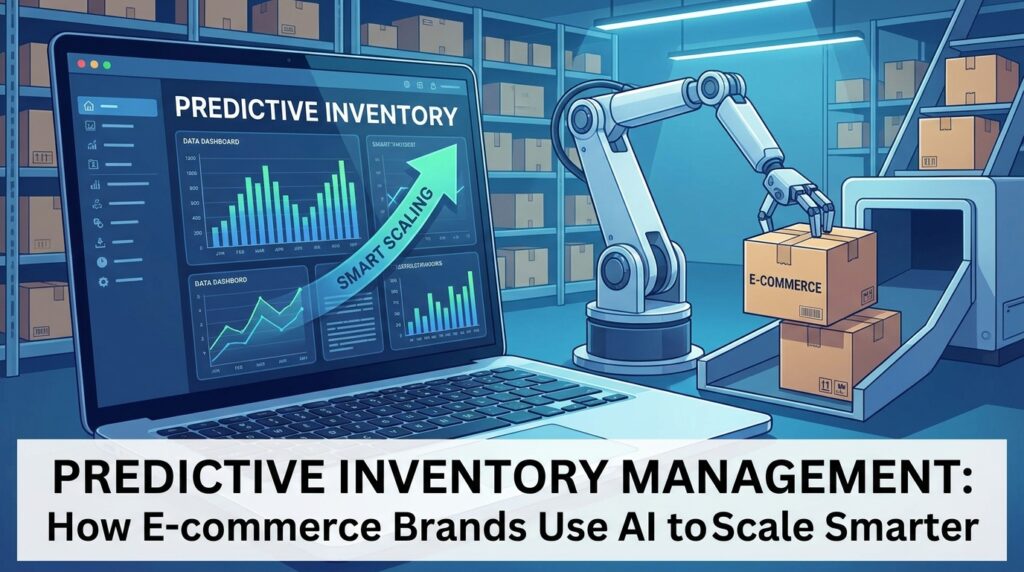
Predictive Inventory Management: How E-commerce Brands Use AI to Scale Smarter
Discover how predictive inventory management uses AI to prevent stockouts, reduce excess storage costs, and boost cash flow. Learn the strategies top e-commerce brands use to scale profitably.
The $1.2 Trillion Problem Hiding in Your Warehouse
Imagine writing a check for $1.2 trillion—and throwing it directly into a shredder. According to industry analysts, that is roughly the value of excess inventory held globally by retailers at any given moment. Worse, 34% of e-commerce brands have lost a customer due to an “out of stock” notification after just one bad experience.
In the fast-paced world of online retail, the old “spreadsheet and gut feeling” method of inventory management is failing. You are either bleeding cash on storage fees for products that won’t move, or losing revenue because your bestseller is sitting on a container ship three weeks away.
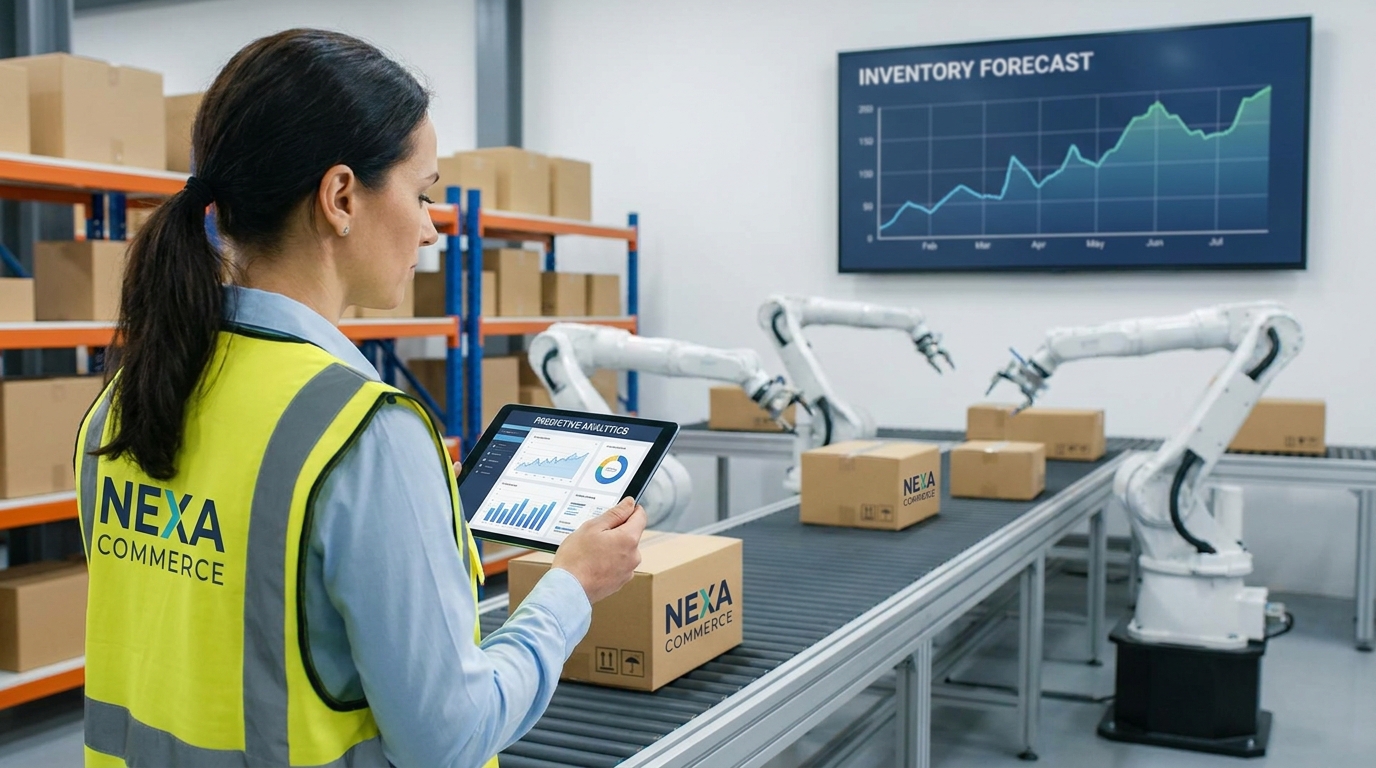
Enter Predictive Inventory Management. Powered by Artificial Intelligence (AI), this is not just a software upgrade; it is a strategic shift that allows e-commerce brands to see the future of demand—and act on it today.
Here is how AI is solving the inventory puzzle and helping brands scale without breaking their supply chain.
What is Predictive Inventory Management?
Traditional inventory management is reactive. You look at last month’s sales, add 10% for growth, and place an order. By the time the stock arrives, trends have changed, competitors have launched sales, or a viral TikTok has tripled your demand.
Predictive inventory management is proactive. It uses machine learning (ML) algorithms to analyze historical sales data, seasonality, market trends, and even external factors (like weather or social media sentiment) to forecast future demand with surgical precision.
Instead of asking, “How many did we sell last year?” AI asks, “Given the current marketing spend, competitor pricing, and macroeconomic climate, how many will we sell next Tuesday?”
Why Traditional Forecasting Fails Modern E-commerce
Before we dive into the AI solution, it is crucial to understand why standard spreadsheets are the enemy of scale.
- The Bullwhip Effect: A small fluctuation in consumer demand creates increasingly wild swings in inventory orders upstream. Spreadsheets can’t catch the nuance.
- Lead Time Blindness: Most spreadsheets assume fixed shipping times. AI integrates real-time logistics data (port strikes, weather delays) to adjust safety stock dynamically.
- Promotion Distortion: Human planners often over-order for Black Friday or Prime Day based on hope. AI analyzes past promotional lift to predict the actual uplift.
If you are holding stock for longer than 90 days, you are not a retailer; you are a storage facility. Predictive AI turns that storage facility back into a revenue engine.
6 Ways E-commerce Brands Use AI to Scale Inventory
How are the top 10% of DTC (Direct-to-Consumer) brands using predictive AI to crush their targets? Here are the specific use cases.
1. Dynamic Safety Stock Optimization
Safety stock is the “emergency stash” you keep to prevent stockouts. Human planners usually set a static number (e.g., “always keep 200 units safe”). AI makes this number dynamic.
- The AI Advantage: During a hurricane in the Gulf of Mexico (affecting oil/shipping), AI automatically increases safety stock for raw materials. During a slow January, it lowers safety stock to free up cash.
- Result: Up to a 25% reduction in inventory holding costs without increasing stockout risk.
2. Seasonality on Steroids
Yes, you know swimsuits sell in summer. But AI detects micro-seasonality.
- Example: An AI engine might detect that vegan protein powder sales spike every Monday morning (New Year’s resolutions) but drop on Fridays. It will adjust warehouse picking schedules and reorder points accordingly, catching nuances human analysts miss.
3. Multi-Echelon Inventory Management (for 3PL & Fulfillment)
If you sell on Amazon FBA, Shopify, and your own warehouse, you have a multi-echelon network. Where should that purple hoodie live?
- The AI Solution: Predictive algorithms calculate the optimal stock allocation per node. It might send 50 units to your LA warehouse (fast shipping to California), 200 units to Amazon FBA (Prime eligibility), and 10 units to your NYC pop-up.
- Result: Lower shipping costs and faster delivery times.
4. Supplier Lead Time Prediction
Your supplier says “30 days.” But the last three shipments took 45 days. AI learns this.
- The AI Advantage: By analyzing historical vendor performance and global shipping indices, AI predicts the real lead time. If it predicts a 45-day lead time, it triggers the reorder 15 days earlier than your ERP (Enterprise Resource Planning) system would, preventing a silent stockout.
5. Markdown and Liquidation Prediction
Nobody wants to hold last season’s fanny packs. AI tells you exactly when to discount.
- How it works: If the sell-through rate of winter jackets drops below 8% per week by January 15th, the AI triggers a “dynamic markdown” (e.g., 20% off week 1, 40% off week 2) to clear space for spring inventory.
6. Cash Flow Liberation
Inventory is just cash in a box. The average e-commerce brand wastes 30-40% of its working capital on dead stock. Predictive management slashes that to 10-15%.
- The Math: If you free up $50,000 in dead stock, that is $50,000 you can put into Google Ads or new product development.
Real-World Case Study: How AI Saved “HealthyBites” (Hypothetical but realistic)
Context: A healthy snack brand selling on Amazon and Shopify.
Problem: They stocked 100 SKUs. Their top-selling “Matcha Bar” sold out for 6 weeks (lost $40k revenue), while their “Vegan Jerky” sat in a 3PL warehouse for 270 days (costing $12k in storage fees).
The AI Implementation:
- Data Unification: They connected Shopify, Amazon Seller Central, and their 3PL API to an AI inventory platform (like NetSuite, Lokad, or Energetic).
- Forecast Generation: The AI analyzed 3 years of sales + Google Trends data for “keto snacks.”
- Action: The AI predicted a 200% spike in Matcha Bars for January (New Year diets) and recommended a 300-unit increase in the pre-holiday order. It also recommended a “Buy One Get One” fire sale for the Vegan Jerky to liquidate it before fees ate the profit.
The Result:
- Stockouts reduced by 89%.
- Storage fees dropped by 45%.
- Cash flow increased by $75,000 within 6 months.
The Tech Stack: How to Start (Without a PhD in Data Science)
You don’t need to build a custom neural network. Affordable SaaS solutions bring predictive inventory to small and mid-sized brands.
The “Goldilocks” Tech Stack for 2025:
- The Data Source: Your ERP or Headless Commerce backend (Shopify Plus, BigCommerce).
- The Forecasting Engine: Tools like Energetic Labs, Inventory Planner by Skubana, or Lokad.
- The Fulfillment Layer: ShipBob, ShipMonk, or Deliverr (which offer native AI forecasting).
- The Analytics Layer: Looker Studio or Tableau for visualization.
Pro Tip: Start with a “hybrid” approach. Run AI forecasting alongside your human planner for 3 months. Compare the accuracy. The AI will win, but the human adds context (e.g., “We are discontinuing that packaging line”).
The Challenges (Don’t Believe the Hype)
Predictive AI is powerful, but it is not magic. Be aware of the “Garbage In, Garbage Out” rule.
- Data Hygiene: If your SKU names are inconsistent (e.g., “Mug-Blue” vs “Blue Coffee Mug”), the AI breaks. You need clean, structured data.
- The Black Swan Event: No algorithm predicted the pandemic toilet paper rush perfectly. AI handles trends, not chaos. You still need a human emergency override.
- Implementation Friction: Your warehouse team might resist new reorder points. Change management is harder than the software install.
The Future: Autonomous Supply Chains
We are moving toward the “Autonomous Supply Chain.” In this future, the AI does not just recommend the order; it places the order.
- AI predicts you need 500 units of “Wireless Earbuds V2” in 45 days.
- AI checks the supplier’s portal (via API) for pricing and availability.
- AI negotiates the shipping lane (via a logistics marketplace).
- AI schedules the inbound receipt at the 3PL.
- Human approves the aggregated invoice on a Monday morning.
This is not science fiction. Amazon has been doing this internally for years. For the rest of us, tools like Pipe17 and HotWax Commerce are making it accessible to brands doing $5M+ in revenue.
Checklist: Is Your Brand Ready for Predictive Inventory?
Before you sign up for an AI tool, ask these three questions:
- [ ] Do you have 12+ months of sales data? (The more, the merrier for training the model).
- [ ] Are your stockouts costing more than your software subscription would? (If you lose $10k/month to OOS, you can afford the AI).
- [ ] Do you have a dedicated Operations Manager? (Someone needs to monitor the AI; it’s a co-pilot, not an autopilot).
If you answered “Yes” to at least two of these, you are losing money every day you wait.
Conclusion: Scale Without the Panic
The goal of e-commerce is not just to sell more; it is to sell profitably and sustainably. The stress of “Did we order enough?” or “Where do we store this?” kills the joy of entrepreneurship.
Predictive inventory management shifts the mindset from firefighting to fireproofing. By leveraging AI, you stop guessing about demand and start knowing. You reclaim your cash flow, your storage space, and your Sunday evenings.
The brands that survive the next five years will not be the ones with the best products—it will be the ones with the most accurate forecasts.
Ready to stop stockouts for good? Audit your current inventory turnover ratio today. If it is below 4.0, it is time to let AI take the wheel.
Frequently Asked Questions (FAQ)
Q: Is predictive inventory management only for huge brands like Amazon?
A: No. SaaS tools have democratized AI. Brands doing $1M+ in annual revenue can easily afford entry-level predictive tools ($500–$2k/month).
Q: Can AI handle “new” products with no sales history?
A: Yes, through “attribute-based forecasting.” The AI looks at similar products (same category, price point, weight) to build a “look-alike” demand curve for the launch.
Q: What is the difference between Inventory Optimization and Demand Forecasting?
A: Demand forecasting predicts how many you will sell. Inventory optimization predicts where and when to put that stock. You need both.
Target Keywords (for SEO):
- Predictive inventory management
- AI inventory forecasting
- E-commerce stockout prevention
- Inventory optimization software
- Multi-echelon inventory management
- DTC supply chain AI
- Reduce holding costs ecommerce
Internal Linking Suggestions:
- Link to a post on “Top 10 3PLs for Small Brands”
- Link to a post on “Cash Flow Management for E-commerce”
- Link to a post on “Shopify vs. BigCommerce for Scaling”