The Rise of Agentic AI: How Autonomous Agents are Replacing Traditional SaaS
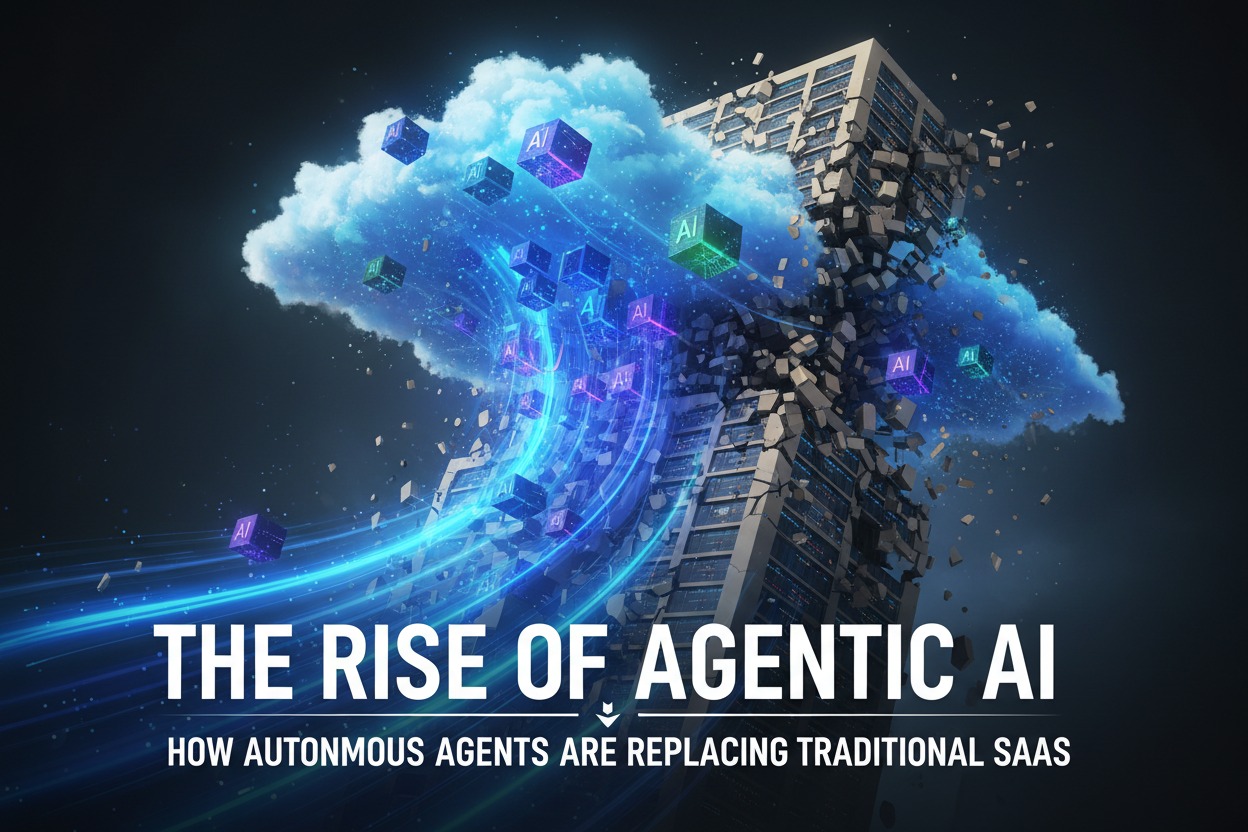
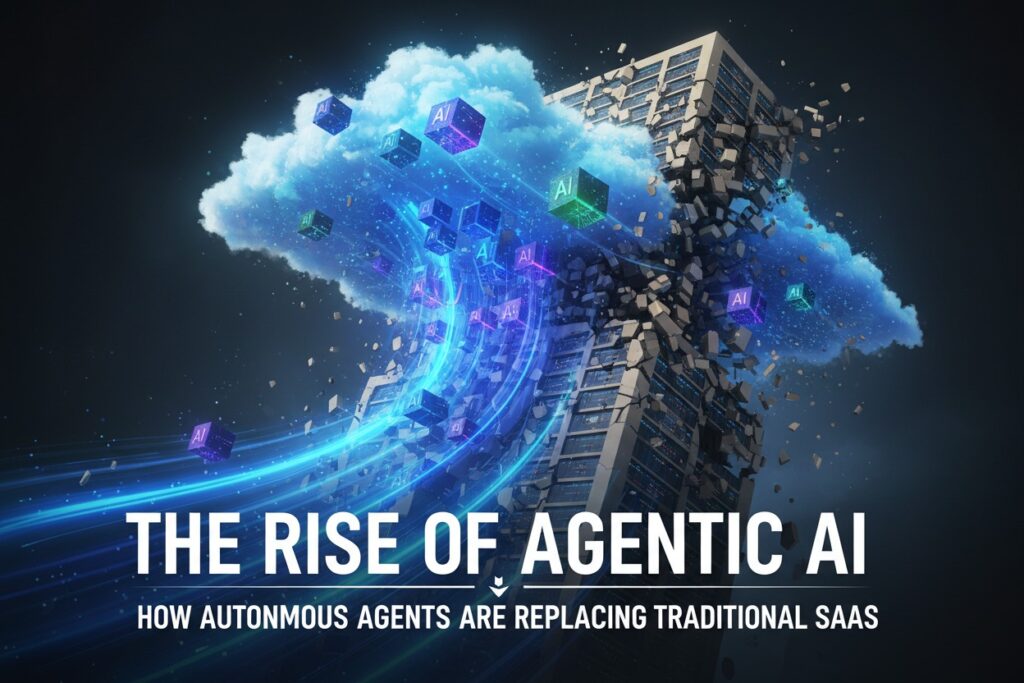
The Rise of Agentic AI: How Autonomous Agents are Replacing Traditional SaaS, The year 2026 will likely be remembered as the moment the software industry’s foundation cracked. Since the early 2000s, the SaaS (Software-as-a-Service) model has reigned supreme: sell access to a standardized tool, charge per user seat, and let customers figure out how to get value from it. That era is ending.
In its place, a new paradigm is emerging: Agentic AI. Instead of humans navigating complex interfaces, autonomous AI agents now execute entire workflows across multiple systems. They don’t just assist—they do. And in doing so, they are dismantling the economic logic that built billion-dollar software companies .
This guide explores how agentic AI is replacing traditional SaaS, the architectural shifts driving this change, and what it means for businesses, investors, and the future of work.
1. The Structural Shift: From “Tools for Humans” to “Workers for Hire”
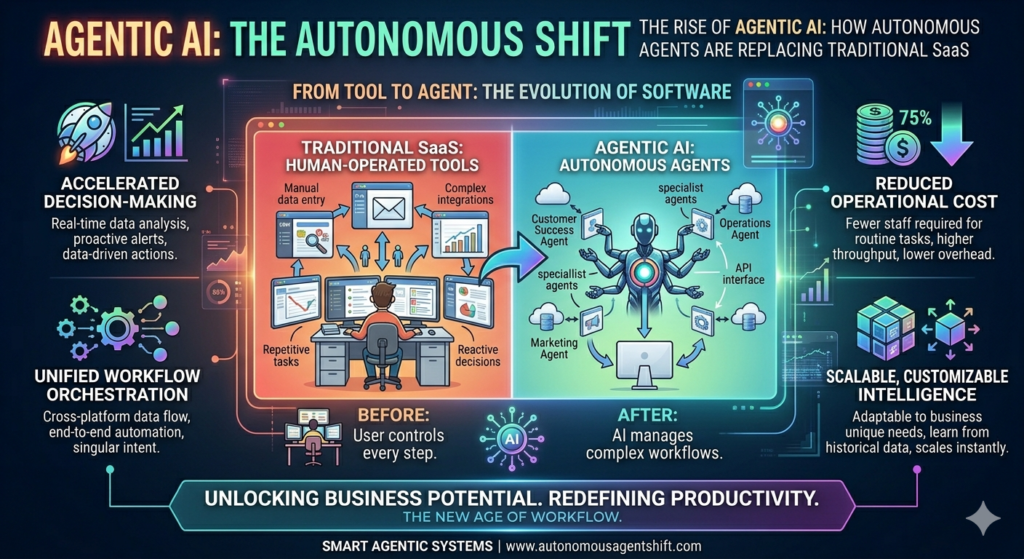
For the past two decades, the SaaS model was built on a simple premise: software packages repetitive human tasks into a standardized interface. Companies bought Customer Relationship Management (CRM) systems like Salesforce because it was better than managing Excel spreadsheets. They bought marketing automation because it was faster than manual outreach. But at the end of the day, a human still had to log in, click the buttons, and move the data .
Agentic AI flips this premise. Instead of a human operating a tool, the AI agent becomes the operator. It doesn’t just help a salesperson log a call; it analyzes the call transcript, updates the CRM, drafts a follow-up email, and schedules the next meeting—all without the human opening the Salesforce interface .
As one industry observer noted, “The user’s core demand is simply to get a compliant and accurate result. The simple ‘process固化’ (process solidification) itself is losing its core competitive advantage.” In other words, customers don’t want the software; they want the outcome the software was supposed to deliver .
The Numbers Don’t Lie
The market is reacting violently to this shift. When Anthropic released an update allowing Claude to call external functions in early 2026, it triggered a massive sell-off in software stocks, wiping out billions in market value . Investors are betting that the “seat-based” revenue model is under existential threat. If a single AI agent can do the work of five employees, why would a company buy five software licenses ?
2. Deconstructing the SaaS Triptych: Data, Logic, and Interface
To understand why agentic AI is so disruptive, we have to look at the architecture of a traditional SaaS application. It can be broken down into three layers:
- User Interface (UI): The visual dashboard and buttons.
- Business Logic: The rules and workflows (e.g., “If a lead scores above 80, notify the sales manager”).
- Structured Data: The actual customer records, transaction histories, and proprietary information.
In the Agentic era, the UI becomes ephemeral. If an agent can talk directly to the database via an API, why does it need a pretty dashboard? The agent can generate a UI on the fly if a human needs to see it, or it can simply execute the task in the background .
The Business Logic is moving to the Agent. Historically, the “logic” was the software’s moat. Today, with advanced reasoning models, the agent can figure out the best path to achieve a goal. If an AI agent receives a voice file and needs to transcribe it, but doesn’t have the right tool installed, it can figure out how to install one or find a workaround to complete the task. It doesn’t require the vendor to have pre-coded a “transcribe” button .
What remains—and what becomes more valuable than ever—is the Structured Data Layer. As Microsoft CEO Satya Nadella noted, SaaS applications are essentially “CRUD databases with business logic.” If the logic migrates to agents, the database (and the proprietary data within) becomes the true strategic asset .
3. The New Value Chain: Who Wins and Who Loses?
The rise of agentic AI is creating a massive divergence in the software industry. It is not the death of software, but the death of shallow software.
The Losers: Thin SaaS and Point Solutions
The most vulnerable companies are those that built their businesses on “漂亮UI + 简单集成” (pretty UIs + simple integrations) . If an application primarily serves as a nice interface on top of data that the customer already owns (or data that is publicly available), it is at high risk of being bypassed.
- GTM Tools (Gainsight, Zendesk, Outreach, Gong): These are often cited as “point solutions” that handle specific adjacent functions. An AI agent can now orchestrate all these functions—sales outreach, call analysis, support tickets—in one seamless workflow, eliminating the need for separate subscriptions .
- Horizontal Project Management: Generic to-do lists and project trackers are trivial for an agent to replicate.
The Winners: “The Data Landlords”
Conversely, companies that act as the “system of record” for complex, proprietary, or regulated data are not just surviving—they are thriving. They are becoming the “Backend Infrastructure” that every AI agent must pay to access .
- Bloomberg: They launched “ASKB,” an agentic interface on top of their terminal. They possess the world’s most comprehensive financial data. Any AI agent trying to do serious financial analysis must query Bloomberg. They are turning AI into a “提款机” (ATM) for their data .
- Epic Systems (Healthcare): Holding millions of patient records, they are indispensable. A general AI cannot guess a patient’s medical history; it must query Epic.
- Veeva (Life Sciences): Dominates pharmaceutical R&D data. Drug development agents cannot operate without it.
- Salesforce? Perhaps. While a thin CRM layer is vulnerable, Salesforce is attempting to move “down the stack” to become the definitive data layer (Data Cloud) and the Agentic platform (Agentforce), betting that agents will run on their infrastructure .
4. The Enterprise Reality: Adoption is Here, but Control is Key
While the narrative of “SaaS is dead” makes headlines, the reality inside enterprises is more nuanced. According to the Dynatrace Pulse of Agentic AI 2026 report, adoption is hitting an inflection point, but not without strict governance .
- Widespread Adoption: The average business now has 28 AI agents deployed, with plans to scale to 40 in the next year .
- The ROI is Real: Contrary to skepticism, 78% of AI automation projects are already delivering moderate to high value, with only 2.5% reporting failure .
- The Bottleneck is Trust: The number one barrier to scaling is not budget (only 15% cite this), but Security, Privacy, and Compliance (52%) . Companies are terrified of turning a rogue agent loose on their financial systems.
- Human-in-the-Loop Remains: Even as agents become autonomous, 69% of decisions are still verified by humans. The current model is a 50/50 split between human and AI collaboration for critical tasks .
This data reveals the actual transition path: We are moving from “SaaS” to “Service-as-Software” —where companies buy outcomes and automated labor—but they are doing so with strict “guardrails” and observability to ensure the agents don’t go off the rails .
5. The Architecture of the Future: The “Post-SaaS” Stack
If we are moving past the era of the monolithic SaaS app, what replaces it? A new architecture is emerging, defined by three distinct layers :
- The Queryable Data Layer (The Asset): This is the structured, governed, and secure repository of proprietary data. It is not a data lake dump; it is a set of stable, versioned APIs (or MCP servers) that agents can reliably query. The value is here.
- The Orchestration Layer (The Brain): This is the AI agent itself or a platform that manages a swarm of agents. It holds the “context” (memory) of the business goals and decides which tools to call.
- The Ephemeral Interface Layer (The Skin): Instead of a permanent dashboard, interfaces are generated on the fly. If a user needs to review a report, the agent generates a visualization. If not, the task is completed silently in the background. Code is becoming disposable.
The Klarna Case Study
Klarna effectively demonstrated this architecture. They extracted their customer and transaction data from Salesforce and Workday, consolidated it into a graph database, and made it queryable by internal AI. They then used AI to generate custom interfaces (with tools like Cursor) on demand. The result? They eliminated hundreds of SaaS licenses because they realized they didn’t need Salesforce’s interface; they just needed the data they had put into Salesforce .
6. The Future: What Survives?
If software is moving to the background, what kinds of applications will remain visible to users? Experts predict three categories of “front-end” software will survive the Agentic transition :
- Strong Creative Environments: Tools like Figma, Adobe, and IDEs (like VS Code). These are spaces where humans want to collaborate with AI in a high-density, iterative loop. Users don’t just want the output; they enjoy the process of creation.
- Strong Network Effects: Social media (TikTok, LinkedIn), marketplaces, and messaging apps. AI can’t replace the fact that “people are already there.” The value is the network, not the interface.
- Strong Reality Connectors: Apps that control hardware, payments, logistics, and identity. The agent may book the Uber, but the Uber app is the one that connects to the driver’s car and handles the payment.
Conclusion
We are entering the “Post-SaaS” era. The shift from Software-as-a-Service to Service-as-Software is not just a technical upgrade; it is a fundamental restructuring of economic value in the digital world .
For the next decade, value will not accrue to those who build the best buttons or the prettiest dashboards. It will accrue to those who own the irreplaceable data that agents need to function, and to those who build the reliable, governed orchestration layers that enterprises trust to run their operations autonomously .
Software isn’t dying. It’s just becoming invisible.