The Rise of Edge AI: Why On-Device Machine Learning is the Future of Privacy
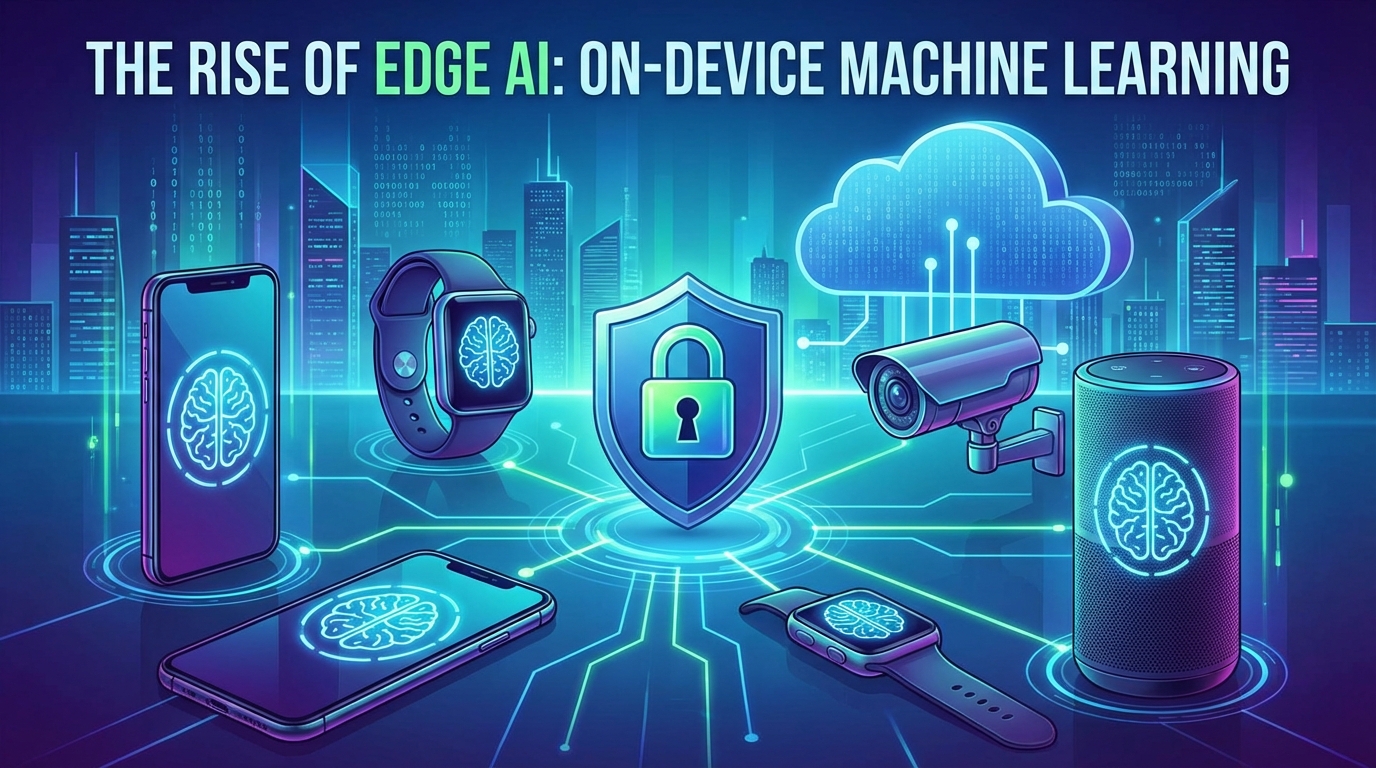
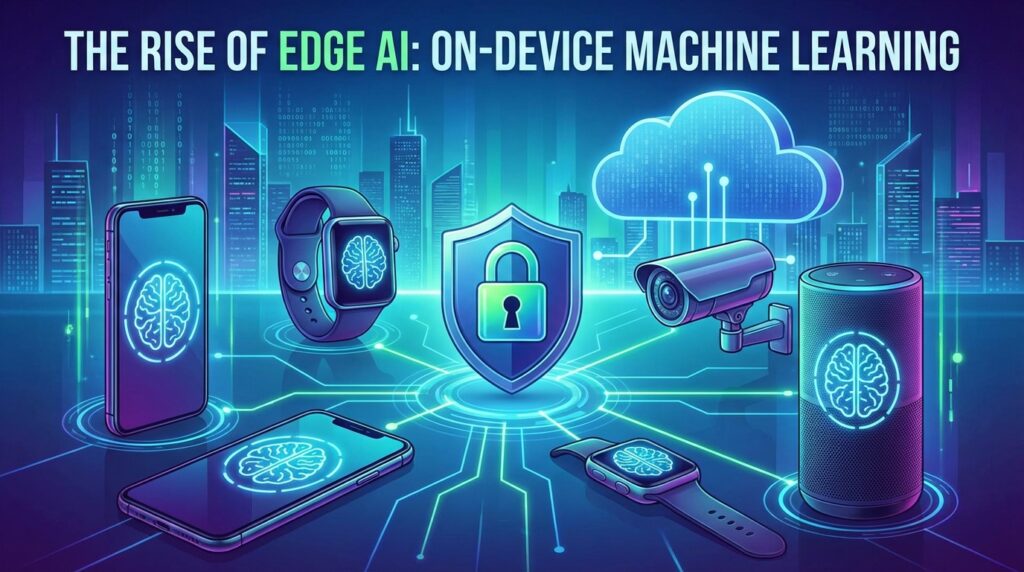
The Rise of Edge AI: Why On-Device Machine Learning is the Future of Privacy, The artificial intelligence landscape is undergoing a fundamental power shift—one that moves intelligence from massive cloud data centers to the devices in your hands, on your wrists, and around your home. This transition, known as Edge AI, represents not just a technological evolution but a philosophical one: the belief that your data should stay yours.
After years of centralized cloud dominance, where every query traveled to distant servers for processing, a new paradigm is emerging. In 2026, machine learning models are being compressed, optimized, and deployed directly onto smartphones, sensors, cameras, and industrial equipment. The driving force behind this shift isn’t just speed or cost—it’s privacy.
What Is Edge AI?
Edge AI refers to the deployment of artificial intelligence algorithms directly on hardware devices at the “edge” of the network—closer to where data is generated—rather than relying on centralized cloud servers.
Think of it as the difference between calling a friend to ask what’s in your refrigerator versus opening the door and looking yourself. The cloud-based approach requires you to send your data (the question) to a distant server, wait for processing, and receive a response. Edge AI processes everything locally, on the device, without any external communication.
The Four Pillars of Edge AI
| Pillar | Description | Impact |
|---|---|---|
| Real-Time Processing | Decisions happen in microseconds, not milliseconds | Critical for autonomous vehicles, industrial safety |
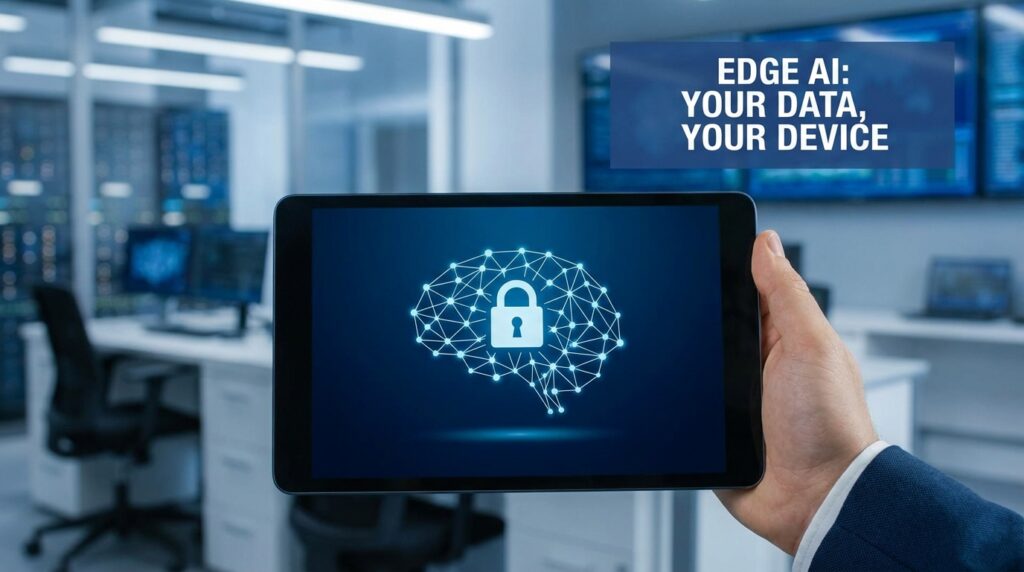
| Privacy by Design | Data never leaves the device | Eliminates cloud transmission risks |
| Bandwidth Efficiency | Only insights, not raw data, travel to cloud | 60-80% reduction in data transmission |
| Offline Operation | Full functionality without internet connectivity | Resilient systems, global accessibility |
The Privacy Imperative: Why Cloud-Based AI Is Failing Users
For years, the dominant architecture for AI has been cloud-centric: your data travels to centralized servers, where powerful models process it and return results. This model has delivered remarkable capabilities, but it comes with significant privacy costs.
The Exposure Problem
Every piece of data sent to the cloud—voice recordings, facial images, personal documents, behavioral patterns—creates exposure risk. Even with encryption in transit and at rest, data must be processed on servers owned by third parties. Breaches, insider threats, and government data requests all become possible.
Dr. Roman Orús, Co-founder and Chief Scientific Officer at Multiverse Computing, explains the consumer shift: “Privacy is the primary driver for consumers, offering the core benefit of data ownership. By processing sensitive information, such as conversations, documentation, and personal planning on a local machine, users eliminate the risk of data leaks and retain full control, bypassing privacy concerns associated with third-party cloud providers”.
The Regulatory Pressure Cooker
Governments worldwide are responding to privacy concerns with increasingly strict regulations. The EU AI Act requires documentation of model energy consumption, while data protection standards across Europe incentivize architectures that minimize raw data movement.
For healthcare organizations handling sensitive patient data, compliance with HIPAA and similar regulations becomes dramatically simpler when data never leaves the premises. As one analysis notes, “healthcare organizations are exploring similar approaches, where ultra-compressed AI models enable complex AI-driven diagnostics to run locally on devices like hospital workstations and secure private clouds”.
The Trust Deficit
Beyond regulation lies a more fundamental issue: trust. Users are increasingly aware that their interactions with cloud AI systems may be logged, reviewed by humans, or used for model training. This awareness creates hesitation—a friction that limits adoption for sensitive applications.
Edge AI eliminates this concern entirely. When processing happens locally, there’s literally nothing to intercept, no server to breach, no third party to trust.
How Edge AI Preserves Privacy: Technical Mechanisms
Edge AI isn’t just a philosophical stance—it’s backed by concrete technical capabilities that fundamentally change the privacy calculus.
On-Device Biometric Authentication
Perhaps the most striking example of Edge AI’s privacy potential is in biometric authentication. Traditional biometric systems send facial images, voice samples, or fingerprint data to cloud servers for verification, creating obvious privacy and security risks.
TinyML—machine learning on ultra-low-power microcontrollers—changes this entirely. As documented in peer-reviewed research, TinyML models deployed on smartphones, wearables, and IoT sensors allow biometric data such as facial recognition, voice patterns, and even physiological signals like ECG (electrocardiogram) to be processed locally.
The workflow is transformative:
- Local capture: Your device captures the biometric signal
- On-device inference: The TinyML model verifies the signal against a stored template
- Token generation: An ephemeral, cryptographically secure token is created
- Cloud authentication: Only the token—not your biometric data—is transmitted
This approach eliminates the need to transmit raw biometric features to external servers, reducing both bandwidth requirements and potential exposure of personally identifiable information.
Federated Learning: Training Without Sharing
Federated learning represents another breakthrough for privacy-preserving AI. Instead of sending user data to a central server for model training, federated learning sends model updates from devices to the cloud—without any raw data ever leaving the device.
How it works:
- A base model is distributed to thousands of devices
- Each device trains locally on its own data
- Only the model updates (mathematical gradients) are transmitted to the cloud
- The cloud aggregates updates from all devices to improve the global model
- Raw data never leaves individual devices
This approach aligns with global privacy regulations while maintaining the adaptability of AI systems to new patterns and usage scenarios.
Zero Trust Architecture at the Edge
Edge AI naturally supports Zero Trust Architecture (ZTA) principles. Rather than assuming any network or service is safe, ZTA verifies every request as though it originates from an open network. Edge AI’s local processing and ephemeral token generation fit perfectly within this framework.
Trusted Execution Environments (TEEs) and secure boot mechanisms ensure that models cannot be tampered with or extracted by malicious actors, providing hardware-level protection for on-device inference.
The Market Reality: Edge AI Is Exploding
The shift to Edge AI isn’t theoretical—it’s already happening at remarkable scale. Market data reveals explosive growth across multiple segments.
Market Size and Projections
The numbers tell a compelling story. According to comprehensive market research:
| Market Segment | 2025 Value | 2026 Value | 2032 Projection | CAGR |
|---|---|---|---|---|
| Edge AI Market (Total) | $27.66 billion | $32.48 billion | $88.72 billion | 18.11% |
| Edge AI Software | $2.29 billion | $2.9 billion | $7.32 billion | 26.7% |
The Edge Artificial Intelligence Market was valued at USD 2.64 billion in 2025 and is projected to grow at a CAGR of 11.15%, reaching USD 5.54 billion by 2032.
What’s Driving This Growth?
Multiple converging factors are accelerating Edge AI adoption:
5G Network Expansion: With global 5G connections reaching nearly 2 billion in early 2024 and projected to hit 7.7 billion by 2028, the infrastructure for edge computing is becoming ubiquitous.
Model Compression Advances: Ultra-compressed AI models are enabling a transition “from the data centre to the device, making Edge AI applications both practical and essential”. Manufacturers are increasingly embedding compressed models directly into hardware.
Privacy Regulation: The regulatory emphasis on data sovereignty has “incentivized architectures that minimize raw data movement and favor local inference and anonymized aggregated telemetry”.
Cost Pressures: Edge processing dramatically reduces bandwidth costs and cloud compute expenses, making it economically attractive at scale.
Industries Being Transformed by Edge AI
Healthcare: Patient Data That Never Leaves
Healthcare represents one of the most compelling use cases for privacy-focused Edge AI. Medical data is among the most sensitive information imaginable, and regulations like HIPAA impose strict requirements on its handling.
Edge AI enables “complex AI-driven diagnostics and patient history summarization to run locally on devices like hospital workstations and secure private clouds”. This localization ensures that “highly sensitive patient data remains within the organization’s firewall, upholding strict data privacy and ethical requirements”.
Wearable health devices are also benefiting. Smart wristbands can continuously monitor heart rhythm or motion patterns using accelerometer and PPG sensors. A trained TinyML model deployed directly on the device can verify biometric signals against stored templates without ever transmitting data to external servers.
Defense and National Security
The defense sector has been an early adopter of Edge AI for obvious reasons: military operations often take place in austere environments where network connectivity is limited or contested.
“By embedding AI directly into platforms like drones, ground vehicles, naval ships, and wearable soldier systems, military forces gain operational resilience and speed,” Orús explains. Applications include immediate situational awareness, where AI detects threats and anomalies from real-time sensor feeds locally, and autonomous navigation for unmanned vehicles in hostile environments.
The privacy implications here extend beyond personal data to national security: sensitive operational intelligence never leaves the tactical edge.
Manufacturing and Industrial IoT
Smart factories represent a sweet spot for Edge AI. A manufacturing facility might have hundreds of IoT sensors generating gigabytes of data daily. Transmitting all this to the cloud is expensive and slow.
Edge processing analyzes data locally and transmits only insights. In documented implementations, this approach achieved:
- 35% reduction in unplanned equipment downtime
- 50% faster detection of quality issues
- 60% reduction in internet bandwidth requirements despite 10x increase in sensor data volume
Autonomous Vehicles
Self-driving cars are perhaps the most visible example of Edge AI. A vehicle can’t afford the 500ms round-trip to the cloud to decide whether to brake. Every perception, planning, and control decision must happen locally, in real-time.
Cloud processing complements local systems by analyzing driving patterns and updating vehicle software, but the safety-critical decisions happen at the edge—where they belong.
Consumer Electronics: Your Personal, Private AI
The most personal applications of Edge AI are arriving in consumer devices. “Laptop manufacturers and consumer electronics providers are increasingly embedding compressed AI models directly into the hardware,” enabling “the creation of an ultra-personalised digital assistant, everyone’s very own ChatGPT, that runs locally”.
This local AI offers dramatic advantages: improved response speed, offline operation, and complete privacy. Your conversations with your personal AI assistant remain on your device, not on some corporate server.
The Security Paradox: Is Edge AI Actually Safer?
One of the most important debates in Edge AI concerns its security implications. The answer, perhaps surprisingly, is nuanced.
The Case for Edge Security
Proponents argue that edge computing is inherently more secure because it reduces the attack surface. As the CTO of Purecontrol notes, “it is much easier to secure a single point than 150 remote sites”. When data never leaves the device, there’s nothing to intercept in transit, and no centralized database to breach.
Edge AI also enables more granular security controls. On-device processing with ephemeral token generation means that even if a token is intercepted, its validity is limited in time and scope.
The Case for Cloud Security
However, edge computing introduces its own security challenges. “Each device on site becomes a point of vulnerability that will have to be patched, supervised, audited, protected,” warns Gautier Avril, CTO of Purecontrol. “If a system is not maintained it is an open door to cyberattacks”.
The decentralized nature of edge deployments creates management complexity. While a cloud provider can secure a single data center with world-class expertise, edge devices may be deployed in uncontrolled environments with inconsistent maintenance.
The Balanced View
The security comparison isn’t absolute—it depends on context. For organizations with strong device management capabilities, edge computing can be more secure. For those lacking robust patch management and monitoring, the cloud’s centralized security may be preferable.
The industrial sector has learned this lesson through experience. As Avril notes, “we saw the same logic as in the 2010s: self-hosted email servers gave the impression of being more secure than cloud solutions such as Office365 or Gmail. It seems a long way off today, and some have learned it the hard way”.
The Hybrid Future: Not Either/Or, But Both
The emerging consensus is clear: the future isn’t Edge AI or Cloud AI—it’s both, working in intelligent orchestration.
Intelligent Routing
Future architectures will employ what Multiverse Computing calls a “small ‘Router AI’ to intelligently balance power, deciding whether to process a request instantly on the local, compressed model or route it to the cloud for more complex, intensive tasks”.
This hybrid approach delivers the best of both worlds: privacy and speed for routine operations, cloud-scale power for complex analysis.
Distributed Processing Hierarchies
The technical architecture of hybrid Edge AI typically involves multiple layers:
| Layer | Function | Example |
|---|---|---|
| Device Edge | Immediate inference on sensors, phones | Face unlock, wake word detection |
| Fog Nodes | Local aggregation, intermediate processing | Factory floor controller |
| Network Edge | Regional processing, model updates | 5G base station |
| Cloud | Global aggregation, heavy training | Cross-site analytics |
This hierarchical approach allows organizations to “distribute workloads dynamically according to latency, bandwidth, and privacy considerations”.
Challenges and Limitations
Edge AI isn’t a panacea. Several significant challenges remain.
Computational Constraints
Edge devices have far less computational power than cloud systems. Running state-of-the-art models on microcontrollers is impossible without aggressive optimization. Solutions like quantization, pruning, and knowledge distillation reduce model size while maintaining acceptable accuracy, but trade-offs exist.
Model Update Complexity
Cloud systems update models continuously. Edge systems spread across thousands of devices are harder to update. Organizations must establish robust over-the-air update mechanisms enabling efficient deployment of model updates to edge fleets.
Heterogeneous Hardware
Edge devices vary dramatically—a factory sensor runs on an ARM processor with limited memory, while a retail display uses more powerful hardware. Building systems that support diverse hardware is challenging, though inference engines supporting multiple targets (TensorFlow Lite, ONNX, OpenVINO) help abstract hardware differences.
Monitoring and Debugging
When edge systems malfunction, diagnosing problems is harder than with centralized cloud systems. Implementing edge observability that sends telemetry about system performance, errors, and anomalies to cloud systems provides visibility without requiring raw data transmission.
The Path Forward: What This Means for You
For Consumers
The shift to Edge AI means you can expect more powerful on-device intelligence in your phones, laptops, and wearables. Your personal AI assistant will increasingly run locally, understanding your patterns without sending your data to the cloud. Voice commands, facial recognition, and behavioral authentication will happen instantly and privately.
For Businesses
Organizations should begin evaluating which workloads are suitable for edge deployment. The key question isn’t whether to use edge or cloud—it’s which processing belongs where. Low-latency, privacy-sensitive, or high-volume tasks are prime candidates for edge. Complex, compute-intensive, or cross-context analysis may remain in the cloud.
Start small. Begin with one location or device type. Prove value before scaling.
For Developers
Edge AI requires different expertise than cloud AI. You need people understanding both AI and embedded systems, IoT infrastructure, and distributed systems. Investing in model optimization skills—quantization, pruning, knowledge distillation—will become increasingly valuable.
Conclusion
Edge AI represents more than a technological shift—it’s a rebalancing of the relationship between users and their data. After years of centralized cloud dominance, intelligence is returning to the edge, bringing privacy, speed, and resilience along with it.
The drivers are clear: consumers demand data ownership, regulators require data protection, and technologists have finally cracked the code of running sophisticated models on constrained devices. The result is a new architecture that keeps sensitive information exactly where it belongs—with the user.
As Dr. Orús notes, “The industry is entering a period where local LLMs will become genuine competitors to cloud-based services. This fundamental shift is driven by ultra-compressed AI models that are enabling a transition from the data centre to the device”.
The future of AI isn’t just about what models can do—it’s about where they do it. And increasingly, that future is happening right at the edge, on devices we already trust with our most personal information.