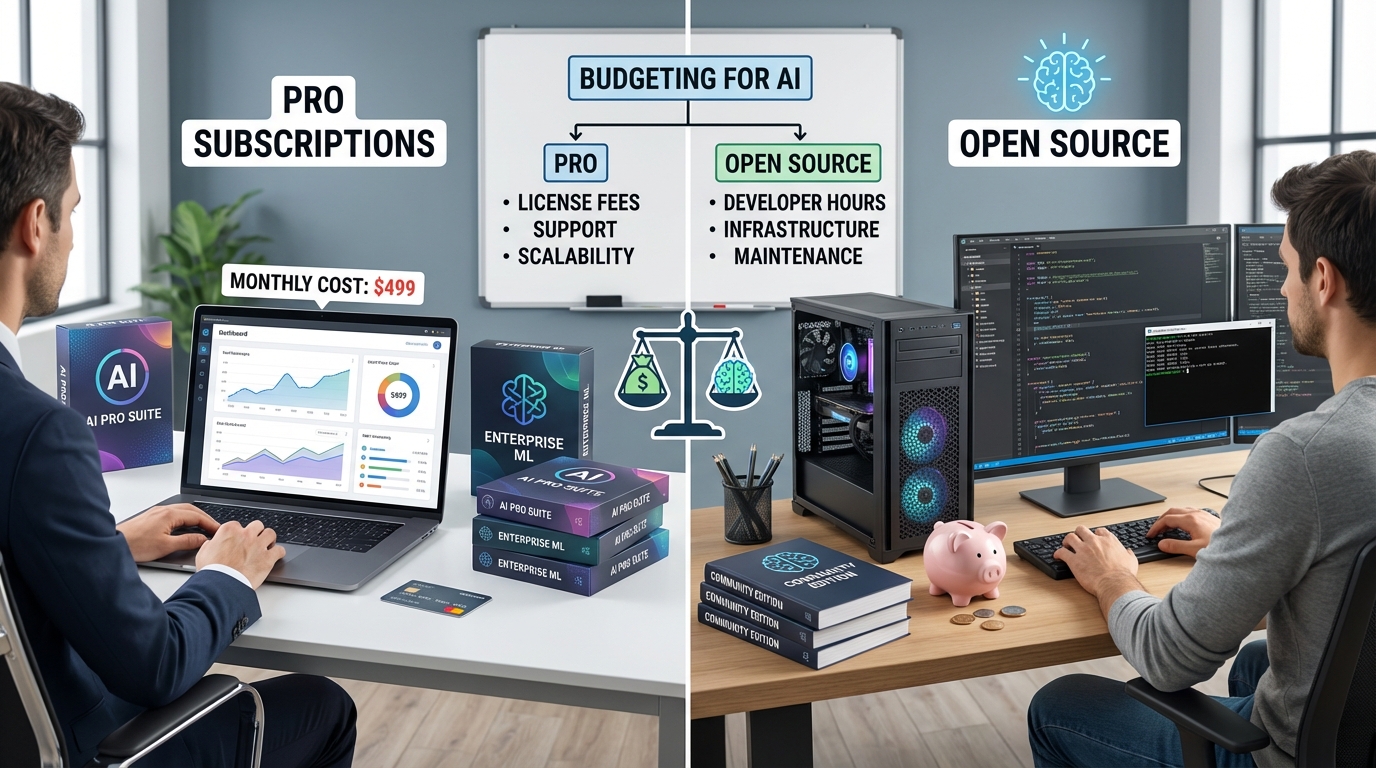
The Cost of AI Implementation: Budgeting for Pro Subscriptions vs. Open Source
The Cost of AI Implementation: Budgeting for Pro Subscriptions vs. Open Source in 2026, The AI landscape has transformed dramatically. The question is no longer whether to adopt AI, but how to pay for it—and the financial implications of that choice extend far beyond the monthly subscription fee on your credit card statement.
In 2026, organizations and individuals face a fundamental decision: pay for premium cloud subscriptions or invest in open-source, self-hosted alternatives. Each path carries distinct cost structures, trade-offs, and hidden expenses that aren’t immediately obvious. This guide breaks down the real economics of AI implementation, helping you make a decision based on your actual usage patterns, privacy requirements, and technical capabilities.
The Big Picture: What MIT Research Reveals
Before diving into specific costs, consider this striking finding from MIT Sloan research: closed, proprietary models account for nearly 80% of AI token usage, despite costing six times more than open alternatives . Open models achieve about 90% of the performance of closed models at the time of release and quickly close the gap, yet most users still opt for the premium option .
The researchers calculated that optimal substitution from closed to open models could save the global AI economy approximately $25 billion annually . This suggests a massive opportunity for cost optimization—but only for organizations willing to navigate the complexities of open-source deployment.
Understanding the “Open” Spectrum
Not everything labeled “open” is truly open. The term has become dangerously diluted in AI marketing .
| Category | What You Get | Typical Licenses | Commercial Safety |
|---|---|---|---|
| Open Source (Strict) | Weights, training data, and full ability to modify | OSI-approved | Total freedom |
| Open-Weights | Downloadable model “brains,” but training data remains closed | Apache 2.0, MIT | High; generally safe for commercial products |
| Source-Available/Terms-Based | Weights are downloadable, but legal terms restrict usage | Llama Community, Gemma Terms | Restricted; includes usage thresholds (e.g., >700M users) |
For commercial deployment, Apache 2.0 or MIT licenses are the safest choices. Models like Llama use Community Licenses with restrictions you should read carefully before shipping anything .
Cloud Subscription Costs: The 2026 Pricing Landscape
Consumer and Pro Tiers
The subscription market has stratified into clear tiers, with competition driving prices down at the entry level.
| Provider | Plan | Monthly Price | Key Features |
|---|---|---|---|
| AI Plus | $7.99 | Gemini 3 Pro, 200 AI credits, 200GB storage | |
| AI Pro | $19.99 | Gemini 3 Pro, 1,000 AI credits, 2TB storage | |
| AI Ultra | $250 | Full feature access, highest capacity | |
| OpenAI | ChatGPT Go | $8 | Entry-level access |
| Microsoft | Copilot (E5) | $60 | Included in Microsoft 365 E5 |
| Microsoft | Copilot (E7) | $99 | Premium AI features including Copilot Cowork |
Google’s AI Plus plan, launched at $7.99 per month (with 50% off for the first two months as of early 2026), represents the new floor for paid consumer AI . Existing Google One Premium 2TB subscribers ($9.99/month) automatically receive AI Plus benefits, creating a compelling bundling option .
Microsoft’s enterprise pricing tells a different story. The company increased Office suite prices by 65% to accommodate AI features, with the high-end E7 package costing $99 per user per month . This reflects the reality that enterprise AI comes at a significant premium.
API Pricing: Pay-as-You-Go for Developers
For developers and organizations building applications, per-token pricing remains the standard model. As of mid-2025 (the most recent comprehensive data available), prices were:
| Model | Provider | Input (per 1M tokens) | Output (per 1M tokens) |
|---|---|---|---|
| GPT-4.1 | OpenAI | $2.00 | $8.00 |
| GPT-4.1 mini | OpenAI | $0.40 | $1.60 |
| GPT-4.1 nano | OpenAI | $0.10 | $0.40 |
| Claude 4 Sonnet | Anthropic | $3.00 | $15.00 |
| Claude 4 Opus | Anthropic | $15.00 | $75.00 |
| Gemini 2.5 Pro | $1.25–$2.50 | $5.00–$10.00 | |
| Llama 4 Maverick (hosted) | Together/Fireworks | $0.20–$0.50 | $0.50–$1.20 |
| Qwen 3 235B (hosted) | Together/Fireworks | $0.15–$0.40 | $0.40–$1.00 |
Note: GPT-5 pricing was not publicly confirmed at the time of data collection . Hardware and API prices fluctuate; verify current figures before making decisions.
Open-weight models hosted on platforms like Together.ai and Fireworks.ai are dramatically cheaper—often 80-90% less than premium proprietary APIs . The trade-off is variable availability under peak load and less predictable latency.
Hidden Cloud Costs
The per-token price is only the beginning. Cloud APIs carry several hidden expenses :
- Rate limits force you to build retry logic, backoff handlers, and request queues
- Egress fees and payload overhead add an estimated 5-15% to the raw token bill
- Vendor lock-in carries real switching costs—re-engineering prompts, rebuilding evaluation suites, and validating output quality regressions
- Compliance add-ons for data residency and zero-retention agreements push enterprise costs 20-40% higher
Annual Projections by Usage Tier
Assuming a 3:1 input-to-output token ratio (typical for general assistant workloads), here’s what you can expect to pay annually :
| Tier | Daily Volume | OpenAI (GPT-4.1) | Anthropic (Sonnet) | Open-Weight API |
|---|---|---|---|---|
| Light | 500K tokens | $1,260 | $1,800 | $360 |
| Medium | 5M tokens | $12,600 | $18,000 | $3,600 |
| Heavy | 50M tokens | $126,000 | $180,000 | $36,000 |
For batch-eligible workloads, OpenAI’s Batch API offers a 50% discount. Volume discounts (typically above $5K/month spend) can reduce figures by 10-25%, but they require contractual commitments .
Open Source and Self-Hosted: The Hardware Reality
The appeal of open-source is obvious: no subscription fees, complete data sovereignty, and unlimited usage after the initial investment. But that initial investment can be substantial.
The GPU Requirements
Your GPU’s VRAM (video RAM) is the single most important specification for running local LLMs. Here’s what different tiers can handle :
| GPU VRAM | Comfortable Model Size | What to Expect |
|---|---|---|
| 8GB | ~3B to 7B parameters | Fast responses, basic coding assistance |
| 12GB | ~7B to 10B parameters | The “daily driver” sweet spot; solid reasoning |
| 16GB | ~14B to 20B parameters | Noticeable capability jump; better code generation |
| 24GB+ | ~27B to 32B parameters | Near-frontier quality; great for RAG and long documents |
Hardware Configurations by Tier
Entry-Level (Personal Use):
- RTX 4060 / 8GB VRAM: ~$300
- Can run models like Ministral 3 8B or Qwen3 8B
- Total system cost: ~$800-1,200
Sweet Spot (Prosumer):
- RTX 4090 / 24GB VRAM: $800-1,200 (used) to $1,600+ (new)
- Can run quantized 70B models with comfortable context lengths
- Total system cost: ~$2,000-3,000
Premium Consumer:
- RTX 5090 / 32GB VRAM: ~$2,000 (MSRP; street prices may be 20-50% higher)
- Represents the current consumer ceiling
- Total system cost: ~$3,500-5,000
Apple Silicon Alternative:
- Mac Studio M4 Ultra with 192GB unified memory: $5,999
- Unified memory allows running much larger models than discrete GPUs
- More power-efficient but higher upfront cost
Quantization: The Secret to Running Big Models on Small Hardware
Quantization reduces model precision, shrinking memory requirements while accepting a controlled quality loss. The industry standard—Q4_K_M—retains about 95% of original performance while reducing memory by roughly 75% .
For a 70B-parameter model:
- FP16 (no quantization): ~140 GB (won’t fit on any consumer GPU)
- Q4_K_M: ~40 GB (fits on a single RTX 4090 or 5090)
Bottom line: With quantization, a $2,000 consumer GPU can run models that would otherwise require $20,000+ enterprise hardware.
The Hidden Costs of Self-Hosting
The hardware purchase is just the beginning. Real-world deployments reveal several ongoing expenses :
Electricity:
- RTX 4090 consumes ~450W at full load
- Running 8 hours/day: ~$65/month in electricity (at $0.12/kWh)
- Running 24/7: ~$200/month
Hardware Depreciation:
- GPUs have an average lifespan of 3-5 years
- Annual depreciation on a $1,500 GPU: $300-500
Human Maintenance:
- Deployment and debugging typically consumes a week or more of engineer time
- Ongoing updates, dependency management, and performance tuning add continuous overhead
- One team reported that due to time zone constraints, their GPU sat idle for two-thirds of the day
The Open-Source Success Story: When Free Forced a Price Drop
In January 2026, a fascinating market event demonstrated the power of open-source competition. Anthropic had been charging $100/month for “Cowork”—an AI agent that could perform multi-step desktop tasks. Developers, finding this too expensive, built Openwork in just 48 hours .
Openwork was free, open-source, ran locally, and was actually 4 times faster than the official version. Within days, Anthropic dropped Cowork’s price to $20/month, making it available to Pro subscribers .
This illustrates a crucial dynamic: open-source serves as a pricing ceiling for commercial AI products. When the open-source alternative is good enough, vendors cannot maintain excessive premiums.
The Total Cost of Ownership (TCO) Calculation
Let’s compare the true costs over 12 and 36 months for a medium-usage scenario (5M tokens/day).
Cloud API Path (12 Months)
- API costs: $12,600 (OpenAI GPT-4.1)
- Integration labor: ~$5,000 (assuming 3-6 hours/month of engineering time)
- Total: ~$17,600
Self-Hosted Path (12 Months)
- Hardware (RTX 5090 build): $4,500
- Electricity: $780 (assuming 8 hours/day)
- Setup labor: $5,000 (one-time, roughly one engineer-week)
- Ongoing maintenance: $3,000 ($250/month for updates, monitoring, troubleshooting)
- Total: ~$13,280
36-Month Comparison
| Path | 12 Months | 36 Months | Notes |
|---|---|---|---|
| Cloud API | $17,600 | $52,800 | Costs scale linearly with usage |
| Self-Hosted | $13,280 | $19,340 | Hardware depreciated; maintenance continues |
The break-even point for self-hosting occurs around month 10-14 for medium usage. For heavy usage (50M tokens/day), self-hosting becomes dramatically cheaper—often paying for itself within 3-6 months .
When Should You Choose Each Path?
Choose Cloud Subscriptions/APIs When:
Your usage is light and unpredictable. Pay-as-you-go models are perfect for experimentation and low-volume work. As the Chinese analysis noted, “if your monthly bill is under $15, just subscribe—it’s simpler” .
You need state-of-the-art performance. Frontier models like GPT-5 and Claude 4 Opus lead benchmark charts. If maximum capability matters more than cost, the cloud is your answer.
You lack engineering resources. Self-hosting requires significant technical expertise. For teams without dedicated ML engineers, the cloud’s “just works” experience is worth the premium .
Data privacy is moderate. While cloud APIs have improved, they still involve sending data to third parties. For non-sensitive work, this risk is acceptable.
Choose Open Source/Self-Hosted When:
Your monthly API bill exceeds $200-300. This is the rough threshold where hardware investment begins to make economic sense .
Data cannot leave your premises. Healthcare, finance, legal, and government work often requires complete data sovereignty. Local inference eliminates the most uncomfortable compliance question: “Where does the data go?” .
You have predictable, high-volume usage. Once you know your usage patterns, the marginal cost of local inference approaches zero. Cloud costs scale linearly forever.
You need offline access. Air-gapped environments and unreliable internet connections make cloud APIs impractical.
You want to avoid vendor lock-in. Switching cloud providers means re-engineering prompts and rebuilding evaluation suites. Local models give you complete control.
The Hybrid Approach: Best of Both Worlds
For many organizations, the optimal strategy isn’t choosing one path—it’s using both strategically .
Intelligent Routing: Use local small models (e.g., Qwen2.5-Coder-7B via Ollama) for routine tasks like code completion and document generation. Route complex reasoning tasks to cloud APIs. This approach can save 60-75% of token costs while preserving access to top-tier models when needed .
Development vs. Production: Use cloud APIs during rapid prototyping and experimentation. Once patterns stabilize, deploy optimized local models for production workloads.
Sensitive vs. Non-Sensitive: Keep sensitive data and proprietary code on local infrastructure. Use cloud APIs for public information and general assistance.
Tools like Continue.dev and IfAI now offer built-in intelligent routing, automatically directing queries to the most appropriate model based on complexity and privacy requirements .
Beyond Models: The Full AI Implementation Budget
Whether you choose cloud or open-source, AI implementation costs extend far beyond the model itself.
Development Cost Ranges (2026)
| Project Type | Cost Range | Timeline |
|---|---|---|
| Proof of Concept | $25,000 – $75,000 | 6-12 weeks |
| MVP Implementation | $75,000 – $250,000 | 3-6 months |
| Mid-Scale Production | $250,000 – $750,000 | 6-12 months |
| Enterprise AI Platform | $750,000 – $3,000,000+ | 12-24+ months |
These figures reflect the reality that data preparation consumes 40-60% of AI budgets—often more than model development itself .
Hidden Long-Term Costs
Model Retraining: Models degrade as data distributions shift. Annual cost: 15-30% of initial development budget .
Monitoring and Drift Detection: Production systems need constant surveillance for accuracy degradation, data quality issues, and performance metrics. Annual cost: $10,000-100,000 depending on scale .
Data Growth: Success creates its own costs. More users → more data → higher storage bills → more processing power. Data costs compound at 20-50% annually for successful AI products .
Compliance and Governance: The EU AI Act and similar regulations now require formal compliance audits, bias monitoring, explainability documentation, and model traceability. These add 20-35% to total AI costs—often $100,000-300,000 per system .
Making the Decision: A Framework
Ask yourself these questions:
- What is your monthly token volume? If under 1M tokens, cloud is likely cheaper. If over 10M tokens, self-hosting probably wins.
- How sensitive is your data? Healthcare, finance, and legal work often mandate local deployment.
- Do you have ML engineering expertise? Self-hosting requires significant technical skill. If you don’t have it on staff, cloud is safer.
- How critical is latency? Local inference eliminates network round-trips, shaving 100-300ms per request.
- What is your tolerance for maintenance overhead? Self-hosting means owning updates, security patches, and 2 AM troubleshooting.
- Do you need offline access? Air-gapped environments require local deployment.
Conclusion
The cloud versus open-source decision in 2026 is not about which is universally “better.” It’s about matching your choice to your specific usage patterns, privacy requirements, and technical capabilities.
For most individuals and small teams, cloud subscriptions offer the simplest path to value. The $8-20/month price point is accessible, and the “just works” experience saves countless hours of configuration and maintenance .
For organizations with high volume, strict privacy requirements, or dedicated engineering resources, open-source self-hosting becomes increasingly attractive. The break-even point for medium usage occurs around month 10-14, after which the savings compound significantly .
For many, the optimal path is hybrid: local small models for routine tasks, cloud APIs for complex reasoning, and intelligent routing to optimize both cost and capability .
The MIT research offers a final perspective: open models achieve 90% of closed-model performance at 87% less cost, and optimal reallocation could save the industry $25 billion annually . Those savings are available to you—if you’re willing to navigate the complexities of open-source deployment.
The choice is yours. Just don’t make it based on the subscription price alone. The real cost of AI is far more interesting—and far more consequential—than the number on your monthly bill.