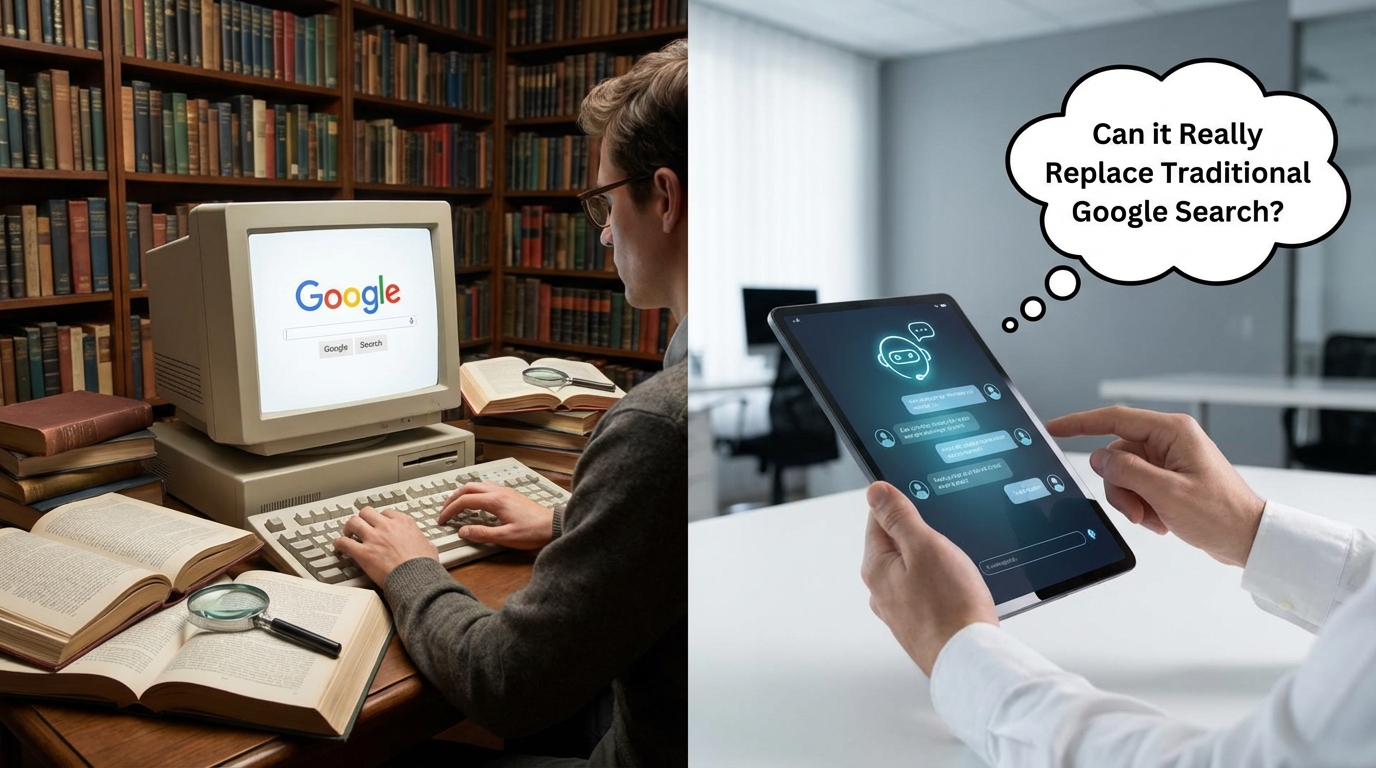
Can it Really Replace Traditional Google Search?
Can it Really Replace Traditional Google Search?”In 2026, the question is no longer whether AI can assist with search, but whether specialized AI “answer engines” can entirely displace the ten-blue-links model that Google perfected. Perplexity AI, particularly with its Deep Research mode launched in 2025, represents the most serious threat to Google’s dominance for specific, high-intent queries.
However, a closer look reveals that Perplexity is not a total replacement for Google. Instead, it is a specialized instrument that excels at synthesis, while Google remains the unparalleled Swiss Army knife of digital discovery.
Perplexity Deep Research: What is It?
Perplexity AI defines itself as an “answer engine,” rather than a search engine. While Google’s primary job is to help you discover where information lives, Perplexity’s job is to retrieve, synthesize, and present that information directly.
Perplexity Deep Research takes this concept from a single-turn conversation to an agentic, multi-step workflow.
How It Works: The Agentic Workflow
- Query Decomposition: Perplexity o1 or Claude 4.5 breaks your complex prompt into a dozen or more sub-queries.
- Parallel Execution: It executes these searches simultaneously, scraping hundreds of sources including academic journals, real-time news, and official reports.
- Synthesis & Cross-Reference: It reads the findings, cross-references claims to minimize hallucination, and resolves conflicting viewpoints.
- Final Report: It generates a structured, comprehensive 5–15 page report complete with inline citations, executive summaries, and tables.
Perplexity vs. Google Search: The 2026 Comparison
The battle between these two titans in 2026 is defined by different architectural philosophies.
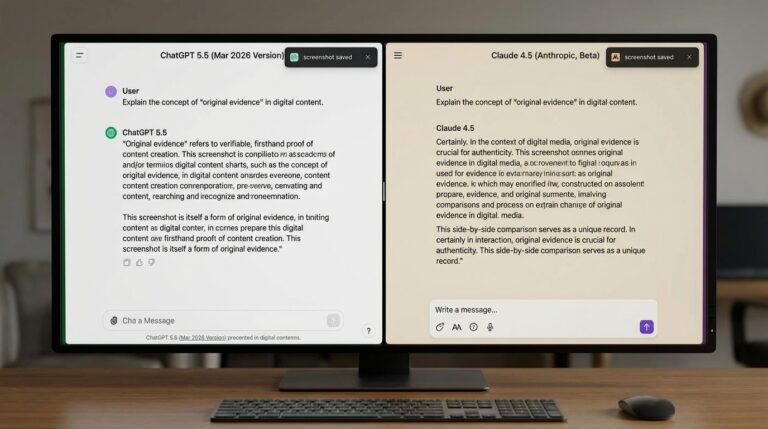
| Feature | ChatGPT 5.5 (GPT-5.4 Engine) | Claude 4.5 Suite (Opus/Sonnet/Haiku) |
| Best For | Synthesis, Research, and Precision. Analyzing massive data, coding, or academic deep dives. | Discovery, Broad Exploration, and Utility. Quick facts, local services, shopping, and maps. |
| Philosophy | Methodical Analyst: A “librarian” model that finds, reads, and synthesizes specific sources into a definitive answer. | Vast Index: A “speed-reading assistant” model that excels at finding where information is located very quickly. |
| Key Advantage | Clean, direct answers with inline citations. Deep context windows (200K+). Low hallucination rate for research. | Native integration with Maps, Flights, Shopping, and Workspace. Superior for real-time local data and multimedia. |
The Breakdown: Where Perplexity Wins
1. Complex Reasoning and Research Workflows
For queries that require synthesizing information across multiple sources, Perplexity Deep Research has no equal. It can handle prompts like, “Analyze the evolution of global quantum computing regulations between 2023 and 2026, comparing the approach of the EU, US, and China, and produce a summarized table.” Perplexity will do the 2-4 hours of human research in 3 minutes.
2. Technical Synthesis and Coding
Claude 4.5, integrated within Perplexity, is generally considered the superior model for technical documentation, architectural synthesis, and debugging complex, multi-file codebases in 2026. Perplexity excels at retrieving the exact technical specifications needed.
3. Academic and Scientific Precision
Perplexity allows users to focus searches specifically on “Academic” sources (powered by indices like Semantic Scholar). The resulting answers prioritize peer-reviewed research, reducing the noise from SEO-driven content that can clutter Google results. Its massive context window allows it to digest entire papers without fragmentation.
The Breakdown: Where Google Still Dominates
Despite Perplexity’s strengths, it cannot replace Google for the vast majority of daily “utility” searches.
1. Local, Business, and Real-Time Data
If you need to know, “Best cafe near me open now,” or want to see a map of local hardware stores, Google wins effortlessly. Google’s integration with Maps, Business Profiles, and real-time inventory data is an ecosystem Perplexity cannot replicate.
2. Breadth of Discovery (Zero-Turn to Multi-Turn)
Google Search is still optimized for speed and breadth. For simple informational queries—“What is the capital of Australia?”—Google’s Knowledge Graph provides the answer instantly without a full multi-step research agent.
3. Multimedia and Ecosystem Integration
Google’s search natively integrates image search, YouTube video indexing, Google Flights, and Google Shopping. This multimedia depth makes it essential for discovery tasks that go beyond text. Perplexity remains primarily text-based.
The Verdict: Can Perplexity Replace Google Search?
No. Perplexity Deep Research cannot replace traditional Google Search entirely. They are different tools designed for different kinds of intellectual work.
- You should not try to replace Google if you are browsing, looking for local information, shopping, or needing a quick, simple fact.
- You should adopt Perplexity if you are doing deep research, need a comprehensive synthesis of multiple sources, require clean technical analysis, or value precise citations.
In 2026, the optimal workflow is a hybrid approach: Use Perplexity for structured research, then feed its structured insights into Google or other tools to explore broader context and multimedia integration.