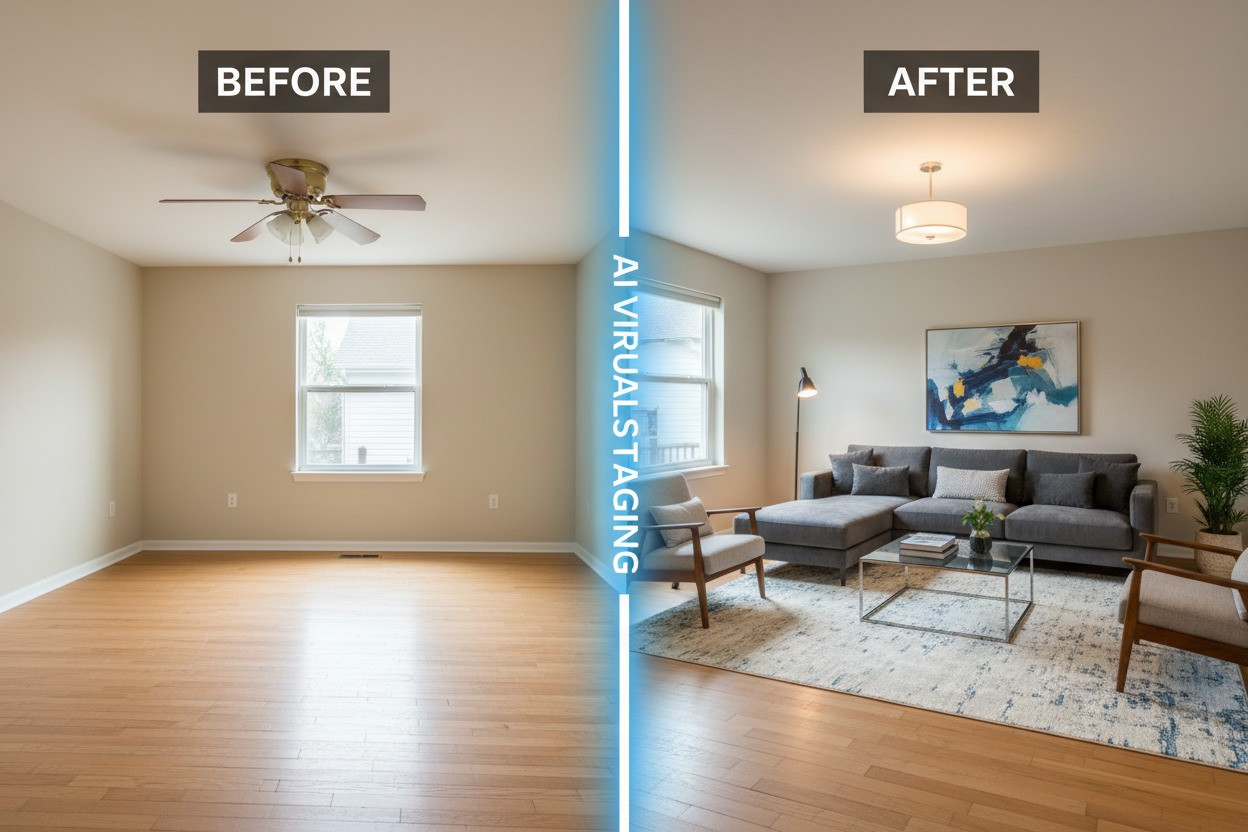
AI in Real Estate: How Virtual Staging and Predictive Analytics are Driving Sales
AI in Real Estate: How Virtual Staging and Predictive Analytics are Driving Sales in 2026, The real estate industry has traditionally been slow to adopt new technology. For decades, the formula remained unchanged: list a property, host open houses, negotiate offers, close. But in 2026, artificial intelligence has fundamentally rewritten that formula.
Two technologies, in particular, are transforming how properties are marketed and sold: virtual staging and predictive analytics. The first changes how buyers see properties. The second changes how agents and investors value them. Together, they are compressing sales timelines, increasing transaction values, and reshaping the economics of real estate.
For agents, brokers, investors, and homeowners, understanding these tools is no longer optional. In a market where buyers expect immersive experiences and sellers demand data-driven pricing, AI has moved from competitive advantage to baseline expectation.
The State of Real Estate in 2026
Before diving into the technologies, it’s worth understanding the market context driving their adoption.
Market Conditions
The real estate market of 2026 is defined by several converging factors:
| Factor | Impact |
|---|---|
| Inventory constraints | Limited housing supply in many markets increases competition for desirable properties |
| Higher interest rates | Buyers are more selective; properties must stand out to justify financing costs |
| Digital-native buyers | Millennials and Gen Z now dominate first-time homebuyer demographics; they expect online-first experiences |
| Remote work persistence | Location flexibility has expanded buyer pools; properties compete regionally, not just locally |
| Data availability | Property records, transaction histories, and consumer behavior data are more accessible than ever |
These conditions have created a market where speed and differentiation matter more than ever. Properties that sit unsold for months face significant price reductions. Properties that capture buyer attention quickly often sell above asking.
The Old Way vs. The New Way
| Traditional Approach | AI-Enhanced Approach |
|---|---|
| Professional photography | Virtual staging of multiple design styles |
| Open houses | 24/7 immersive virtual tours |
| Comparative market analysis (manual) | AI-powered price optimization |
| Gut-feeling pricing | Predictive analytics on market timing |
| Print brochures | Personalized digital marketing campaigns |
Virtual Staging: Transforming Property Presentation
What Is Virtual Staging?
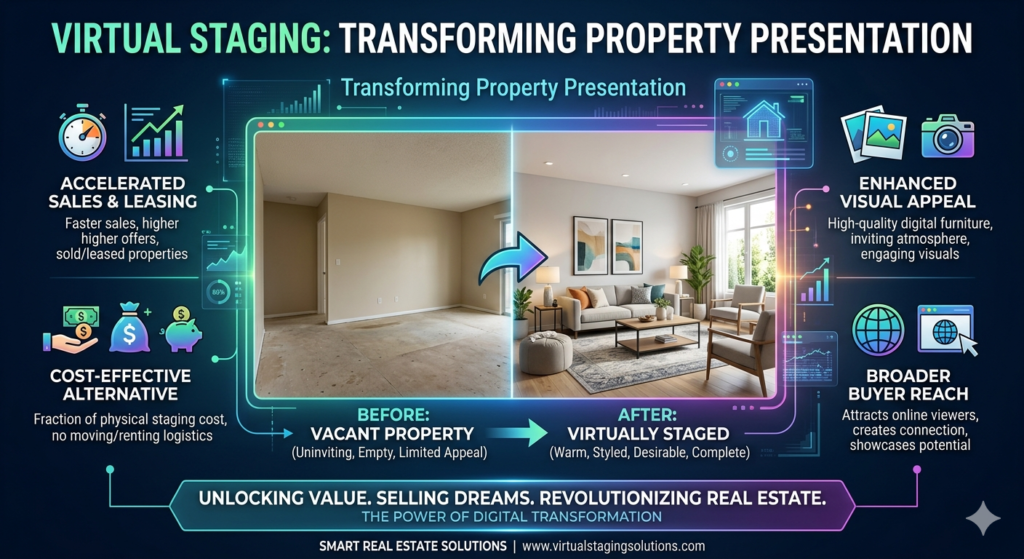
Virtual staging is the process of digitally furnishing and decorating empty or outdated property photos to help buyers visualize the potential of a space. Unlike traditional staging—which requires renting furniture, hiring movers, and scheduling installation—virtual staging happens entirely in software.
In 2026, virtual staging has evolved far beyond simply dropping generic furniture into room photos. Modern AI-powered virtual staging tools offer:
- Photorealistic rendering indistinguishable from traditional photography
- Multiple design styles (modern, traditional, minimalist, industrial, etc.)
- Style customization for different buyer demographics
- Virtual renovations (changing wall colors, flooring, countertops, cabinetry)
- Virtual decluttering of occupied properties
- Exterior enhancements (landscaping, paint, roofing)
- Virtual twilight and seasonal staging for curb appeal
How It Works
The technology behind modern virtual staging leverages the same generative AI capabilities found in tools like Sora 2, Midjourney, and DALL-E, but specialized for real estate applications.
The Process:
- Property photography: Standard MLS-quality photos are uploaded
- Room identification: AI detects room types, dimensions, and architectural features
- Empty space detection: AI identifies empty areas suitable for staging
- Furniture placement: AI selects appropriate furniture based on room dimensions and selected style
- Lighting and shadow matching: Rendered furniture matches the original photo’s lighting conditions
- Output generation: Final images are indistinguishable from traditionally staged photos
Leading platforms in 2026 include:
- BoxBrownie (industry veteran with AI-enhanced workflows)
- VirtualStaging.ai (specialized AI-first platform)
- Apply Design (high-end luxury market focus)
- PadStyler (international presence, multi-language support)
The ROI of Virtual Staging
The business case for virtual staging is compelling and well-documented.
Time on Market:
| Staging Method | Average Days on Market | Reduction |
|---|---|---|
| No staging | 45-60 days | Baseline |
| Traditional staging | 30-40 days | 25-33% |
| Virtual staging | 20-30 days | 50-60% |
Sale Price Impact:
According to industry data from 2025, staged homes (virtual or traditional) sell for 5-15% more than non-staged equivalents . Virtual staging achieves comparable results to traditional staging at a fraction of the cost.
Cost Comparison:
| Staging Method | Cost per Property | Notes |
|---|---|---|
| Traditional staging | $2,000 – $10,000+ | Ongoing rental fees, storage, logistics |
| Virtual staging | $50 – $500 per room | One-time cost, no physical logistics |
| Hybrid approach | $1,000 – $3,000 | Stage key rooms virtually; stage common areas physically |
For a $500,000 home, even a modest 5% price premium represents $25,000 in additional value—dramatically outweighing the minimal cost of virtual staging.
Beyond Empty Properties: Virtual Staging for Occupied Homes
Virtual staging isn’t just for empty properties. For occupied homes, AI can perform virtual decluttering and virtual renovations that help buyers see beyond current occupants’ belongings.
Use Cases:
- Virtual decluttering: Removing personal items, excess furniture, and visual distractions from photos
- Virtual renovations: Showing what outdated kitchens and bathrooms could look like after renovation
- Style neutralization: Replacing bold design choices (bright paint colors, eclectic decor) with neutral alternatives
- Room repurposing: Showing a spare bedroom as a home office, gym, or nursery
This capability is particularly valuable for properties that are still occupied during the listing period, where physical staging isn’t practical.
The Psychology of Virtual Staging
The effectiveness of virtual staging isn’t just about aesthetics—it’s about cognitive psychology.
Key Principles:
- Visualization reduces friction: Buyers struggle to imagine empty or cluttered spaces as homes. Virtual staging bridges the imagination gap.
- Emotional connection drives offers: Properties that evoke an emotional response receive more offers and higher offers.
- Design signals value: Professionally staged properties signal that sellers are serious, organized, and willing to invest—positive cues for buyers.
- Space perception: Empty rooms often appear smaller than they actually are. Properly scaled furniture helps buyers understand true dimensions.
Research from real estate psychology studies indicates that staged properties generate higher perceived value even when buyers know the staging is virtual—the emotional response persists despite intellectual awareness of the technology.
Best Practices for Virtual Staging
Do:
- Stage all main living areas (living room, kitchen, primary bedroom, dining room)
- Match staging style to property architecture (modern furniture in modern homes)
- Maintain realistic furniture scales (oversized furniture makes rooms look smaller)
- Use consistent design styles across all rooms
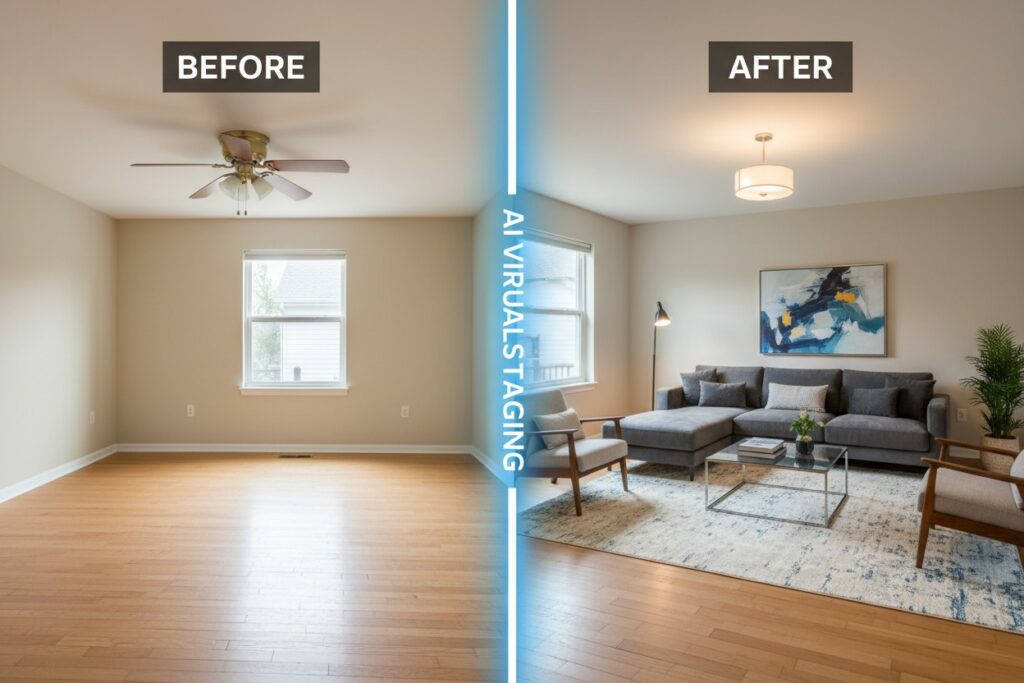
- Include before-and-after images for transparency
- Use virtual staging for online listings; physical staging may still be appropriate for high-end properties
Don’t:
- Overstage (cluttered rooms look smaller and distract from architecture)
- Use unrealistic furniture that wouldn’t fit through doors
- Misrepresent room dimensions (some platforms include square footage overlays)
- Use virtual staging exclusively for exterior or unique architectural features that buyers want to see raw
Disclosure Considerations:
While virtual staging is widely accepted, ethical agents disclose when photos have been digitally altered. Most MLS platforms now have fields for “virtually staged” disclosure, and buyer expectations have evolved to expect some level of digital enhancement.
Predictive Analytics: The New Science of Real Estate Valuation
If virtual staging changes how properties are seen, predictive analytics changes how they are valued, priced, and timed.
What Is Predictive Analytics in Real Estate?
Predictive analytics uses historical data, machine learning algorithms, and real-time market signals to forecast future outcomes—including property values, optimal listing prices, time-to-sale, and buyer behavior.
In 2026, predictive analytics has moved from institutional investors to mainstream real estate agents and individual sellers. Tools that were once reserved for hedge funds and commercial developers are now available as consumer and agent-friendly platforms.
Core Predictive Models
1. Automated Valuation Models (AVMs)
AVMs have been around for years (Zillow’s Zestimate being the most famous), but modern AVMs are dramatically more accurate. They incorporate:
- Comparable sales: Recent transactions of similar properties
- Property characteristics: Square footage, bedrooms, bathrooms, lot size, age, condition
- Location data: School quality, crime rates, walkability scores, transit access
- Market conditions: Inventory levels, interest rates, seasonal trends
- Micro-market signals: Block-level and even property-specific trends
Accuracy has improved significantly. While early Zestimates had median error rates of 10-15%, modern AVMs achieve 2-5% median error in active markets .
2. Optimal Pricing Algorithms
Pricing a property remains one of the most critical decisions in real estate. Price too high, and the property languishes, requiring eventual reductions that signal desperation. Price too low, and you leave money on the table.
AI pricing tools analyze thousands of data points to recommend the optimal list price—not just the highest possible price, but the price that maximizes net outcome. The algorithms consider:
- Price elasticity: How demand changes at different price points
- Pricing psychology: The impact of price endings ($499,000 vs. $500,000)
- Competitive positioning: How the property compares to active and pending listings
- Time sensitivity: Seller’s timeline and market conditions
3. Time-to-Sale Prediction
Perhaps the most useful tool for sellers is knowing when to list. Predictive models analyze:
- Seasonality: Historical patterns in local markets
- Competitive timing: How many similar properties are entering the market
- Buyer activity: Search trends, showing requests, and offer patterns
- Economic indicators: Interest rate movements, employment data, consumer confidence
Some platforms now offer specific date recommendations: “List on March 12th to maximize within 30 days.”
4. Buyer Persona Targeting
Modern predictive analytics doesn’t just predict price—it predicts who will buy and why.
By analyzing buyer search patterns, demographic data, and behavioral signals, AI can identify the most likely buyer segments for a specific property:
- First-time buyers vs. move-up buyers vs. downsizers
- Local vs. out-of-state vs. international
- Investment buyers vs. owner-occupants
- Specific industries or income brackets
This targeting enables hyper-personalized marketing campaigns that reach the right buyers with the right messaging.
Predictive Analytics Platforms in 2026
| Platform | Focus | Key Features |
|---|---|---|
| HouseCanary | Investor-grade analytics | Market forecasts, property-level projections, risk assessment |
| Zillow | Consumer and agent | Zestimate, market heat maps, buyer demand signals |
| OJO Labs | Buyer-side AI | Personalized property recommendations, natural language search |
| Revaluate | Agent-focused | Predictive scores for neighborhoods and properties |
| Plunk | Homeowner analytics | Real-time home value tracking, renovation ROI predictions |
The Impact on Real Estate Professionals
Predictive analytics is not replacing real estate agents—but it is fundamentally changing what agents do.
Before Predictive Analytics:
- Agents relied on experience, intuition, and limited comparable sales
- Pricing was as much art as science
- Marketing was broad and undifferentiated
- Success was driven by local market knowledge
After Predictive Analytics:
- Agents combine experience with data-driven insights
- Pricing is optimized by algorithms; agents focus on strategy and negotiation
- Marketing is targeted to specific buyer personas
- Success requires data literacy alongside relationship skills
The most successful agents in 2026 are not those who resist technology but those who use it to augment their human expertise. They let AI handle the number-crunching while they focus on the uniquely human aspects of real estate: negotiation, relationship building, and navigating complex emotions around life transitions.
AI-Powered Marketing and Buyer Engagement
Virtual staging and predictive analytics are often integrated into broader AI-powered marketing systems that manage the entire buyer journey.
AI Video Tours
Beyond still photos, AI video generation tools (like Sora 2 and Runway) are creating:
- AI-narrated walkthroughs: Automated voiceovers describing property features
- Dynamic video tours: Cameras that “move” through virtually staged spaces
- Personalized videos: Different versions highlighting features relevant to specific buyer types
- Neighborhood tours: AI-generated videos showing local amenities, schools, and transit
Conversational AI for Lead Management
AI chatbots and voice assistants now handle initial buyer inquiries:
- 24/7 availability for property questions
- Automated scheduling of showings
- Qualification of serious buyers
- Personalized property recommendations based on conversation
For agents, this means spending time only with qualified, ready-to-transact buyers rather than fielding hundreds of initial inquiries.
Dynamic Listing Optimization
AI systems continuously optimize property listings based on performance data:
- Testing different headlines, descriptions, and photo orders
- Adjusting ad spend across platforms based on engagement
- Updating pricing recommendations based on showing activity
- Suggesting listing modifications when engagement lags
The Investor Perspective: AI-Driven Acquisition and Development
While virtual staging and predictive analytics benefit individual sellers, institutional investors and developers are using AI at an entirely different scale.
Acquisition Targeting
Large investors use AI to identify acquisition opportunities before they hit the market. Models analyze:
- Tax records indicating potential distress or motivation
- Building permit data suggesting renovation opportunities
- Neighborhood demographic trends predicting appreciation
- Rental market data for cash flow projections
Development Optimization
Developers use AI to optimize new construction:
- Site selection: Identifying optimal locations for new development
- Unit mix optimization: Predicting which layouts, sizes, and finishes will maximize value
- Amenity prioritization: Determining which amenities drive premium pricing
- Phasing strategies: Optimal sequencing for multi-phase developments
Portfolio Management
For investors with multiple properties, AI enables:
- Performance monitoring: Real-time tracking of portfolio metrics
- Predictive maintenance: Identifying properties likely to need repairs
- Disposition timing: Optimal timing for selling individual assets
- Risk management: Exposure analysis across markets and property types
Ethical Considerations and Challenges
The adoption of AI in real estate is not without concerns.
The Digital Divide
Virtual staging and AI tools create advantages for sellers and agents who can afford and effectively use them. This potentially disadvantages:
- Low-budget sellers: Unable to invest in premium virtual staging
- Technologically less-savvy agents: Older or less technically inclined professionals
- Rural markets: Where technology adoption may lag urban areas
Disclosure and Deception
Virtual staging exists on a spectrum between enhancement and misrepresentation:
| Enhancement | Potential Misrepresentation |
|---|---|
| Adding furniture to empty rooms | Hiding structural flaws or damage |
| Neutralizing bold paint colors | Misrepresenting room dimensions |
| Improving lighting in dark spaces | Adding features that don’t exist |
| Virtual landscaping | Obscuring poor lot conditions |
Industry standards increasingly require clear disclosure of virtual staging, particularly for significant alterations. The National Association of Realtors (NAR) guidelines recommend:
“Members should disclose the use of virtual staging and ensure that altered images do not materially misrepresent the property’s condition.”
Algorithmic Bias
Predictive analytics models are only as unbiased as their training data. Historical redlining, discriminatory appraisal practices, and segregated housing patterns can perpetuate bias if models are not carefully designed.
Concerns include:
- AVMs undervaluing properties in minority neighborhoods
- Predictive models perpetuating historical discrimination
- Buyer targeting systems reinforcing segregation
Responsible AI developers now conduct regular bias audits and incorporate fairness constraints into model training.
Privacy and Data Usage
The data collected for predictive analytics—search behavior, financial information, location data—raises privacy concerns. Buyers and sellers may not fully understand how their data is used or shared.
The Future: What’s Next for AI in Real Estate
2026-2028 Predictions
| Trend | Timeline | Impact |
|---|---|---|
| Fully AI-generated listing photos | Now | No distinction between real and virtual staging |
| Live AI open houses | 2026-2027 | AI agents host virtual open houses, answer buyer questions in real time |
| AI transaction coordination | 2026-2027 | Contract generation, deadline tracking, compliance checks automated |
| Predictive closing timelines | 2027 | AI predicts financing delays, inspection issues, and closing dates |
| AI negotiation agents | 2027-2028 | AI negotiates terms within defined parameters |
| Fully autonomous transactions | 2028+ | End-to-end AI-driven transactions with human oversight |
The Long View: Real Estate as a Service
The ultimate vision for AI in real estate is the transformation from transactional to service-based models.
Instead of the traditional model—list a property, pay a commission—future models may include:
- Continuous portfolio optimization: AI continuously monitors property value and suggests optimal holding periods
- Predictive maintenance: AI identifies upcoming repair needs before they become emergencies
- Lifestyle matching: AI matches buyers to neighborhoods based on preferences and predicted satisfaction
- Transaction concierge: AI handles the entire transaction process with minimal human intervention
Action Plan: For Real Estate Professionals
Immediate Steps
- Invest in virtual staging: If you’re not using virtual staging for every listing, you’re leaving money on the table. Start with key rooms (living, kitchen, primary bedroom) and expand from there.
- Adopt a predictive analytics platform: Choose one platform (HouseCanary, Revaluate, or similar) and master it. Use it for every pricing discussion with sellers.
- Update your marketing: Integrate AI-generated video tours and targeted buyer campaigns into your listing presentations.
- Document your AI use: Maintain records of virtual staging disclosures and pricing methodology. Transparency builds trust.
- Train your team: Ensure everyone on your team understands how to use AI tools effectively and ethically.
For Individual Sellers
- Ask about virtual staging: If your agent doesn’t offer virtual staging, consider why. It’s now standard practice.
- Review pricing data: Ask for the data behind pricing recommendations. How many comparables? What market signals are being considered?
- Consider staging investment: For high-value properties, a hybrid approach (physical staging for key rooms, virtual for others) often delivers the best ROI.
- Be realistic about technology: Virtual staging enhances but doesn’t transform a problematic property. Structural issues, location challenges, and price remain fundamental.
For Buyers
- Assume some photos are virtually staged: Recognize that rooms may look different in person. Request un-staged photos or arrange in-person showings.
- Use predictive tools for research: Platforms like Zillow and Redfin offer predictive insights for buyers too—understand market trends and timing.
- Work with tech-savvy agents: Agents who use AI tools can provide better market intelligence and negotiation support.
Conclusion
AI has moved from novelty to necessity in real estate. Virtual staging transforms how buyers see properties, compressing sales timelines and increasing transaction values. Predictive analytics transforms how properties are valued and marketed, enabling data-driven decisions that outperform intuition alone.
For real estate professionals, the message is clear: embrace these tools or be left behind. The agents and brokers who combine AI capabilities with human expertise—relationship building, negotiation, local knowledge—will thrive. Those who resist will find themselves competing against sellers who present better, price smarter, and market more effectively.
For sellers, AI-powered marketing is now the baseline expectation. Buyers expect immersive, high-quality visual experiences and data-driven pricing rationales. Homes marketed without these advantages risk longer time on market and lower final sale prices.
For buyers, AI tools offer unprecedented transparency and insight. The asymmetry of information that traditionally favored sellers has been significantly reduced. Smart buyers use predictive analytics to understand true market value and time their purchases strategically.
The real estate industry is being rewritten. The tools described in this guide—virtual staging and predictive analytics—are not the final chapter. They are the foundation upon which the next generation of real estate technology will be built. The professionals who understand and leverage these tools today will be positioned to lead tomorrow.