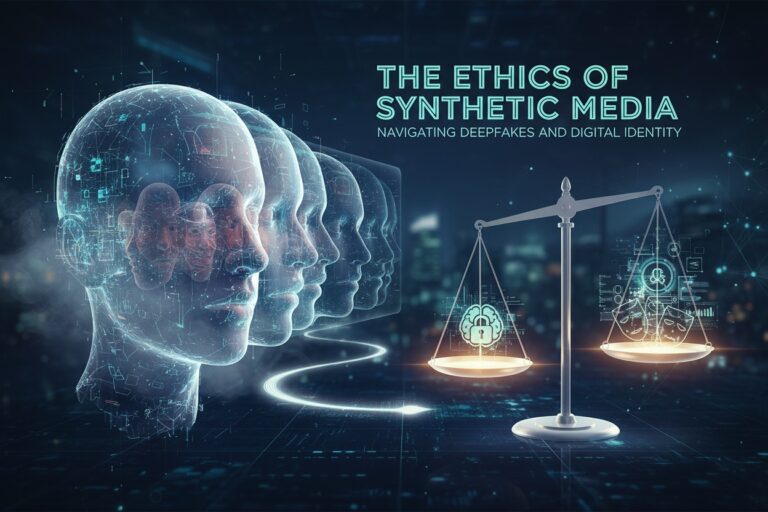
AI and Data Privacy: How to Protect Your Intellectual Property in 2026
AI and Data Privacy: How to Protect Your Intellectual Property in 2026, The artificial intelligence revolution has created an uncomfortable paradox. The same tools that enable unprecedented productivity and creativity also pose existential risks to the very intellectual property they help generate.
In 2026, the question is no longer whether your organization uses AI—it’s whether your AI usage is leaking your competitive advantage. Every prompt you type, every document you upload, every code snippet you generate may be training the next generation of models that your competitors will use against you.

This guide explores the evolving landscape of AI data privacy and provides actionable strategies to protect your intellectual property in an era where the lines between user and trainer have blurred beyond recognition.
The New Reality: Your Data Is Training Data
The fundamental tension in AI data privacy is simple but profound: most AI models improve by learning from user interactions. When you use a tool, your data doesn’t just get processed—it gets incorporated.
How AI Models Learn
Different AI providers handle user data differently, but the patterns are revealing:
| Provider | Training on User Data | Default Setting | Opt-Out Available |
|---|---|---|---|
| OpenAI (ChatGPT) | Yes, for non-API users | Opt-in (as of 2025) | Yes, via form |
| Google (Gemini) | Yes, for consumer products | Opt-in (with consent) | Yes, in settings |
| Anthropic (Claude) | No for API; yes for web | Opt-in | Yes |
| Microsoft (Copilot) | Varies by product | Mixed | Case-by-case |
| Cursor | No for code; aggregated for improvement | Opt-out | Yes |
The landscape shifted significantly in late 2025 when OpenAI announced it would no longer train on API customer data by default, following backlash from enterprise clients . However, consumer products and free tiers remain areas of concern.

The Hidden Data Flows
Even when providers claim not to train on your data, risks remain:
Human Review: Many AI companies employ human reviewers to evaluate outputs for quality improvement. Your “private” conversation may be read by a contractor in another country .
Third-Party Plugins: When you use an AI tool with plugins (email integration, document storage, code repositories), your data flows through multiple systems with different privacy policies .
Output Leakage: AI models sometimes reproduce training data in responses. If you’re building proprietary code, there’s a non-zero chance it could appear in someone else’s output .
Metadata Exposure: Even if the content isn’t stored, metadata about your usage patterns—what you ask, when you ask it, how you refine prompts—can reveal strategic direction .
The Legal Landscape: What the Courts Are Saying
2025 and early 2026 saw a cascade of legal decisions reshaping AI intellectual property rights.
The Fair Use Pendulum
The ongoing New York Times v. Microsoft and OpenAI case has become the defining legal battle for AI training data. In January 2026, a federal judge allowed key copyright claims to proceed, rejecting OpenAI’s motion to dismiss . While a final verdict remains months away, the ruling signaled that courts are taking copyright holders’ concerns seriously.
Simultaneously, a wave of class-action lawsuits from authors, visual artists, and musicians has created what legal experts call “a patchwork of uncertainty” . The outcomes of these cases will determine whether AI training on public data constitutes fair use or copyright infringement.
Trade Secrets in the AI Era
A lesser-known but equally significant legal development involves trade secret protection. In Synopsys v. OpenAI (decided November 2025), a California court ruled that proprietary code inadvertently exposed through AI training could constitute trade secret misappropriation even without direct copying .
The ruling established that if an AI model has been trained on protected information, the provider may be liable for “inevitable disclosure”—even if the information never appears verbatim in outputs . This has sent shockwaves through enterprise legal departments.
International Divergence
Regulatory approaches vary dramatically by jurisdiction:
- European Union: The EU AI Act, fully implemented in 2025, mandates strict transparency requirements for training data and gives individuals rights to object to AI processing of their information
- China: Cybersecurity and data localization laws require that AI training data remain within Chinese borders, with government oversight of model outputs
- United States: A fragmented approach with sector-specific regulations (healthcare, finance) but no comprehensive federal AI privacy law as of March 2026
For multinational organizations, this patchwork creates compliance complexity that demands proactive management.
Intellectual Property Risks by AI Use Case
Different AI applications carry different risk profiles. Understanding where your data is most vulnerable is the first step to protecting it.
Code Generation and Development
Risk Level: Critical
When developers use AI coding assistants, they expose proprietary algorithms, internal logic, and architectural decisions. In 2025, a major financial services firm discovered that proprietary trading logic had been incorporated into a public AI model after a developer used a consumer-grade assistant with company code .
Specific Risks:
- Proprietary algorithms appearing in competitor outputs
- Security vulnerabilities exposed through training data
- License compliance issues with open-source dependencies
- Accidental disclosure of API keys and credentials
Best Practices:
- Use enterprise-tier tools with guaranteed data isolation
- Implement code scanning to detect AI-generated code that may contain license conflicts
- Establish clear policies about what code can be shared with AI tools
Content Creation and Marketing
Risk Level: High
Marketing teams using AI for content generation expose brand strategy, upcoming campaigns, and proprietary research. In one notable incident, a consumer goods company’s unreleased product details appeared in AI-generated content created by a competitor’s marketing team—because both had used the same AI tool trained on the original prompts .
Specific Risks:
- Premature exposure of product launches
- Competitive intelligence leakage
- Brand voice dilution through widespread imitation
- Copyright uncertainty around AI-generated assets
Best Practices:
- Use brand-specific fine-tuned models rather than public assistants
- Sanitize prompts to remove identifying information
- Establish clear copyright ownership documentation for AI-generated content
Research and Development
Risk Level: Critical
R&D teams represent the highest-risk use case. The intellectual property generated during research and development—failed experiments, novel approaches, proprietary data—represents years of investment. AI tools used during this phase can inadvertently expose strategic direction .
Specific Risks:
- Novel approaches revealed through training data
- Research direction inferred from usage patterns
- Proprietary datasets exposed through uploads
- Patent filing compromised by prior disclosure
Best Practices:
- Isolate R&D AI usage to air-gapped or private instances
- Never upload proprietary research data to public AI tools
- Use on-premises or private cloud AI deployments
- Train internal models on proprietary data when necessary
Customer Support and Internal Communications
Risk Level: Medium to High
AI tools used for drafting emails, summarizing meetings, or responding to customers can expose sensitive internal information, client relationships, and strategic decisions.
Specific Risks:
- Client confidentiality breaches
- Internal strategy exposed through training data
- HR and personnel information leakage
- Compliance violations in regulated industries
Best Practices:
- Use AI tools with data isolation guarantees
- Implement content filtering to prevent sensitive data uploads
- Train employees on what constitutes “safe” AI usage
- Consider on-premises solutions for highly regulated environments
The Enterprise Protection Stack
Protecting intellectual property in the AI era requires a multi-layered approach that combines technical controls, policy frameworks, and cultural change.
Layer 1: Selection and Contracting
The first line of defense is choosing AI vendors with appropriate protections.
Key Contract Terms to Negotiate:
- Data Isolation: Explicit agreement that your data will not be used for training, stored separately, and deleted after processing
- Audit Rights: Ability to verify compliance with data protection commitments
- Indemnification: Vendor liability for intellectual property infringement arising from model outputs
- Data Sovereignty: Guarantees about where your data is processed and stored
- Subprocessor Control: Approval rights over third-party vendors handling your data
Enterprise-Tier Options with Strong Protections:
| Platform | Data Isolation | Training Opt-Out | On-Premises Option |
|---|---|---|---|
| Azure OpenAI Service | Yes (by contract) | Default | No |
| Google Vertex AI | Yes | Default | No |
| Amazon Bedrock | Yes | Default | No |
| Anthropic Claude Enterprise | Yes | Default | No |
| Cursor Enterprise | Yes | Opt-out | No |
For organizations requiring absolute control, open-source models deployed on private infrastructure remain the only fully secure option.
Layer 2: Technical Controls
Prompt Sanitization: Implement automated systems that scan prompts for sensitive data (API keys, passwords, proprietary terminology) before they reach AI services.
Data Loss Prevention (DLP): Extend existing DLP tools to monitor AI interactions. Solutions like Netskope, Palo Alto Networks, and Symantec now offer AI-specific detection capabilities.
API Key Management: Use separate API keys for different teams and projects. Rotate keys regularly. Never embed keys in code or share them across environments.
Output Filtering: Implement systems that scan AI outputs for potential intellectual property leakage—proprietary terms, code patterns, or confidential information that should never appear in outputs.
Access Controls: Limit AI tool access based on role and necessity. Not every employee needs access to the most powerful models with the largest context windows.
Layer 3: Policy and Governance
Acceptable Use Policies: Update employee handbooks with clear guidance on AI usage. Specify what data can and cannot be shared, which tools are approved, and consequences for violations.
Approved Tools List: Maintain a curated list of approved AI tools with pre-negotiated data protection terms. Shadow AI—employees using unapproved tools—represents one of the largest security gaps in most organizations.
Review and Approval Process: For high-risk AI implementations (R&D, code generation, customer data processing), require security and legal review before deployment.
Incident Response: Develop procedures for AI-related security incidents, including data exposure, model output containing sensitive information, and unauthorized training data inclusion.
Layer 4: Employee Training
The most sophisticated technical controls fail if employees don’t understand the risks. Effective AI privacy training should cover:
What Not to Share:
- Proprietary code or algorithms
- Unreleased product information
- Customer data (especially in regulated industries)
- Employee personal information
- Trade secrets and internal strategy documents
How to Use AI Safely:
- Never paste production credentials or API keys
- Sanitize examples before using for debugging
- Use approved enterprise tools rather than consumer versions
- Report suspicious outputs or data exposure concerns
Recognizing Red Flags:
- AI responses containing proprietary information from other organizations
- Outputs that seem to know about internal projects
- Models that behave unexpectedly after updates
Open-Source and Self-Hosted Alternatives
For organizations with the highest security requirements, self-hosted open-source models represent the only truly private option.
Advantages of Self-Hosting
- Complete data control: No external access to prompts or outputs
- No training data exposure: Your usage doesn’t improve models available to competitors
- Compliance certainty: Meets strict data residency requirements
- Customization: Fine-tune on proprietary data without sharing it
Leading Open-Source Options (March 2026)
| Model | Capabilities | Hosting Requirements | Licensing |
|---|---|---|---|
| Llama 4 | 2 trillion parameters, multimodal | Significant GPU clusters | Commercial use permitted |
| Mistral Large 3 | 1.2T parameters, strong reasoning | Enterprise hardware | Commercial friendly |
| Qwen 2.5-72B | Strong multilingual support | Moderate GPU requirements | Commercial use permitted |
| DeepSeek-V3 | 671B parameters, efficient inference | Optimized for deployment | Open source |
Hosting Options
Cloud Private: AWS, Google Cloud, and Azure offer private AI hosting where your instance runs on isolated infrastructure but within cloud data centers. This balances control with operational convenience.
On-Premises: For the highest security requirements, on-premises deployment keeps all data within your physical infrastructure. This requires significant hardware investment and specialized operational expertise.
Hybrid: Many organizations use a hybrid approach—self-hosted for sensitive R&D and proprietary code, enterprise cloud APIs for non-sensitive productivity tasks.
The Future of AI Data Privacy
Several trends will shape the AI data privacy landscape through 2026 and beyond.
Federated Learning
Federated learning allows models to improve without centralizing training data. Instead of sending data to the model, the model comes to the data—training on local instances and sharing only aggregated updates. Early enterprise implementations show promise for privacy-sensitive industries like healthcare and finance.
Differential Privacy
Differential privacy adds calibrated noise to training data or model outputs, making it mathematically impossible to determine whether any specific piece of data was used in training. Google and Apple have pioneered these techniques, and they’re increasingly being adopted by enterprise AI platforms.
Model Watermarking
Emerging techniques allow organizations to “watermark” their proprietary data used in fine-tuning. If outputs contain distinctive patterns traceable to the original fine-tuning set, organizations can detect and prove unauthorized use of their intellectual property.
Regulatory Convergence
While current regulations vary by jurisdiction, 2026 is likely to see movement toward harmonization. The EU AI Act is becoming the de facto global standard, with many multinational organizations adopting its requirements worldwide for consistency.
Action Plan: Securing Your AI Usage Today
If you take nothing else from this guide, implement these five actions immediately:
1. Audit Your AI Usage
Identify every AI tool used across your organization. The security team should know:
- Which tools are approved versus shadow IT
- What data types are being shared
- Which teams are using AI most heavily
- What contractual protections exist
2. Establish Clear Policies
Create and distribute an AI acceptable use policy that:
- Defines approved tools and prohibited tools
- Specifies what data can and cannot be shared
- Assigns responsibility for compliance
- Establishes consequences for violations
3. Implement Technical Controls
Deploy DLP monitoring for AI interactions, especially:
- Browser extensions and web-based AI tools
- IDE integrations for code generation
- API access patterns and volumes
- Unusual uploads of sensitive documents
4. Negotiate Enterprise Terms
For any organization-wide AI deployment:
- Move from consumer to enterprise tiers
- Negotiate data isolation in contracts
- Establish clear training data opt-out
- Document audit rights
5. Train Your Teams
Conduct mandatory training on AI privacy risks covering:
- What not to share
- How to identify approved versus unapproved tools
- How to report incidents or concerns
- The business impact of intellectual property leakage
Conclusion
The AI revolution isn’t slowing down, and neither is the competition for intellectual property advantage. In 2026, the organizations that thrive will be those that embrace AI’s productivity benefits while rigorously protecting the proprietary insights that differentiate them.
The tools and strategies outlined in this guide represent a starting point—a framework for thinking about AI data privacy as a strategic imperative rather than a compliance checkbox. The specific implementation will vary by organization, but the underlying principle is universal: in an era where your prompts become training data, protecting your intellectual property requires intention, investment, and vigilance.
The question isn’t whether you can afford to implement these protections. The question is whether you can afford not to.