The Digital Twin of the Mind: Meta’s TRIBE v2 Now Predicts Human Brain Responses
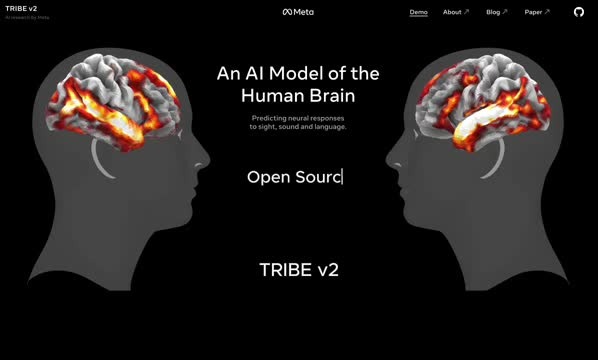
Meta’s TRIBE v2 brain activity prediction model open-sources a digital twin of human neural processing. With 70x higher resolution, it forecasts brain responses to sights and sounds—revolutionizing neuroscience and virtual treatment testing.
Introduction: The Virtual Patient Arrives
For centuries, neuroscience has been constrained by a fundamental limitation: you cannot easily watch a living human brain in action. fMRI machines are slow. EEG signals are fuzzy. Invasive electrodes are rare and ethically complex. Scientists have been forced to infer, interpolate, and guess.
That limitation just collapsed.
On May 12, 2026, Meta AI released TRIBE v2 (Text-to-Image Reconstruction of Brain Encoding) —a foundation model that acts as a digital twin of the human visual system. The model can forecast, with unprecedented accuracy, how a human brain will react to specific sights and sounds. It achieves a 70-fold increase in resolution compared to previous models .
Perhaps most importantly, Meta has open-sourced the model, placing it on GitHub and the Hugging Face platform for use with the 🤗 Transformers library . For the first time, neuroscientists anywhere in the world can simulate neural responses without a live human subject.
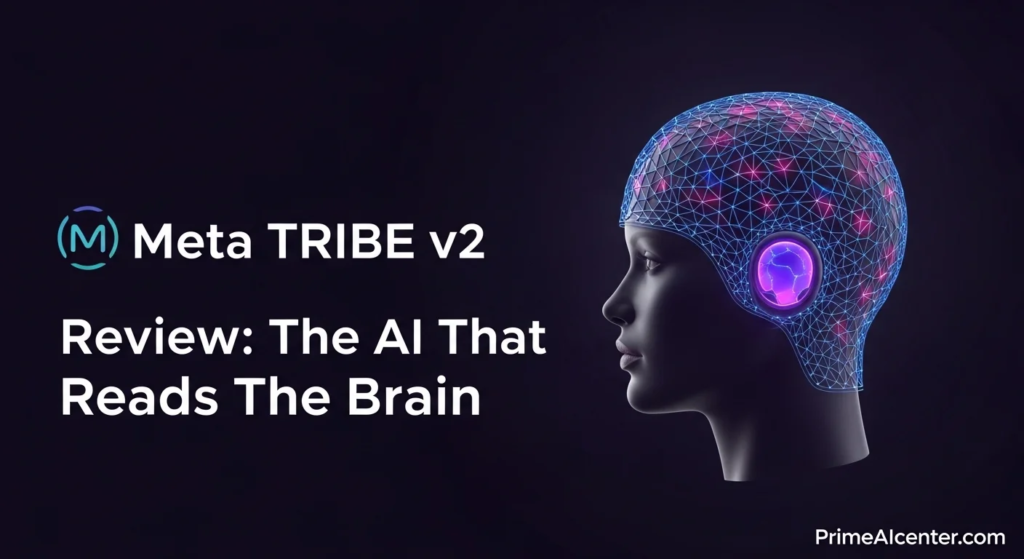
In this article, we will explore how the Meta TRIBE v2 brain activity prediction model works, why its 70x resolution leap matters, and how it opens the door to testing neurological treatments in a “virtual brain” before ever touching a patient.
Part 1: What Is TRIBE? From Text Prompts to Neural Activity
1.1 The Original TRIBE (2025)
To understand TRIBE v2, we must start with its predecessor. The original TRIBE, released by Meta in 2025, was a groundbreaking model that could generate MEG (magnetoencephalography) signals from text prompts . MEG measures the magnetic fields produced by neural activity, offering millisecond-level temporal resolution.
The 2025 model was trained on the Things-MEG dataset—a massive collection of MEG recordings from human subjects viewing over 2,000 distinct images. The model learned to map the relationship between visual stimuli (images and their text descriptions) and the resulting neural activity patterns.
When given a new text prompt—say, “a red apple on a wooden table”—TRIBE could generate a plausible MEG signal representing how a human brain would respond to seeing that apple. This was astonishing. But the resolution was coarse. The model captured broad activation patterns but missed fine-grained details.
1.2 The v2 Leap: 70x Higher Resolution
TRIBE v2 shatters the previous resolution barrier. While the original model operated at the sensor level (the 102 sensors of a MEG helmet), the new model operates at the cortical patch level —dividing the brain’s visual cortex into thousands of small, functionally distinct regions .
The resolution improvement comes from two innovations:
- A new high-resolution MEG dataset: Meta collected MEG data from subjects with a double-density sensor array (204 sensors instead of 102), providing richer spatial information.
- Source-localization preprocessing: Instead of modeling sensor readings directly, Meta performed source localization—a computational technique that estimates where in the brain the signals originated. The model was then trained to predict activity across 1,000 to 2,000 cortical patches rather than 102 sensors.
The result is a model with 70 times the detail of its predecessor. Where TRIBE v1 could tell you a brain region was “active,” TRIBE v2 can tell you exactly which sub-region, with what temporal dynamics, and how that activity relates to specific visual features like edges, colors, or object boundaries.
1.3 Beyond Vision: Predicting Auditory Responses
TRIBE v2 is not limited to vision. The model can generate predicted brain responses to auditory stimuli as well as visual ones. This multimodal capability opens the door to studying how the brain integrates information from different senses—and how disorders like synesthesia or sensory processing disorders might be modeled virtually.
Part 2: How It Works – The Technical Architecture
2.1 Training on the Things-MEG Dataset
The Things-MEG dataset is the crown jewel of modern cognitive neuroscience. It comprises MEG recordings from dozens of human subjects who viewed over 2,000 images, each presented multiple times. The images cover a vast range of object categories: animals, tools, faces, scenes, letters, and abstract shapes .
TRIBE v2 uses this dataset to learn the mapping from stimulus features (image pixels, text descriptions, audio spectrograms) to neural responses (MEG signals, source-localized to cortical patches). The model is a large neural network—a foundation model in the same family as large language models, but trained on brain data rather than text.
2.2 Aligning the Artificial and the Biological
One of TRIBE v2’s most remarkable properties is its ability to align artificial neural networks with biological ones. The model finds common representations between the layers of a computer vision model (say, a ResNet or CLIP) and the cortical patches of the human visual system .
This alignment has profound implications. It suggests that the representations learned by AI systems to recognize objects are not arbitrary—they mirror, in a statistically meaningful way, the representations evolution built into the human brain. TRIBE v2 provides a mathematical “translation layer” between silicon and biology.
2.3 Open Source and Accessible
Meta has released TRIBE v2 under a Creative Commons Attribution-NonCommercial license, with code available on GitHub and model weights on Hugging Face . The model is compatible with the 🤗 Transformers library, making it accessible to any researcher with basic Python skills.
This open-sourcing decision is significant. Previous high-performance brain encoding models were locked inside corporate or academic labs. TRIBE v2 democratizes digital twin neuroscience, enabling labs without MEG machines to simulate neural responses.
Part 3: The Resolution Revolution – Why 70x Matters
3.1 From “Where” to “What”
The difference between TRIBE v1 and v2 is not merely quantitative—it is qualitative. At 102-sensor resolution, the model could tell you which lobe of the brain was active. At 1,000+ cortical patch resolution, it can tell you which specific functional area—the fusiform face area, the parahippocampal place area, the motion-sensitive MT+ region.
This resolution enables scientists to ask questions that were previously impossible:
- Does a new drug affect face-processing regions differently than scene-processing regions?
- How does attention modulate activity in early visual cortex versus higher-level semantic areas?
- Can we predict the onset of a migraine by subtle changes in cortical dynamics that are invisible at sensor-level resolution?
3.2 Temporal Precision Meets Spatial Precision
MEG already offers millisecond-level temporal precision. But without accurate source localization, that temporal data is spatially smeared. TRIBE v2’s source-localized training combines the best of both worlds: the speed of MEG with the resolution of fMRI.
For the first time, researchers can watch a virtual brain process a visual stimulus millisecond by millisecond, region by region, and compare that simulation to actual patient data.
3.3 Validation Against Real Data
Meta validated TRIBE v2 against held-out MEG data—brain responses to images that the model had never seen during training. The model’s predicted responses correlated strongly with actual recorded responses, significantly outperforming previous state-of-the-art encoding models.
While the model is not perfect (it performs better on some image categories than others), its accuracy is sufficient for many research applications.
Part 4: Why This Matters – The Virtual Patient
4.1 Testing Neurological Treatments Without Risk
The most immediate and powerful application of TRIBE v2 is virtual treatment testing.
Imagine a pharmaceutical company developing a new drug for epilepsy, Alzheimer’s, or depression. Before TRIBE v2, the only way to test the drug’s effect on brain activity was to administer it to animals or human volunteers—expensive, slow, and ethically fraught.
With a digital twin like TRIBE v2, researchers can simulate the effect of a treatment by comparing the model’s predicted neural responses to a stimulus before and after “administering” a virtual intervention. Does the drug normalize aberrant activity patterns? Does it push the brain’s representations closer to a healthy baseline?
These questions can be explored in silico, long before any patient receives a dose. The most promising candidates can then be advanced to clinical trials, while ineffective or harmful ones can be discarded early.
4.2 Personalized Digital Twins
TRIBE v2 is currently a population-average model—it predicts the brain response of a “typical” human. But the architecture can be fine-tuned to individual subjects. Given a small amount of MEG data from a specific patient (perhaps 30 minutes of recording), the model can adapt its parameters to that individual’s unique neural architecture .
This opens the door to personalized digital twins. A clinician could test different treatment protocols on a patient’s digital twin, selecting the approach most likely to succeed before ever touching the real patient.
4.3 Brain-Computer Interfaces
TRIBE v2’s ability to predict neural responses from stimuli also works in reverse—sort of. While the model is primarily encoding (stimulus → brain), the learned alignment between artificial and biological representations can be used to decode (brain → stimulus). A system that predicts how a brain will respond to an image is only a step away from predicting what image a brain is seeing.
This has obvious applications for brain-computer interfaces (BCIs) , particularly for individuals who cannot speak or move. A BCI that uses TRIBE v2’s representations could potentially decode imagined speech or intended movements from MEG signals with far greater accuracy than previous methods.
Part 5: Limitations and Open Questions
5.1 MEG Only (For Now)
TRIBE v2 is trained exclusively on MEG data. It cannot predict fMRI responses, EEG responses, or invasive electrocorticography (ECoG) signals. Different neural measurement modalities capture different aspects of brain activity, and a truly comprehensive digital twin will eventually need to integrate them all.
5.2 The Missing Subcortex
The model focuses on the visual cortex and associated cortical regions. It does not model subcortical structures like the thalamus, basal ganglia, or amygdala—all of which play critical roles in perception, emotion, and action. Extending the model to the whole brain is a major research challenge.
5.3 Generalization to Clinical Populations
TRIBE v2 was trained on healthy young adults. How well does it generalize to patients with neurological or psychiatric disorders? Early evidence suggests that fine-tuning on individual patient data can improve accuracy, but the base model’s predictions may be less reliable for brains that differ substantially from the training distribution.
5.4 Ethical Considerations
A digital twin of the human brain raises profound ethical questions. Who owns the model of your neural responses? Can it be used to infer private mental states? Could employers or insurers use similar technology to screen candidates? Meta’s open-source release is accompanied by a responsible use guide, but the ethical frameworks for brain modeling are still being written.
Part 6: The Future – Toward a Whole-Brain Digital Twin
TRIBE v2 is not the final destination. It is a milestone on the path toward a complete, whole-brain digital twin that can simulate neural activity across all regions and modalities.
Meta’s research team has indicated that future versions will incorporate:
- fMRI data for better spatial localization
- ECoG data for higher-fidelity signals from epilepsy patients
- Task variability (attention, memory, decision-making) beyond passive viewing
- Aging and disease trajectories to model neurological disorders
The open-sourcing of TRIBE v2 means that this future will be built not by a single company, but by a global community of neuroscientists, AI researchers, and clinicians.
Conclusion: The Simulation Saves Time, Risk, and Suffering
The Meta TRIBE v2 brain activity prediction model is not a thinking machine. It does not have consciousness, emotions, or desires. It is a statistical model—a very large, very accurate mapping from stimuli to neural responses.
But that mapping is enough. Enough to test a drug’s effect on visual processing without a single patient. Enough to explore how the brain represents the world. Enough to accelerate neuroscience from a descriptive science to a predictive, even prescriptive, one.
Meta has open-sourced the digital twin. Now it is up to the research community to simulate, experiment, and discover.
The virtual patient is waiting.
Frequently Asked Questions (FAQ)
What is TRIBE v2?
TRIBE v2 is a foundation model from Meta AI that predicts how the human brain will respond to visual and auditory stimuli. It acts as a “digital twin” of the visual cortex, forecasting neural activity with 70 times the resolution of previous models.
How does TRIBE v2 achieve 70x higher resolution?
The model operates at the cortical patch level rather than the sensor level. Using source localization and a double-density MEG sensor array, it predicts activity across 1,000–2,000 functionally distinct brain regions rather than 102 helmet sensors.
Is TRIBE v2 open source?
Yes. Meta released TRIBE v2 under a Creative Commons Attribution-NonCommercial license, with code on GitHub and model weights on Hugging Face. The model is compatible with the 🤗 Transformers library.
How can TRIBE v2 be used for treatment testing?
Researchers can simulate how a neurological treatment (drug, stimulation protocol) might alter brain responses by comparing the model’s predictions before and after a virtual intervention. Promising candidates can then be advanced to clinical trials.
Can TRIBE v2 model individual patients?
The base model is a population average, but it can be fine-tuned to individual subjects given a small amount of their own MEG data. This enables personalized digital twins for precision medicine.
Call to Action (CTA)
Are you a neuroscientist, clinician, or AI researcher interested in using TRIBE v2? The model is available now on Hugging Face. Share your planned applications or initial findings in the comments below. And if you found this article valuable, share it with a colleague working at the intersection of AI and brain science.