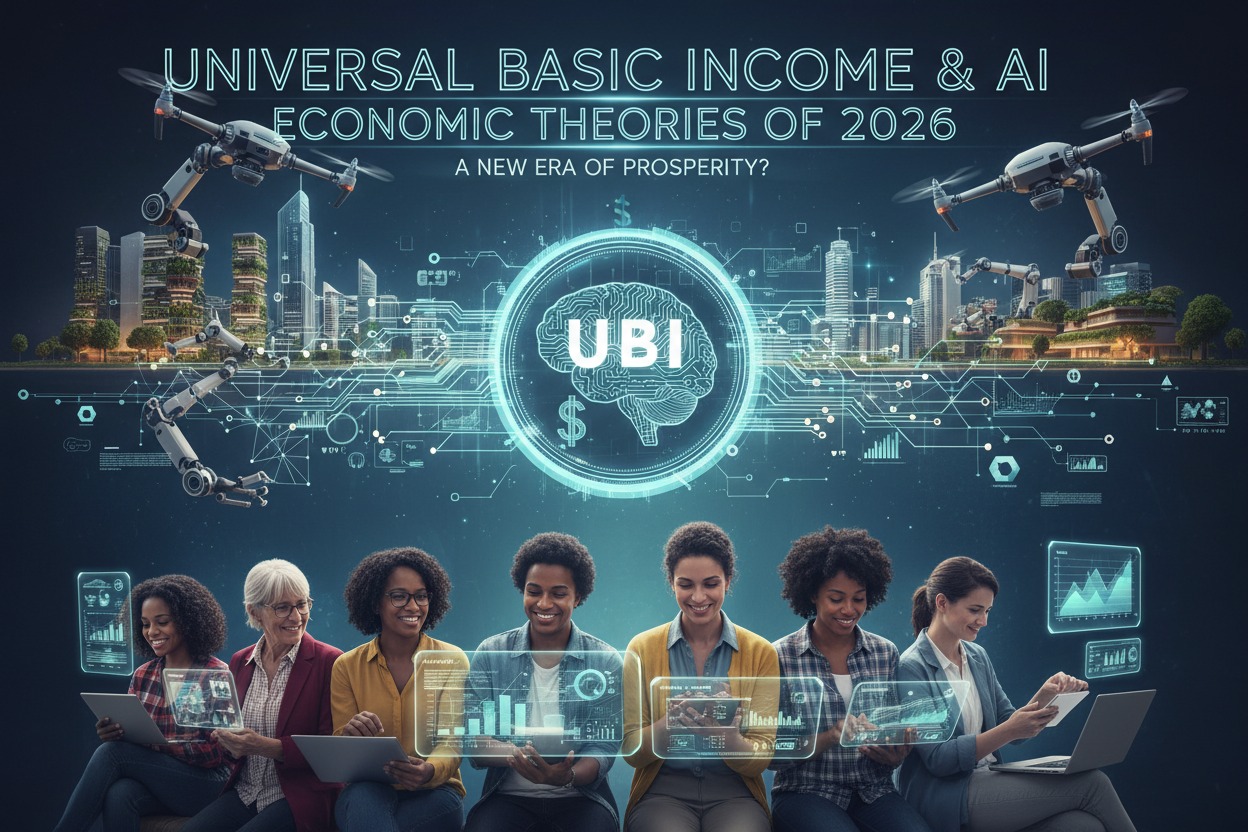
Universal Basic Income and AI: Exploring the Economic Theories of 2026
Universal Basic Income and AI: Exploring the Economic Theories of 2026, The conversation about Universal Basic Income (UBI) has shifted dramatically. What was once a fringe idea debated by academics and futurists has become a mainstream policy proposal, driven by a single, powerful force: artificial intelligence. In 2026, as AI systems demonstrate an accelerating ability to perform cognitive and creative tasks once thought exclusively human, the question is no longer whether AI will disrupt the labor market, but how societies will respond when it does .
This guide explores the core economic theories surrounding UBI in the age of AI, from the utopian visions of Silicon Valley’s “radical abundance” to the stark fiscal realities and philosophical objections raised by economists and policymakers.
The Catalyst: Why AI Changes the Economic Equation
The urgency of the UBI debate stems from a fundamental shift in how value is created. For centuries, the economic engine ran on a simple loop: human labor produced goods and services, earning wages that allowed people to buy what was produced, sustaining demand and funding governments through taxes .
AI threatens to break this loop. As systems become capable of performing tasks—from writing code and reviewing contracts to diagnosing diseases and managing logistics—the link between human work and economic output begins to unravel . The core economic theories for UBI in 2026 all originate from attempts to solve this impending “break in the loop.”
Former presidential candidate Andrew Yang, a prominent voice in this debate, warns of a “great disemboweling” of white-collar employment, predicting that millions of office professionals, marketers, and software developers could face displacement within a short timeframe . This isn’t just about factory floors anymore; it’s about the “laptop class” . The challenge is no longer a temporary dislocation but a potential structural collapse of the wage-based economy.
The Tech Architect’s Vision: “Silicon Valley Socialism”
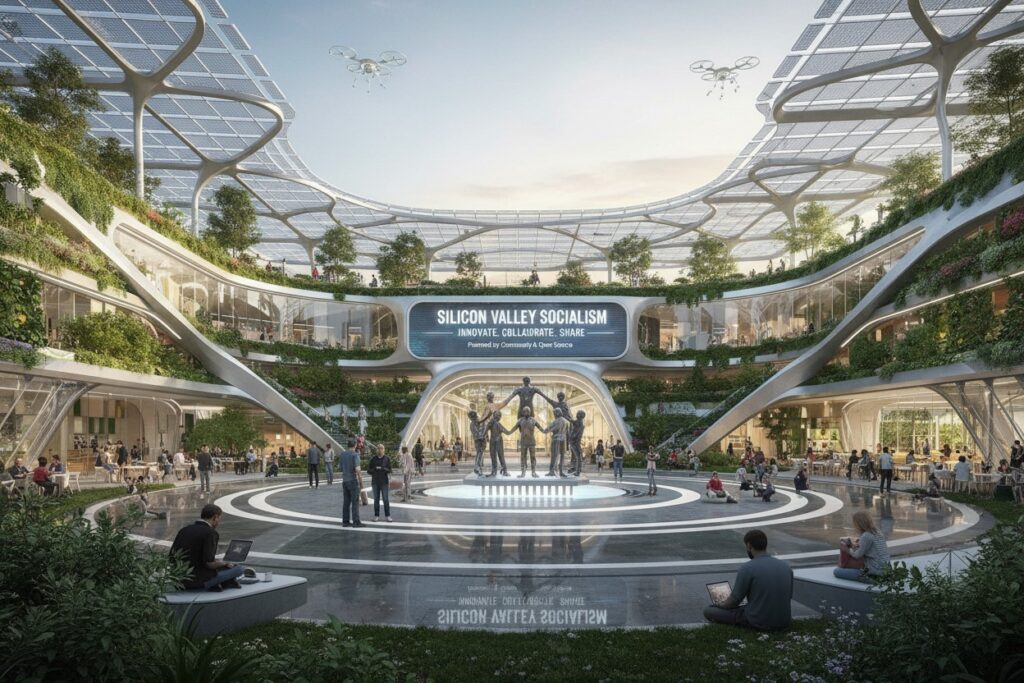
The most detailed and controversial funding models for UBI come not from politicians, but from the technologists building the future. They see AI-driven abundance as an opportunity to create a new form of capitalism, but critics have labeled their vision “Silicon Valley socialism” .
Sam Altman’s “American Equity Fund”
OpenAI’s Sam Altman has offered the most formalized proposal. In his “Moore’s Law for Everything” essay, Altman argues that as AI drives the cost of goods and services toward zero, wealth will shift from labor to capital . To prevent societal collapse, he proposes creating the American Equity Fund (AEF) , a national fund that would be capitalized by taxing large companies (above a predetermined valuation) and privately held land at 2.5% of their market value annually . The fund would then distribute annual cash dividends to every American adult.
Elon Musk’s “Universal High Income”
Elon Musk’s position has evolved from UBI to what he calls Universal High Income (UHI) . His theory is rooted in “extreme abundance”: if humanoid robots and AI can perform all labor, the cost of goods will fall to the price of raw materials. In this world, the government would have massive tax revenue from automated industries, allowing it to provide citizens not just a basic income, but a genuinely comfortable one. Jobs, Musk suggests, would become “optional” hobbies .
The Central Critique: Techno-Feudalism
A powerful critique unites these tech-led visions: they socialize the costs while privatizing the rewards. Critics argue that Altman and Musk propose a future where a tiny elite owns the AI “commanding heights”—the chips, models, and data centers—and simply hands everyone else a check .
This system has been termed “techno-feudalism” . The public would receive a stipend (a dividend) but would have no ownership, no control, and, crucially, no meaningful role in the economy . As one analyst put it, the tech titans keep the “means of production,” and we get an allowance. The fear is a future where a population is materially pacified but politically powerless, stripped of the dignity and purpose that comes from contribution .
The Alternative Vision: An “Economic Dignity Compact”
Not everyone agrees that a monthly check is the right solution. A significant counter-theory argues that UBI ignores a fundamental human need: the dignity of work.
The Case Against UBI from the Left
Gene Sperling, a top economic adviser to three U.S. presidents (Clinton, Obama, and Biden), launched the Economic Dignity Lab at Georgetown University in 2026 to offer a sharp alternative to UBI . Sperling argues that proposals like UBI and Universal Basic Capital (a lump-sum payment) ignore the connection between work and purpose, potential, and social connection.
Sperling’s “Economic Dignity Compact for the AI Age” proposes a three-part alternative :
- Create “Double Dignity Jobs”: A large-scale investment in jobs with dignified wages that help provide dignity to others—specifically in education, mental health, rural care, and counseling.
- Target Holes in the Floor: Strengthen existing targeted policies like child care, paid leave, a higher minimum wage, and the Earned Income Tax Credit (EITC).
- An Economic Transition Strategy: A proactive plan for workers displaced by AI that avoids the devastation seen in factory towns during past industrial shifts.
The Conservative View: Removing Barriers to Work
From a classical liberal perspective, the primary critique of UBI is that it risks creating a “permanent transfer state” . Economists at the American Enterprise Institute (AEI) and Cato Institute argue that the best response to technological change is not to pay people for “economic resignation,” but to make adaptation easier .
This means removing barriers to work: cutting red tape, reducing occupational licensing, lowering taxes, and eliminating “benefit cliffs” where welfare recipients lose support as soon as they earn a small amount of money. Instead of a universal check, they propose targeted, conditional support (e.g., “empowerment accounts” for those in transition) combined with a freer, more flexible economy .
The Funding Dilemma: Who Pays in a Cashless World?
Regardless of your preferred theory, the most immediate and practical question is: How do you pay for it?
The Trifold Fiscal Spiral
As AI displaces workers, public finances face a perfect storm :
- Rising Unemployment & Falling Tax Revenues: Fewer workers means less income tax and lower social security contributions.
- Rising Welfare Spending: More unemployed people increase the demand for state support.
- A Shrinking Middle Class: As wages stagnate and job security declines, consumption weakens, shrinking the value-added tax (VAT) base.
This creates a scenario where the government has less money coming in, more going out, and a potentially collapsing economy. The only way out, economists argue, is to shift the tax base from human labor to “equipment labor” .
New Tax Categories for the AI Era
To fund a UBI or any new social contract, governments will likely need to create entirely new forms of taxation :
| New Tax Category | Core Concept |
|---|---|
| AI / Automation Tax | A tax on the “efficiency dividend” companies gain when they replace human workers with AI. |
| Data Dividend Tax | A levy on the value created from user data, treating data as a public resource that companies must pay to use. |
| Compute & Energy Tax | A tax on the physical inputs of AI—electricity, chips, and data center usage. |
These proposals aim to force the companies that benefit most from automation to bear the cost of the societal disruption they cause.
The Experimental Reality: What the Data Actually Shows
Amidst the theoretical debates, what does the evidence from real-world UBI pilots tell us? A major analysis of 122 guaranteed income pilots (across 33 U.S. states between 2017 and 2025) offers crucial, if nuanced, insights .
Key findings from the study include:
- Overall Impact on Employment: Among 30 randomized pilots, the average effect was a tiny 0.8 percentage-point increase in employment. This challenges the idea that a small stipend destroys the will to work .
- The Larger Study Anomaly: However, when focusing on the four largest pilots (which accounted for 55% of participants), the impact was a 3.2 percentage-point decline in employment. This suggests that larger, more generous, or longer-term payments might indeed reduce labor supply .
- Non-Economic Benefits: Crucially, the studies consistently found significant improvements in wellbeing, financial stability, and confidence .
The evidence is mixed. While UBI does not appear to cause a mass exodus from the workforce, the idea that it pays for itself by boosting employment is not supported by the largest studies.
Conclusion: A Fork in the Road
The rise of AI forces a fundamental choice about the future of society. The economic theories of 2026 present two distinct paths forward:
Path One: The AI Dividend. This is the tech-centric path of “Silicon Valley socialism.” It accepts the obsolescence of traditional work and proposes a new social contract based on redistribution. The state would tax automated production and data to fund a universal cash payment. Its success hinges on solving the fiscal dilemma and overcoming the risk of techno-feudalism.
Path Two: The Dignity Compact. This path rejects the inevitability of a workless future. It argues for proactive government to create new, meaningful jobs in care, education, and community, while strengthening the traditional safety net (minimum wage, EITC). Its success depends on the ability to generate enough “double dignity jobs” to absorb displaced workers and the political will to implement targeted, rather than universal, support.
As AI continues its relentless advance, the choice between a universal check or a job with dignity will define the economic and social landscape for generations to come. The experiments are happening now. The theories are being tested. The future is not yet written.