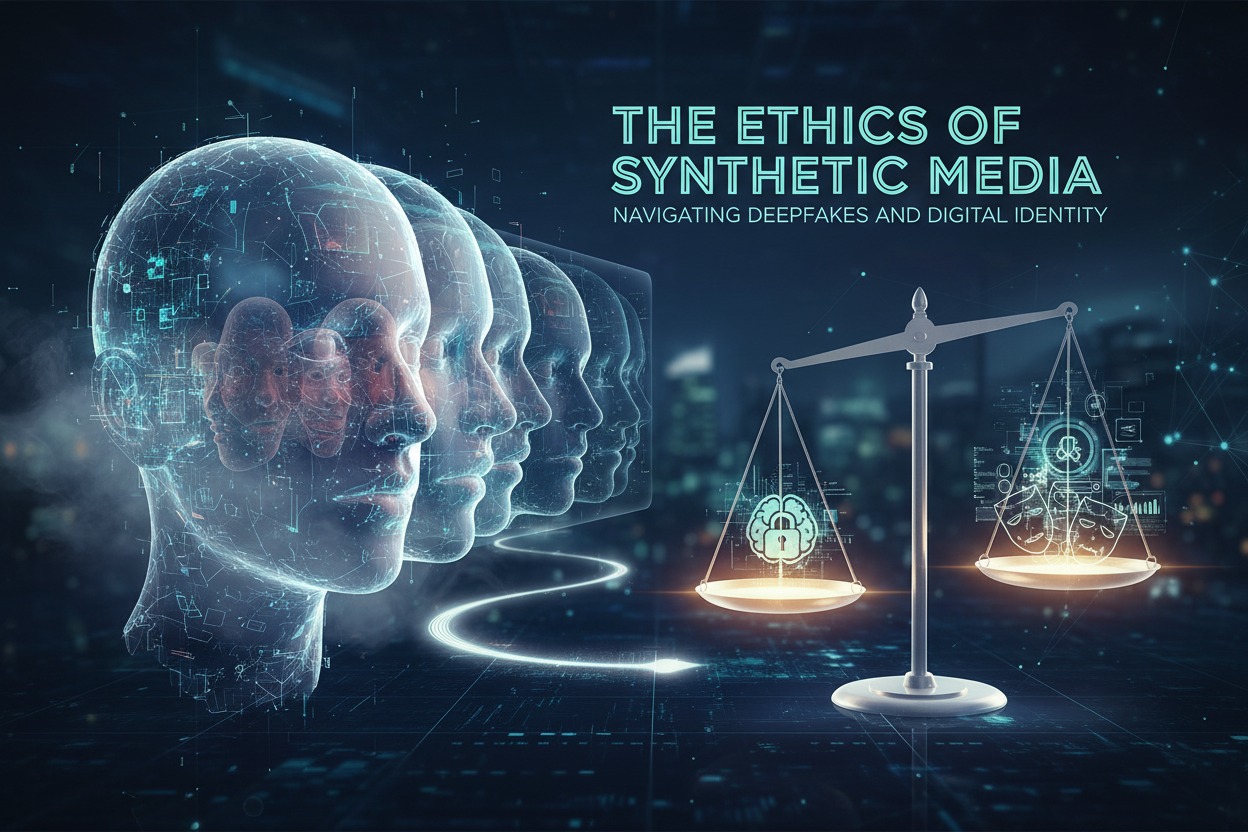
The Ethics of Synthetic Media: Navigating Deepfakes and Digital Identity
The Ethics of Synthetic Media: Navigating Deepfakes and Digital Identity, The year is 2026. A video of a world leader announcing a military strike circulates for seventeen minutes before it’s debunked as a deepfake. A teenager’s face is seamlessly transplanted into explicit content she never created. A Fortune 500 CEO’s voice is cloned to authorize a $25 million wire transfer. A deceased actor is “resurrected” for a leading role, sparking industry-wide outrage.
These are not speculative dystopian scenarios. They are real incidents from the past eighteen months.
Synthetic media—content generated or manipulated by artificial intelligence—has evolved from a technological curiosity into a societal challenge of unprecedented scale. The tools that enable stunning creative expression also enable deception, exploitation, and the erosion of trust itself.
This guide explores the ethical landscape of synthetic media in 2026, examining the technology, the risks, the regulatory responses, and the emerging frameworks for navigating what many are calling the defining information integrity challenge of our time.
What Is Synthetic Media?
Synthetic media encompasses any content—image, video, audio, or text—generated or substantially modified by artificial intelligence. While the term “deepfake” has become synonymous with malicious synthetic media, the reality is far more nuanced.
The Spectrum of Synthetic Media
| Type | Description | Benevolent Use | Malicious Use |
|---|---|---|---|
| Deepfake Video | AI-generated or manipulated video where faces or entire scenes are synthesized | Film restoration, historical education, accessible dubbing | Political disinformation, non-consensual pornography, fraud |
| Voice Synthesis | AI-generated audio that mimics specific voices | Accessibility tools, audiobook narration, voice preservation | Voice phishing (vishing), identity theft, evidence fabrication |
| Image Generation | AI-created or modified images | Design prototyping, medical imaging enhancement, art creation | Misinformation campaigns, non-consensual intimate imagery, fraud |
| Text Generation | AI-written content at scale | Content creation, translation, accessibility | Disinformation campaigns, impersonation, academic fraud |
| Live Deepfakes | Real-time face and voice replacement during video calls | Privacy protection, virtual avatars, accessibility | Fraudulent impersonation, evading identification |
The Technology Behind the Threat
The rapid advancement of synthetic media capabilities stems from several converging technological trends:
Generative Adversarial Networks (GANs): The original deepfake technology, where two neural networks compete—one generating content, one detecting fakes—creating increasingly convincing outputs.
Diffusion Models: More recent architectures (like those powering image and video generation) that create content by iteratively refining noise into coherent outputs. These models produce higher quality results with fewer artifacts than earlier approaches.
Real-Time Inference: Processing power improvements now enable live face and voice replacement during video calls—what security researchers call “real-time deepfakes”—eliminating the buffer that previously allowed for detection.
Multimodal Models: Systems like Google Gemini 3, OpenAI GPT-5, and Anthropic Claude can now generate and understand across text, image, audio, and video simultaneously, enabling new forms of synthetic media that combine modalities.
According to industry estimates, the volume of synthetic media created daily in 2026 exceeds 10 billion pieces—more than the total number of videos uploaded to YouTube in 2015 .
The Ethical Landscape: Five Critical Dimensions
Understanding the ethics of synthetic media requires examining multiple overlapping dimensions. No single framework captures the complexity.
1. Consent and Bodily Autonomy
The most viscerally harmful applications of synthetic media involve the creation of content depicting individuals without their consent.
Non-Consensual Intimate Imagery (NCII): Deepfake pornography remains the most widely recognized malicious application. According to a 2025 study by the AI Forensics Initiative, 96% of deepfake videos online are non-consensual pornography, with women comprising 99% of targets . The psychological harm to victims—who face reputational damage, harassment, and emotional trauma—is profound.
Celebrity Exploitation: Public figures face constant synthetic impersonation. Deepfakes of celebrities endorsing products, making statements, or appearing in compromising situations circulate widely, creating reputational chaos and eroding public trust.
The “Right to One’s Image”: Legal frameworks are struggling to catch up. While some jurisdictions (like California and New York) have passed laws specifically targeting non-consensual deepfakes, enforcement remains inconsistent, and international coordination is minimal.
2. Truth, Trust, and Information Integrity
Synthetic media threatens the foundational assumption that audio and video evidence are reliable records of reality.
Political Disinformation: The 2024 and 2026 election cycles saw unprecedented synthetic media campaigns. Deepfakes of candidates making inflammatory statements, fabricated audio of private conversations, and entirely synthetic news anchors delivering false reports have become standard tools of disinformation operations.
The challenge is not merely that deepfakes exist—it’s that the mere possibility of deepfakes creates what scholars call the “liar’s dividend.” Public figures can dismiss genuine compromising recordings as AI-generated, and citizens can dismiss all evidence as potentially fabricated.
Evidence and Adjudication: Courts are grappling with how to handle synthetic evidence. The Federal Rules of Evidence were amended in 2025 to require authentication protocols for audio and video evidence, but the burden on courts and litigants has increased substantially.
Journalistic Integrity: News organizations now face the challenge of verifying every piece of user-generated content before publication. What was once a verification challenge for breaking news is now a standard requirement for all visual content.
3. Economic Disruption and Labor Rights
Synthetic media is fundamentally reshaping creative industries, raising profound questions about labor rights, compensation, and the nature of creative work.
The Hollywood Writers’ and Actors’ Strike (2023-2024): A watershed moment in synthetic media labor disputes. The strikes, which paralyzed the entertainment industry, centered partly on studios’ attempts to use AI to generate scripts and to scan actors’ likenesses for indefinite future use without consent or ongoing compensation.
The resulting contracts established important precedents: requiring consent for digital replicas, mandating compensation for AI-generated work, and limiting the use of synthetic performers. But as technology advances faster than contract negotiations, new battles emerge.
Voice Actors and the “Voice Cloning” Crisis: Voice actors face an existential threat from AI voice synthesis. In 2025, a major animation studio generated an entire season using AI voices based on scanned performances from previous seasons—without compensating or even notifying the original actors.
The Right of Publicity: Legal protections for the commercial use of one’s identity vary wildly by state. The absence of a federal right of publicity in the United States creates a patchwork that allows exploitation in less protective jurisdictions.
4. Identity, Authenticity, and the Self
Synthetic media challenges fundamental concepts of identity and authenticity.
Posthumous Exploitation: The “resurrection” of deceased performers raises complex ethical questions. When a deceased actor appears in a new film, who controls that performance? What rights do estates have? What about artists who explicitly rejected such use during their lifetimes?
In 2025, the family of a beloved actor successfully sued to block the release of a film featuring an AI-generated performance, citing the actor’s documented opposition to such technology before his death. The case established that posthumous rights may outweigh a studio’s contractual claims.
Personal Identity Protection: For ordinary individuals, the proliferation of synthetic media means losing control over one’s digital identity. Your face can appear anywhere; your voice can say anything. The psychological burden of knowing that any depiction of you could be fabricated—and that you cannot prove otherwise—is increasingly recognized as a form of digital trauma.
Authenticity as a Scarce Resource: In a world where any media can be synthesized, authenticity becomes valuable. “Provenance”—the documented history of a piece of content from creation to consumption—is emerging as a critical concept. But the infrastructure for verifying authenticity remains nascent.
5. Access, Equity, and Democratization
Synthetic media is not solely a threat. It also represents powerful tools for accessibility, creativity, and democratization.
Accessibility Applications: Voice synthesis enables communication for individuals who have lost their voices due to illness or injury. Visual description generation makes media accessible to blind and low-vision individuals. Language translation and dubbing democratize content across linguistic boundaries.
Creative Democratization: Synthetic media tools lower barriers to creative expression. Independent filmmakers can generate visual effects that previously required studio budgets. Musicians can experiment with arrangements beyond their technical capabilities. Visual artists can explore concepts without years of technical training.
Historical Preservation and Education: Deepfake technology enables the restoration of degraded historical footage, the completion of unfinished works, and educational experiences that bring historical figures to life—with appropriate disclosure.
The ethical challenge is maximizing these benefits while minimizing harm—a balance that requires thoughtful governance, not technological prohibition.
The Regulatory Landscape: A Patchwork Response
Governments worldwide are scrambling to regulate synthetic media, resulting in a fragmented legal landscape.
United States: State-Led Innovation
The United States lacks comprehensive federal synthetic media legislation. Instead, a patchwork of state laws addresses specific concerns:
| State | Key Legislation | Scope |
|---|---|---|
| California | AB 602 (2019), AB 730 (2019), AB 2355 (2024) | Bans deepfake pornography; prohibits AI-generated political ads without disclosure; requires labeling of AI content |
| Texas | SB 20 (2023) | Bans deepfake pornography with criminal penalties |
| New York | Bill A. 2205 (2024) | Creates civil liability for non-consensual deepfakes |
| Minnesota | HF 1370 (2023) | Includes deepfakes in revenge porn laws |
Federal Activity: The proposed DEEPFAKES Accountability Act has been introduced multiple times but remains unpassed. The Federal Election Commission issued advisory opinions restricting AI-generated political ads but lacks enforcement authority. The FTC has begun using its existing authority against deceptive AI-generated commercial content.
European Union: The AI Act
The EU AI Act, fully implemented in 2025, takes a risk-based approach that places synthetic media in the “limited risk” category—requiring transparency but not prohibition .
Key provisions:
- Disclosure Requirement: All AI-generated or manipulated content must be clearly labeled unless it’s obviously synthetic or part of artistic/creative works
- Prohibition on Certain Uses: Real-time biometric surveillance (which could enable deepfake identification) is restricted
- High-Risk Classification: Deepfakes used for law enforcement, border control, or critical infrastructure face stricter requirements
The Act’s extraterritorial reach means any organization serving EU citizens must comply, making it effectively a global standard for many companies.
China: State Control and Approval
China has taken the most restrictive approach, requiring:
- Approval for Deepfake Services: Companies must register with authorities
- Mandatory Watermarking: All synthetic content must be clearly marked
- User Verification: Deepfake service users must provide real-name identification
- Content Moderation: Platforms must monitor and remove harmful synthetic content
This approach prioritizes state control and stability over individual protections—a model that balances some risks while creating others.
United Kingdom: Online Safety Act
The UK’s Online Safety Act (2023, with provisions rolling out through 2025) criminalizes the sharing of non-consensual deepfake intimate images, with penalties up to two years imprisonment . It also requires platforms to proactively remove such content.
International Coordination
Efforts toward international coordination remain limited. The Global Partnership on AI (GPAI) has issued guidelines, and UNESCO’s Recommendation on the Ethics of AI provides framework principles. But binding international agreements on synthetic media are years away.
Technical Solutions: Detection, Provenance, and Authentication
Legal and ethical frameworks rely on technical infrastructure for enforcement. Several technological approaches are emerging.

Detection Tools
AI-based detection systems analyze content for artifacts of generation—subtle inconsistencies that human perception misses.
Strengths: Detection tools can identify synthetic content without relying on metadata or collaboration from creators.
Limitations: The arms race between generation and detection is inherently asymmetrical. As detection improves, so does generation. No detection system is perfect, and false positives—flagging authentic content as synthetic—create their own harms.
Leading Detection Platforms (2026):
- Microsoft Video Authenticator
- Intel FakeCatcher
- Sensity (formerly Deeptrace)
- Reality Defender
Provenance and Watermarking
Provenance systems attach cryptographically verifiable metadata to content at creation, documenting its history and any modifications.
C2PA (Coalition for Content Provenance and Authenticity): An industry consortium including Adobe, Microsoft, Intel, and major news organizations has developed an open standard for content provenance. C2PA credentials are embedded in content metadata and cryptographically signed, allowing users to verify authenticity .
Adoption Status (March 2026):
- Adobe: C2PA integration in Creative Cloud, Photoshop, and Firefly
- Microsoft: Integration in Designer, Teams, and Windows
- Camera Manufacturers: Sony, Nikon, and Leica offer cameras that sign images with provenance data
- News Organizations: Associated Press, Reuters, BBC, and others require provenance for user-generated content
Limitations: Provenance only works if creators choose to use it. Malicious actors won’t. The system also struggles with content that goes through multiple platforms that strip metadata.
Synthetic Content Labeling
Platform policies increasingly require labeling of synthetic content:
| Platform | Policy (as of March 2026) |
|---|---|
| YouTube | Requires disclosure of altered or synthetic content; adds labels to viewer |
| TikTok | Requires AI-generated content labels; automatically labels certain AI content |
| Meta (Facebook/Instagram) | Requires disclosure for photorealistic AI content; adds “Imagined with AI” labels |
| X (Twitter) | Requires labeling of synthetic media; removes unlabeled deceptive content |
| Encourages disclosure; labels AI-generated profile photos |
Enforcement remains inconsistent, and platforms struggle with scale—billions of pieces of content daily, with detection systems that generate false positives.
Emerging Ethical Frameworks
As synthetic media matures, ethical frameworks are evolving beyond simple “good versus bad” binaries.
Disclosure as First Principle
The emerging consensus centers on disclosure. The harm of synthetic media is not the technology itself but the deception. If content is clearly labeled as synthetic, audiences can evaluate it appropriately.
Key Questions:
- What constitutes sufficient disclosure? A small watermark? A clear statement?
- Does disclosure need to be machine-readable for automated systems?
- What about artistic works where the synthetic nature is part of the creative intent?
- How do we handle synthetic content that is “obviously” fake but not labeled?
Proportional Harm Assessment
Not all synthetic media is equally harmful. An ethical framework requires assessing:
- Intent: Was the content created to deceive, harm, or entertain?
- Harm: Does the content cause specific, identifiable harm to individuals or society?
- Context: Is the content satire, art, or political speech deserving of protection?
- Audience: Is the audience capable of recognizing the content as synthetic?
The Principle of Meaningful Consent
For synthetic media depicting individuals, consent must be:
- Informed: The individual understands how their likeness will be used
- Specific: Consent covers particular uses, not open-ended exploitation
- Revocable: Individuals can withdraw consent
- Compensated: Commercial use warrants fair compensation
Collective Rights and Public Interest
Individual consent frameworks are insufficient for collective harms. What about synthetic media that harms a community? What about political deepfakes that undermine democratic processes?
Emerging frameworks recognize:
- Public figure exceptions: Public figures have reduced privacy expectations but increased protection against outright fraud
- Community harm: Synthetic content that incites violence against groups may warrant restriction regardless of individual consent
- Democratic integrity: Political deepfakes that risk election outcomes may be regulated even if no specific individual is depicted
Practical Guidance for Stakeholders
Different stakeholders face different ethical challenges with synthetic media.
For Content Creators and Artists
- Label your synthetic content. Build trust through transparency.
- Obtain meaningful consent when depicting real individuals.
- Consider the potential harms of your work before publication.
- Support industry standards like C2PA for provenance.
- Join collective advocacy for labor protections and fair compensation.
For Businesses and Organizations
- Establish clear synthetic media policies. Define what uses are permitted and what disclosure is required.
- Implement technical controls to prevent unauthorized synthetic media creation using your likeness or intellectual property.
- Train employees to recognize synthetic media and respond appropriately.
- Audit third-party vendors for their synthetic media practices.
- Support legislative efforts that balance innovation with protection.
For Journalists and Media Organizations
- Verify before publishing. Treat all user-generated visual content as potentially synthetic until verified.
- Use provenance tools. Prioritize content with verified provenance.
- Disclose your own AI use. If you use synthetic media in reporting (e.g., to protect sources or illustrate concepts), disclose clearly.
- Educate audiences about synthetic media and how to evaluate it.
- Develop verification workflows that don’t rely solely on automated detection.
For Policymakers and Regulators
- Prioritize non-consensual intimate imagery. This is where harm is clearest and regulation most justified.
- Require disclosure, not prohibition. Disclosure preserves speech rights while informing audiences.
- Harmonize across jurisdictions. The current patchwork creates enforcement gaps.
- Support technical infrastructure for provenance and detection.
- Update evidence rules for synthetic media in courts.
For Individuals
- Assume skepticism. In 2026, not everything you see is real.
- Check provenance. Look for C2PA credentials and platform labels.
- Verify before sharing. If content seems designed to provoke strong emotion, verify it first.
- Protect your digital identity. Limit publicly available images and voice recordings.
- Know your rights. In many jurisdictions, non-consensual synthetic media is illegal.
The Future of Synthetic Media Ethics
Several trends will shape synthetic media ethics through the remainder of the decade.
Real-Time Deepfakes at Scale
As processing power increases, real-time deepfakes during video calls will become indistinguishable from reality. This will fundamentally change authentication protocols for everything from banking to courtroom testimony.
Fully Synthetic Influencers and Personalities
Entirely AI-generated influencers—with no underlying human—already exist. As they become more sophisticated, questions about disclosure, intellectual property, and audience manipulation will intensify.
The Provenance Infrastructure
Expect continued development of the provenance infrastructure. If major platforms, camera manufacturers, and creative tools all adopt C2PA or similar standards, provenance could become the default rather than the exception.
Regulatory Convergence
While the current landscape is fragmented, pressure for international coordination is growing. The EU AI Act is becoming the de facto global standard for many companies, and future agreements are likely.
Erosion of the “Video Evidence” Standard
The assumption that video and audio are reliable evidence is already eroding. The legal system, journalism, and everyday trust relationships are adapting—slowly—to a world where any media can be fabricated.
Conclusion
Synthetic media is not going away. The same technologies that enable breathtaking creative expression, accessibility breakthroughs, and democratized production also enable unprecedented deception, exploitation, and erosion of trust.
The ethical challenge of our time is not to reject synthetic media but to navigate it thoughtfully—to build frameworks that maximize its benefits while minimizing its harms. This requires technical solutions, legal frameworks, organizational policies, and individual vigilance working in concert.
Perhaps most importantly, it requires a fundamental shift in how we relate to media. The age of assuming that seeing is believing is over. The age of critical evaluation, provenance verification, and informed skepticism has begun.
The tools will continue to improve. The harms will continue to evolve. But so will our capacity to respond—if we choose to build the infrastructure, enact the protections, and develop the habits of mind that a synthetic media world demands.
The choice is ours.