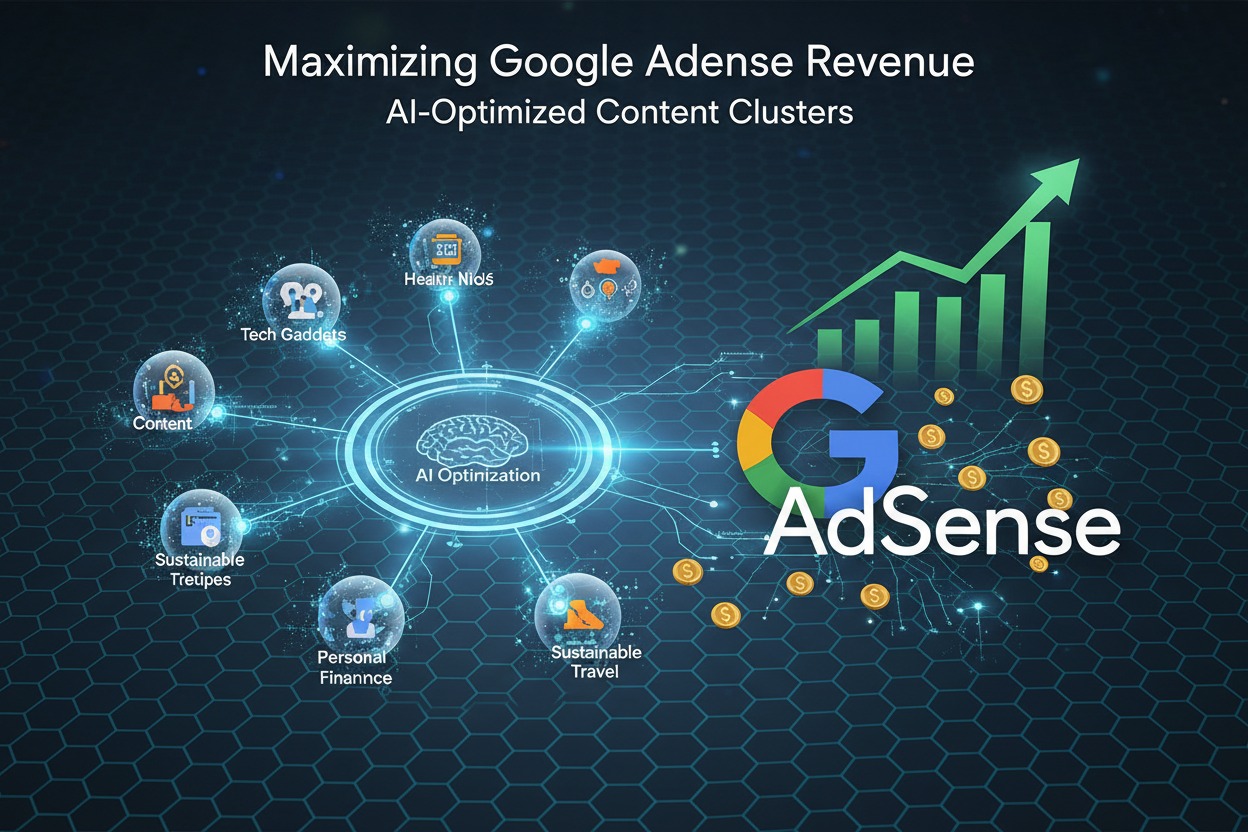
Maximizing Google AdSense Revenue with AI-Optimized Content Clusters
Maximizing Google AdSense Revenue with AI-Optimized Content Clusters, The dream of every content publisher is simple: create content once and let it generate passive income indefinitely through Google AdSense. However, in 2026, the landscape is more competitive than ever. The days of writing isolated blog posts and hoping for traffic are over.
To truly maximize AdSense revenue, you need to think in terms of systems, not individual articles. Enter AI-Optimized Content Clusters—a strategic framework that combines the scalability of artificial intelligence with the structural authority of topic-based architecture.
This guide will show you how to leverage AI to build content clusters that not only rank higher in search engines but also increase pageviews, dwell time, and ultimately, your AdSense earnings.
What Are Content Clusters?
Before diving into AI optimization, let’s define the foundation.
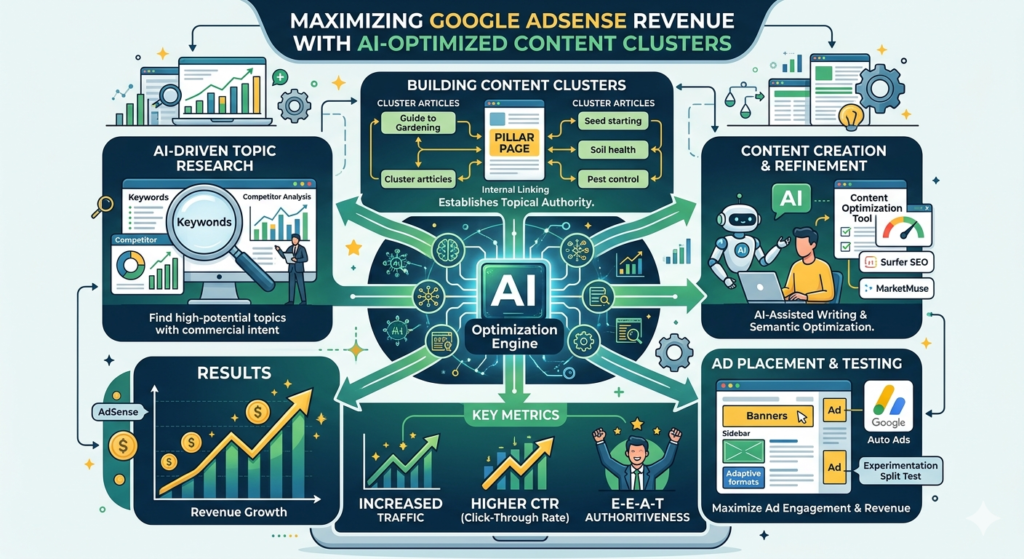
A content cluster (also known as pillar-cluster architecture) is a strategic content structure consisting of:
- A Pillar Page: A comprehensive, long-form guide covering a broad topic (e.g., “Complete Guide to Digital Marketing”).
- Cluster Content: Multiple supporting articles that target specific subtopics, long-tail keywords, and answer specific user questions (e.g., “How to Calculate SEO ROI,” “Best Email Marketing Tools for 2026”).
- Internal Links: A strategic web of hyperlinks connecting every cluster article back to the pillar page (and relevant articles to each other).
This structure tells Google that your website is an authority on the subject. Instead of having 50 weak pages competing against each other, you have one strong pillar supported by 50 relevant, interlinked pages. This increases domain authority and significantly boosts pageviews per session—a critical metric for AdSense revenue.
Why AI is the Perfect Tool for Content Clusters
Creating a content cluster manually is labor-intensive. Researching 50 subtopics, writing 50 articles, and managing the internal linking structure can take a team months.
AI (like ChatGPT, Claude, or specialized SEO tools) accelerates this process in three key ways:
- Scalability: AI can generate outlines, first drafts, and even full articles at a speed no human can match.
- Semantic Relevance: AI models are trained on massive datasets, allowing them to identify related subtopics and latent semantic indexing (LSI) keywords that naturally fill out a cluster.
- Consistency: AI ensures that the tone, structure, and internal linking logic remain consistent across hundreds of articles.
However, the goal is not to publish low-quality, AI-generated spam. Google AdSense strictly prohibits auto-generated content that provides no value. The goal is to use AI as a productivity multiplier for high-quality, human-edited content.
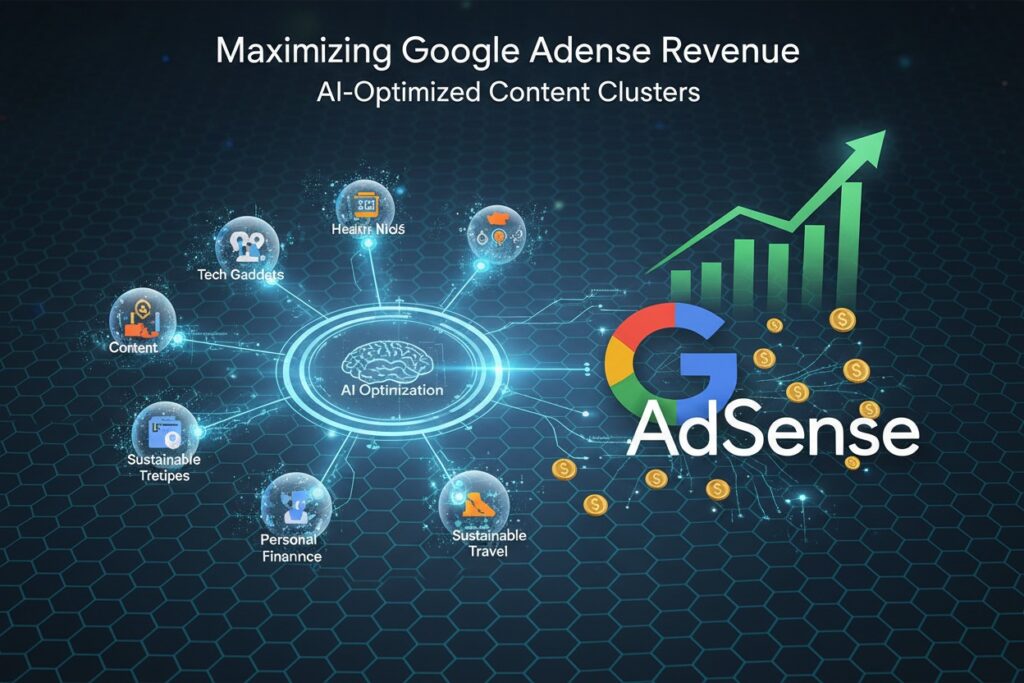
The 5-Step Framework to Build AI-Optimized Content Clusters
Follow this framework to build clusters that maximize both organic traffic and AdSense RPM.
Step 1: Identify High-Value Pillar Topics
Not every topic is profitable for AdSense. You need topics with high CPC (Cost Per Click) and high search volume.
How AI Helps:
Use AI tools to analyze your niche. Prompt the AI with:
“Act as a digital strategist. List 10 pillar topics in the [Finance/Travel/Technology] niche that have high commercial intent and high CPC for Google AdSense. Suggest topics where users are likely to make purchasing decisions or seek professional advice.”
Select topics where advertisers pay more.
Generally, niches like insurance, finance, software reviews, legal advice, and B2B SaaS have higher CPCs than entertainment or general news.
Example:
- Weak Pillar: “Funny Cat Videos”
- Strong Pillar: “Complete Guide to Pet Insurance for Cats” (High CPC, commercial intent)
Step 2: Generate Semantic Subtopics (Cluster Mapping)
Once you have a pillar, you need to map out 20 to 50 cluster articles. The goal is to cover every possible question a user might have about the pillar topic.
How AI Helps:
Prompt the AI to generate a content map. Use a detailed prompt to ensure depth:
“I am creating a content cluster for the pillar topic: ‘Complete Guide to Pet Insurance for Cats.’ Generate 30 cluster article topics. Include a mix of:
- Comparison topics (e.g., ‘Pet Insurance vs. Savings Account’)
- Question-based topics (e.g., ‘Does Pet Insurance Cover Dental?’)
- Review topics (e.g., ‘Best Pet Insurance for Senior Cats’)
- Long-tail keywords with low competition.”
Output: You will receive a structured map. This prevents you from running out of ideas after 10 articles and ensures you build true topical authority.
Step 3: Create a “Content Bibles” for Consistency
The biggest challenge with scaling content is consistency. If one writer (or AI prompt) uses a formal tone and another uses a casual tone, the user experience suffers.
How AI Helps:
Create a Content Bible—a master document defining your brand voice, target audience, formatting rules, and internal linking strategy. Feed this document into your AI tools as a “system prompt” before generating any article.
Example System Prompt:
“You are a professional blogger for [Website Name]. Our audience is middle-class homeowners. Use a professional but accessible tone. Avoid jargon. Always include a FAQ section. Always link back to the main pillar page using anchor text that includes the primary keyword. Format with H2 and H3 headers for readability.”
By setting this context, every AI-generated article will feel like it came from the same author, building brand trust and improving user engagement metrics.
Step 4: The AI-Human Hybrid Workflow
This is the most critical step for AdSense approval. Never copy-paste raw AI output directly to your website.
Implement a strict workflow:
- Research (AI): Use AI to gather data, create outlines, and list FAQs.
- Drafting (AI): Generate a first draft. Aim for 80% AI, 20% placeholder.
- Human Editing (You/Editor): This is where value is added.
- Add personal anecdotes, case studies, and original data.
- Verify facts (AI can “hallucinate” false information).
- Optimize for readability and break up walls of text.
- Insert original images, screenshots, or charts.
- SEO Enhancement (AI + Tools): Use AI to write meta descriptions, alt text for images, and suggest internal links.
Why this matters for AdSense: Google AdSense reviewers look for “original content.” If your site is filled with unedited AI text that exists on 100 other sites, you will be rejected. The human touch transforms generic AI text into unique, valuable content.
Step 5: Automate Internal Linking with AI
Internal links are the glue of content clusters. They distribute “link juice” (SEO authority) from the pillar page to the cluster articles and keep users clicking through your site.
A user who reads one article and leaves earns you one ad impression. A user who clicks through to five articles earns you five ad impressions—a 500% revenue increase from the same visitor.
How AI Helps:
Instead of manually adding links, use AI to suggest them.
Prompt:
“Here is a new article I wrote about ‘Senior Cat Dental Care.’ Here is a list of 50 existing articles in my cluster. Identify the 5 most semantically relevant articles and suggest anchor text for natural internal links.”
Then, use a plugin (like Link Whisper or Rank Math) to automate the insertion of these links. This ensures that every new article immediately connects to the existing cluster, maximizing pageviews per session from day one.
AdSense Optimization Within Content Clusters
Building the cluster architecture brings traffic; optimizing for AdSense maximizes the revenue from that traffic.
1. Strategic Ad Placement in Pillar vs. Cluster
- Pillar Pages: These are long (3,000+ words). Place high-performing ad units (e.g., in-content responsive ads) within the body every 3-4 paragraphs. Users here are in “learning mode” and will scroll deep.
- Cluster Articles: These are shorter (1,000-1,500 words). Use a sticky sidebar ad and a footer anchor ad. Users often read these quickly to answer a specific question; a sticky ad ensures visibility regardless of scroll depth.
2. Target High-CPC Keywords in Clusters
Your pillar page might rank for a broad, high-volume keyword. Your cluster articles should target specific, high-CPC keywords.
Use AI to identify these:
“Analyze the keyword ‘senior cat insurance.’ Suggest 10 long-tail variations with high commercial intent (e.g., ‘best senior cat insurance no waiting period’). Rank them by estimated CPC.”
By targeting these in cluster articles, you attract visitors who are closer to making a purchase decision—visitors who are more valuable to advertisers.
3. Improve Dwell Time with AI-Generated Interactive Elements
Dwell time (how long a user stays on a page) is a ranking factor and directly impacts AdSense revenue (more time = more ad views).
Use AI to create elements that keep users on the page:
- Custom Calculators: Use AI to help you code (or design) an ROI calculator or mortgage calculator relevant to your niche.
- Comparison Tables: AI can generate detailed feature-by-feature comparison tables for product reviews.
- Quizzes: Use AI to create interactive quizzes (e.g., “Which Insurance Plan is Right for You?”) that require users to click through multiple pages.
Measuring Success: KPIs for AI-Optimized Clusters
To ensure your investment in AI and content clusters is paying off, track these specific metrics in Google Analytics and AdSense:
| Metric | Why It Matters |
|---|---|
| Pages Per Session | The ultimate measure of cluster effectiveness. A well-linked cluster should achieve 2.5+ pages per session. |
| Dwell Time | Average time on page. AI-generated content must keep users engaged. Aim for 3+ minutes on pillar pages. |
| Ad RPM | Revenue per 1,000 impressions. As you build authority, your RPM should increase because Google deems your site more premium. |
| Organic Traffic Growth | Monitor the pillar page and its 20+ cluster articles collectively. The cluster should drive exponential growth, not linear. |
Common Mistakes to Avoid
When using AI for AdSense monetization, avoid these pitfalls that can lead to rejection or penalization.
1. Publishing AI Content Without Fact-Checking
AI models sometimes invent statistics, quotes, or even product names. Publishing false information destroys trust and can lead to AdSense termination.
2. Ignoring E-E-A-T (Experience, Expertise, Authoritativeness, Trustworthiness)
Google prioritizes sites with demonstrated expertise. If you are using AI to write medical or financial advice, you must have a human expert review the content and add their credentials (bio, author byline). AI alone cannot satisfy E-E-A-T requirements.
3. Cannibalizing Your Own Keywords
If you let AI generate 10 articles all targeting the exact same keyword, they will compete against each other. Always use your cluster map to ensure each article targets a unique, specific subtopic.
Conclusion: The Future of AdSense is Strategic, Not Random
In 2026, maximizing Google AdSense revenue requires moving from a volume-based strategy to a value-structure strategy. AI-Optimized Content Clusters represent the most efficient way to build topical authority, improve user engagement, and increase ad impressions per user.
By using AI to handle the heavy lifting of research, outlining, and initial drafting, and combining that with your human expertise in editing, fact-checking, and strategic linking, you can build a content empire that satisfies both Google’s algorithms and your bottom line.
Remember: AI is the engine, but strategy is the driver. Build your clusters with intent, optimize for user experience, and watch your AdSense revenue scale.